

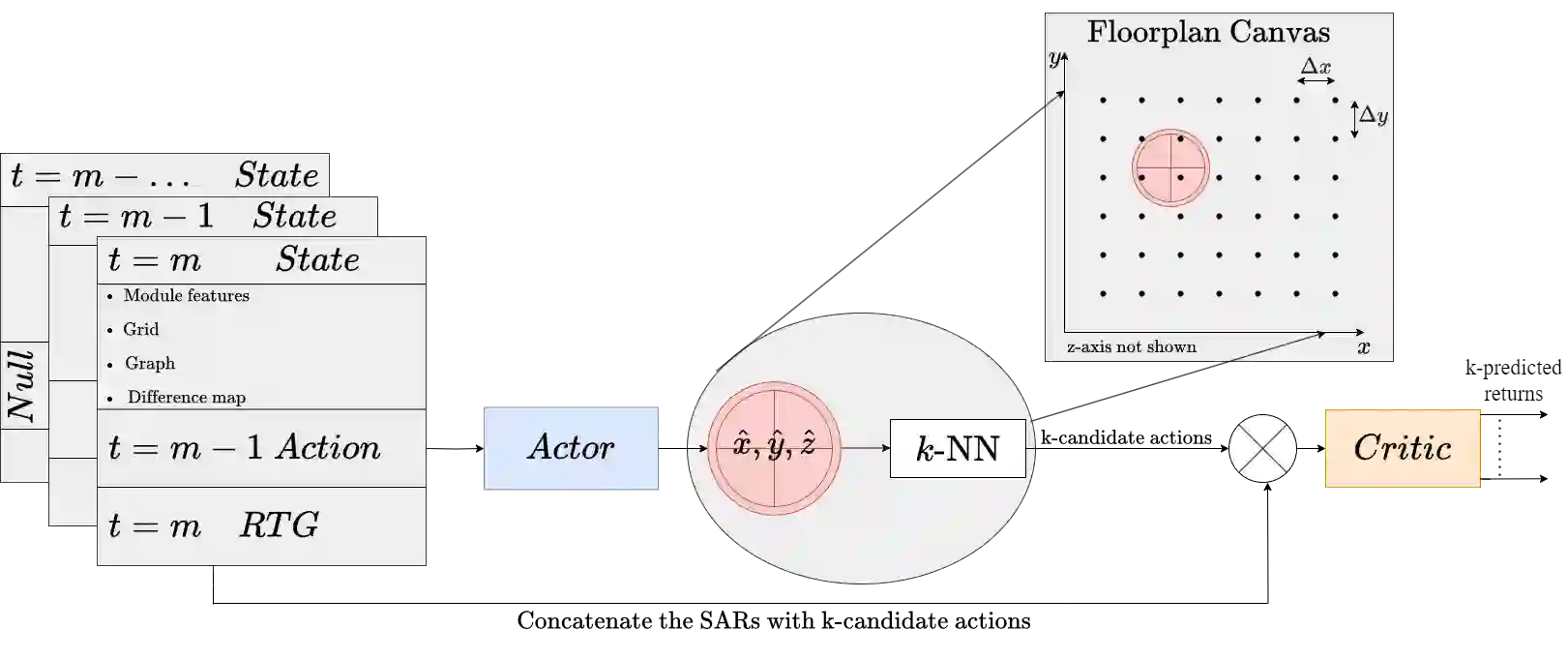
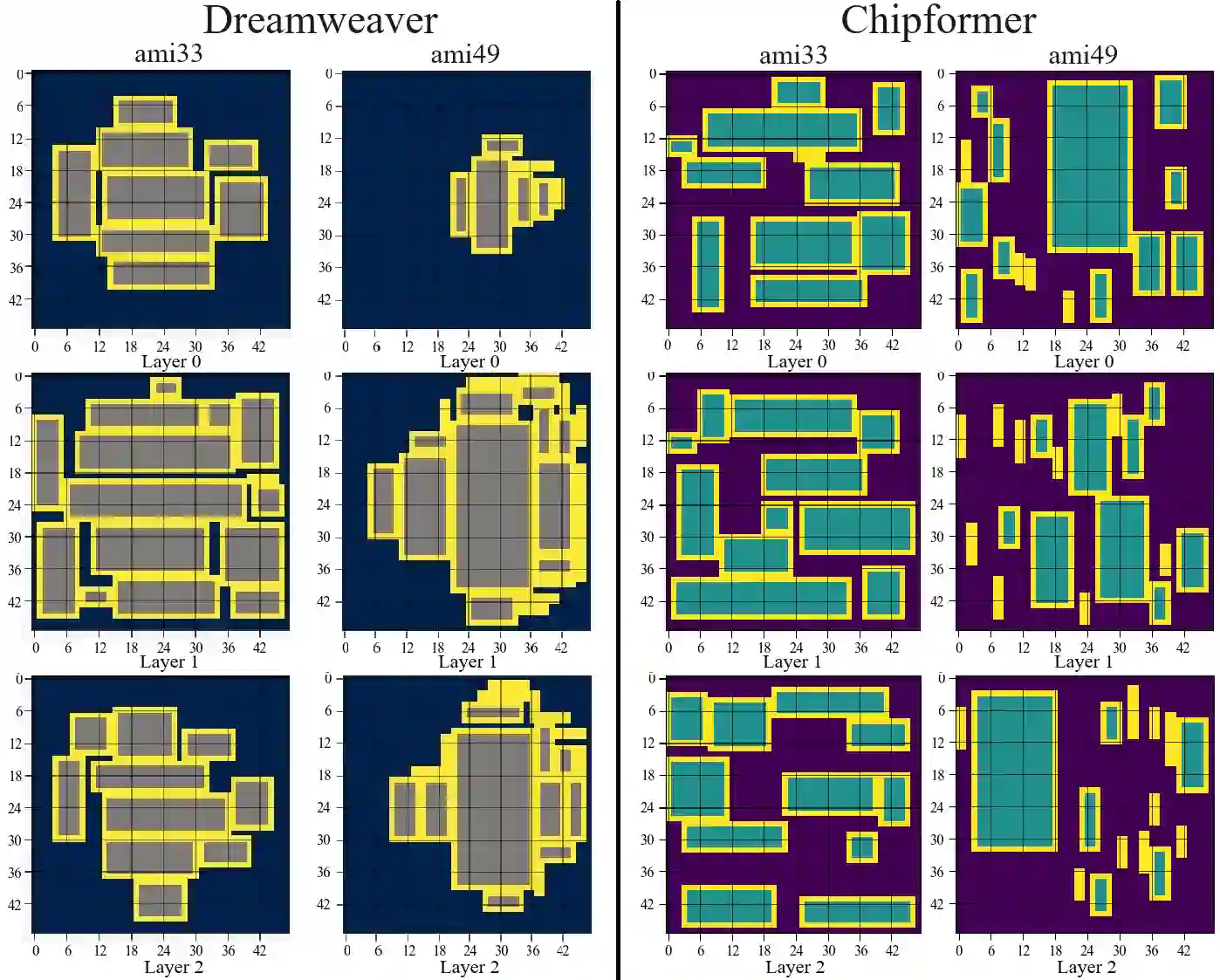
In this paper, we introduce Dreamweaver, which belongs to a new class of auto-regressive decision-making models known as large reasoning models (LRMs). Dreamweaver is designed to improve 3D floorplanning in electronic design automation (EDA) via an architecture that melds advancements in sequence-to-sequence reinforcement learning algorithms. A significant advantage of our approach is its ability to effectively reason over large discrete action spaces, which is essential for handling the numerous potential positions for various functional blocks in floorplanning. Additionally, Dreamweaver demonstrates strong performance even when trained on entirely random trajectories, showcasing its capacity to leverage sub-optimal or non-expert trajectories to enhance its results. This innovative approach contributes to streamlining the integrated circuit (IC) design flow and reducing the high computational costs typically associated with floorplanning. We evaluate its performance against a current state-of-the-art method, highlighting notable improvements.
翻译:本文提出了一种新型自回归决策模型——大推理模型(LRMs),并介绍了其代表Dreamweaver。该模型通过融合序列到序列强化学习算法的最新进展,旨在提升电子设计自动化(EDA)中的3D布局规划性能。本方法的核心优势在于能够有效处理大规模离散动作空间,这对布局规划中众多功能模块的潜在位置配置至关重要。值得注意的是,Dreamweaver即使在完全随机轨迹上训练仍表现出优异性能,展现了其利用次优或非专家轨迹提升结果的能力。这一创新方法有助于优化集成电路(IC)设计流程,并显著降低布局规划通常所需的高昂计算成本。通过与当前最先进方法的对比实验,我们验证了其性能的显著提升。




相关内容




 微信扫码咨询专知VIP会员