

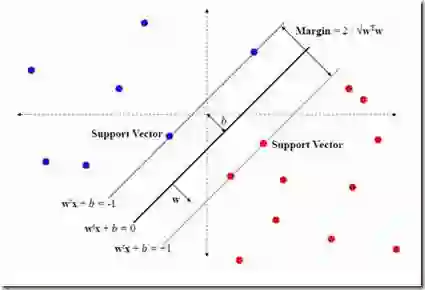
Quadratic programming is a fundamental problem in the field of convex optimization. Many practical tasks can be formulated as quadratic programming, for example, the support vector machine (SVM). Linear SVM is one of the most popular tools over the last three decades in machine learning before deep learning method dominating. In general, a quadratic program has input size $\Theta(n^2)$ (where $n$ is the number of variables), thus takes $\Omega(n^2)$ time to solve. Nevertheless, quadratic programs coming from SVMs has input size $O(n)$, allowing the possibility of designing nearly-linear time algorithms. Two important classes of SVMs are programs admitting low-rank kernel factorizations and low-treewidth programs. Low-treewidth convex optimization has gained increasing interest in the past few years (e.g.~linear programming [Dong, Lee and Ye 2021] and semidefinite programming [Gu and Song 2022]). Therefore, an important open question is whether there exist nearly-linear time algorithms for quadratic programs with these nice structures. In this work, we provide the first nearly-linear time algorithm for solving quadratic programming with low-rank factorization or low-treewidth, and a small number of linear constraints. Our results imply nearly-linear time algorithms for low-treewidth or low-rank SVMs.
翻译:二次规划是凸优化领域中的一个基本问题。许多实际任务可以表述为二次规划,例如支持向量机(SVM)。在深度学习主导之前,线性SVM是过去三十年来机器学习中最流行的工具之一。通常,一个二次规划的输入规模为$\Theta(n^2)$(其中$n$是变量数量),因此需要$\Omega(n^2)$的时间来求解。然而,来自SVM的二次规划的输入规模为$O(n)$,这使得设计近线性时间算法成为可能。两类重要的SVM程序分别是具有低秩核分解的程序和具有低树宽的程序。低树宽凸优化在过去几年中引起了越来越多的关注(例如线性规划 [Dong, Lee and Ye 2021] 和半定规划 [Gu and Song 2022])。因此,一个重要的开放问题是:对于具有这些良好结构的二次规划,是否存在近线性时间算法?在这项工作中,我们首次提出了一个近线性时间算法,用于求解具有低秩分解或低树宽以及少量线性约束的二次规划。我们的结果意味着对于低树宽或低秩SVM具有近线性时间算法。




相关内容


 微信扫码咨询专知VIP会员