

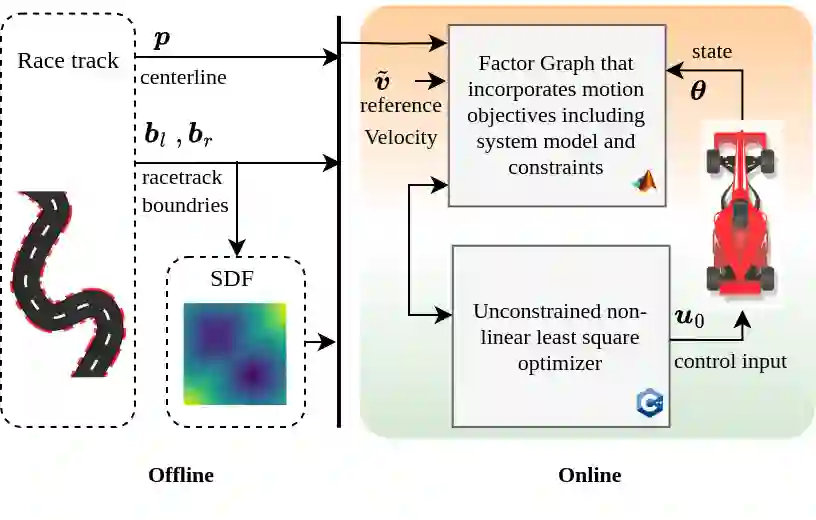
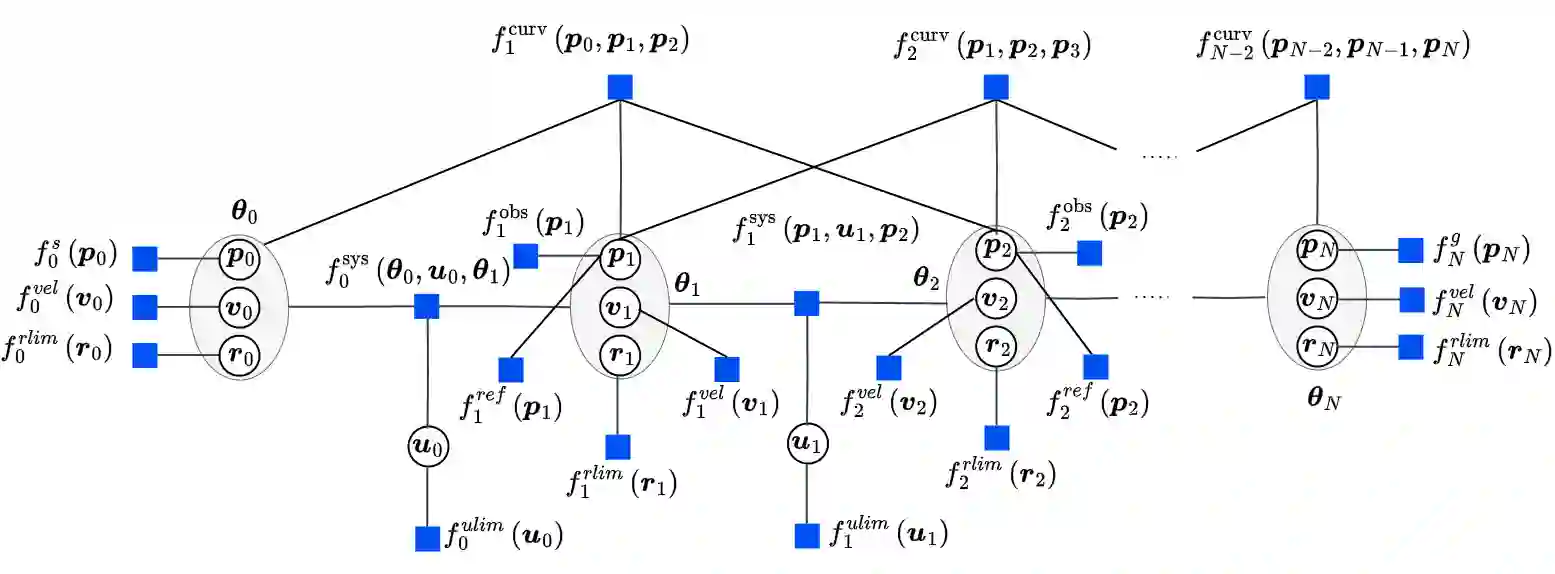
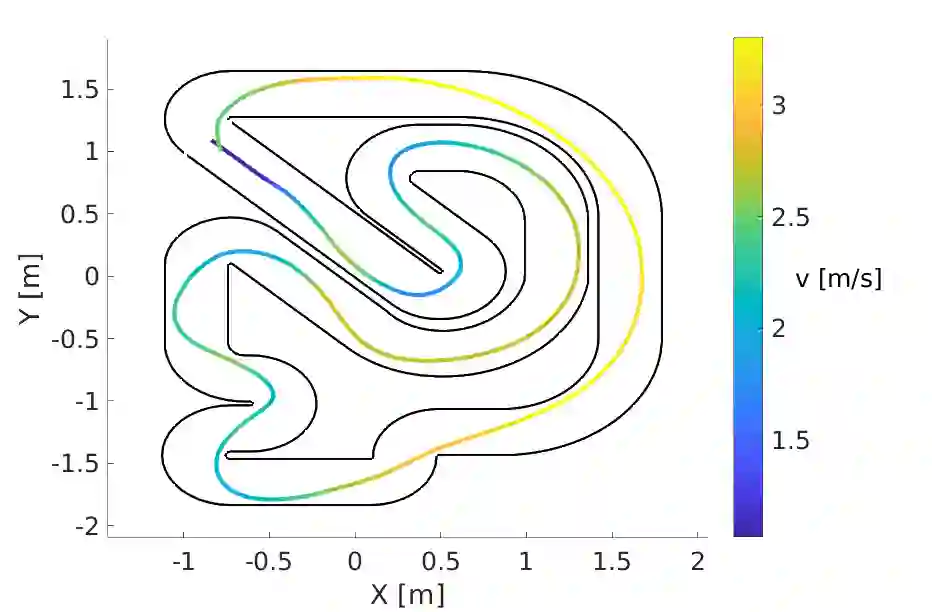
Factor graph, as a bipartite graphical model, offers a structured representation by revealing local connections among graph nodes. This study explores the utilization of factor graphs in modeling the autonomous racecar planning problem, presenting an alternate perspective to the traditional optimization-based formulation. We model the planning problem as a probabilistic inference over a factor graph, with factor nodes capturing the joint distribution of motion objectives. By leveraging the duality between optimization and inference, a fast solution to the maximum a posteriori estimation of the factor graph is obtained via least-squares optimization. The localized design thinking inherent in this formulation ensures that motion objectives depend on a small subset of variables. We exploit the locality feature of the factor graph structure to integrate the minimum curvature path and local planning computations into a unified algorithm. This diverges from the conventional separation of global and local planning modules, where curvature minimization occurs at the global level. The proposed framework is evaluated through simulation, demonstrating superior cumulative curvature and average speed performance. Furthermore, the results highlight the computational efficiency of our approach. While acknowledging the structural design advantages and computational efficiency of the proposed approach, we also address its limitations and outline potential directions for future research.
翻译:因子图作为一种二分图模型,通过揭示图节点之间的局部连接关系提供了结构化的表示。本研究探索了利用因子图对自动驾驶赛车规划问题建模的可行性,为传统的基于优化的公式化方法提供了另一种视角。我们将规划问题建模为因子图上的概率推理过程,其中因子节点捕获运动目标的联合分布。通过利用优化与推理之间的对偶性,通过最小二乘优化快速求解因子图的最大后验估计。这种公式化方法固有的局部化设计思想确保运动目标仅依赖于少量变量。我们利用因子图结构的局部性特征,将最小曲率路径和局部规划计算整合到统一算法中。这与传统上全局与局部规划模块分离(曲率最小化在全局层面进行)的做法不同。通过仿真对所提出的框架进行了评估,展示了其优越的累积曲率和平均速度性能。此外,结果还凸显了我们方法的计算效率。在承认所提方法在结构设计优势与计算效率的同时,我们也指出了其局限性并概述了未来研究的潜在方向。




相关内容


 微信扫码咨询专知VIP会员