

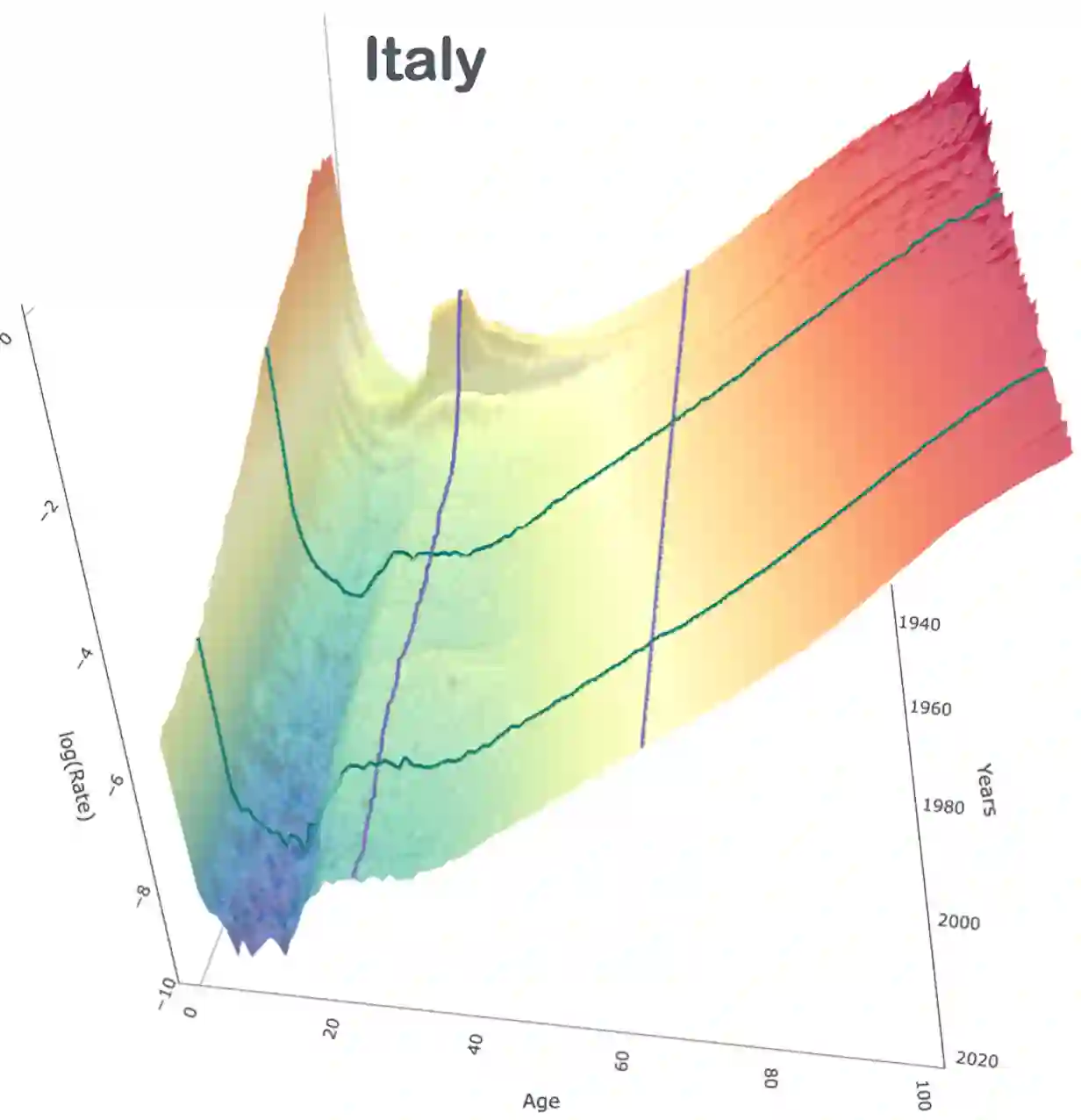
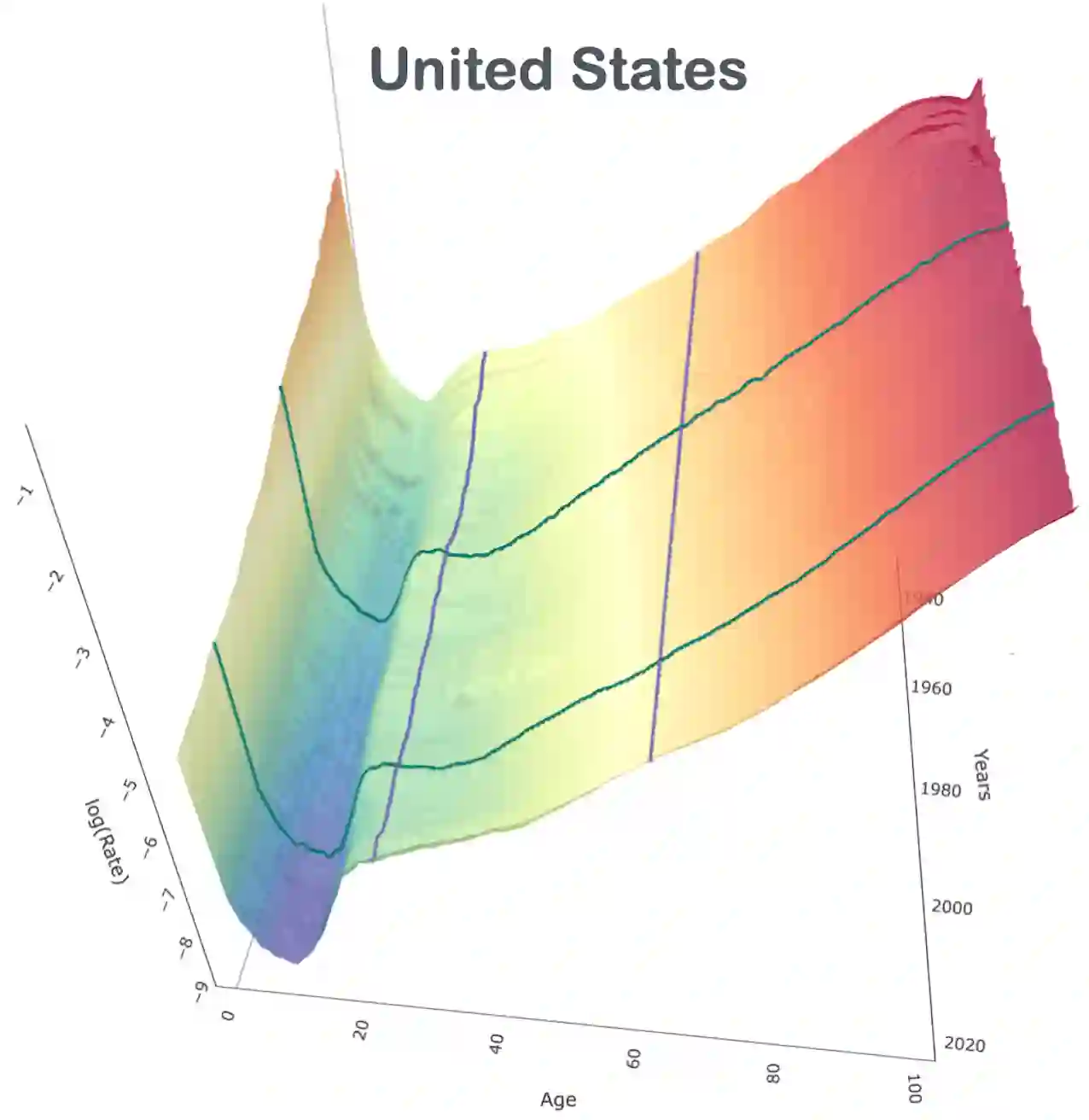
Although the analysis of human mortality has a well-established history, the attempt to accurately forecast future death-rate patterns for different age groups and time horizons still attracts active research. Such a predictive focus has motivated an increasing shift towards more flexible representations of age-specific period mortality trajectories at the cost of reduced interpretability. Although this perspective has led to successful predictive strategies, the inclusion of interpretable structures in modeling of human mortality can be, in fact, beneficial for improving forecasts. We pursue this direction via a novel B-spline process with locally-adaptive dynamic coefficients. Such a process outperforms state-of-the-art forecasting strategies by explicitly incorporating the core structures of period mortality within an interpretable formulation which enables inference on age-specific mortality trends and the corresponding rates of change across time. This is obtained by modeling the age-specific death counts via a Poisson log-normal model parameterized through a linear combination of B-spline bases with dynamic coefficients that characterize time changes in mortality rates via suitable stochastic differential equations. While flexible, the resulting formulation can be accurately approximated by a Gaussian state-space model that facilitates closed-form Kalman filtering, smoothing and forecasting, for both the trends of the spline coefficients and the corresponding first derivatives, which measure rates of change in mortality for different ages. As illustrated in applications to mortality data from different countries, our model outperforms state-of-the-art methods both in point forecasts and in calibration of predictive intervals. Moreover, it unveils substantial differences in mortality patterns across countries and ages, both in the past decades and during the COVID-19 pandemic.
翻译:尽管人类死亡率分析已有悠久历史,但针对不同年龄段和时间跨度准确预测未来死亡率模式的研究仍持续活跃。这种预测导向推动了更灵活的分年龄时期死亡率轨迹表征方法的发展,但代价是解释性降低。虽然这一视角已催生成功的预测策略,但在人类死亡率建模中融入可解释结构实际上有助于提升预测效果。我们通过一种具有局部自适应动态系数的新型B样条过程推进这一方向。该过程通过将时期死亡率的核心结构显式纳入可解释的公式表述中(该表述使分年龄死亡率趋势及其随时间的变化率推断成为可能),其性能优于现有前沿预测策略。该过程通过泊松对数正态模型对分年龄死亡人数建模,该模型采用B样条基函数的线性组合参数化,并配备通过恰当随机微分方程刻画死亡率时间变化的动态系数。尽管具有灵活性,该公式可被高斯状态空间模型精确近似,从而支持对样条系数趋势及其对应的一阶导数(衡量不同年龄死亡率变化率)进行闭式卡尔曼滤波、平滑与预测。通过将模型应用于不同国家的死亡率数据,我们证明其在点预测与预测区间校准方面均优于前沿方法。此外,该模型揭示了各国及各年龄段在过往数十年及COVID-19疫情期间死亡率模式的显著差异。





相关内容




 微信扫码咨询专知VIP会员