

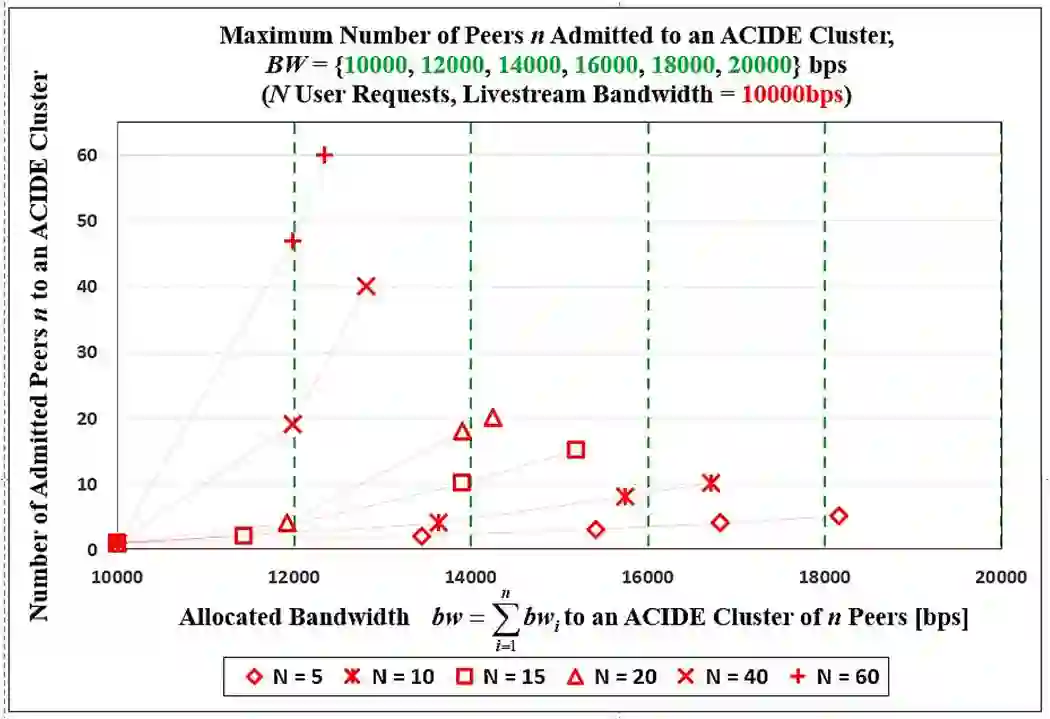
In this study, the Active Control in an Intelligent and Distributed Environment (ACIDE) media distribution model solution and algorithms are proposed for livestreaming in capacity efficient mobile wireless networks. The elements of the ACIDE model are a base station and a cluster formed by a number of peers able to establish peer to peer communications. The cluster peers are selected from a group of users interested in livestreaming the same media. The ACIDE model solution minimizes the bandwidth allocated to a cluster of n peers such that an uninterrupted media play for all peers is guaranteed. The livestream media is sent to the peers in packages and every media package is divided into n blocks. The blocks are distributed to the n peers of a cluster in two phases, such that the base station bandwidth is utilized during first phase only. The allocated bandwidth, the amount of bandwidth the base station has to allocate to a cluster, is minimized and its lower bound is equal to the bandwidth required for multicasting. In this study, the ACIDE model is used to address the problem of how to find the maximum number of peers n, chosen from a group of N users, that can be admitted to a cluster knowing the given allocated bandwidth, the amount of bandwidth that a base station allocates to a cluster in advance, prior to admitting users. When users become peers of an ACIDE cluster, the network capacity, the total number of users who are able to access live media, increases meaning that network resources are used more efficiently. The problem of finding the maximum number of peers n is addressed as an optimization problem, with the objective of having the entire given allocated bandwidth used by the peers admitted to the cluster. This problem is NP-complete and a non-optimal solution is proposed for peers selection such that all admitted peers play media continuously.
翻译:本研究提出了一种适用于容量高效移动无线网络的智能分布式环境主动控制(ACIDE)媒体分发模型解决方案及算法。ACIDE模型的核心要素包括基站和由若干能够建立点对点通信的对等节点组成的集群。集群中的对等节点从对同一媒体直播感兴趣的用户群体中筛选得出。该模型解决方案在保证所有对等节点不间断播放媒体流的前提下,最小化分配给包含n个对等节点的集群的带宽。直播媒体以数据包形式发送给对等节点,每个媒体包被分割为n个数据块。这些数据块分两个阶段分配给集群中的n个对等节点,其中基站带宽仅在第一阶段使用。基站需分配给集群的带宽(即分配带宽)被最小化,其下界等于组播所需带宽。本研究利用ACIDE模型解决以下问题:在已知给定分配带宽(基站预先分配给集群的带宽量)的情况下,如何从N个用户中确定可接纳至集群的最大对等节点数量n。当用户成为ACIDE集群的对等节点时,网络容量(即能够访问直播媒体的用户总数)随之增加,表明网络资源利用效率提升。该最大对等节点数量n的求解被建模为优化问题,其目标为使集群接纳的对等节点充分使用全部给定分配带宽。该问题属于NP完全问题,本文提出一种非最优的对等节点选择方案,确保所有被接纳的对等节点能够连续播放媒体。





相关内容



 微信扫码咨询专知VIP会员