

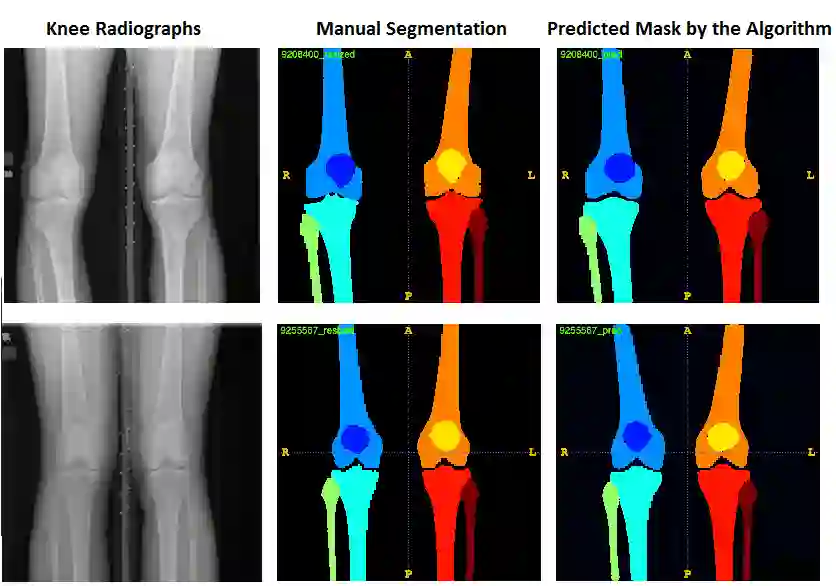
Automatic segmentation of knee bony anatomy is essential in orthopedics, and it has been around for several years in both pre-operative and post-operative settings. While deep learning algorithms have demonstrated exceptional performance in medical image analysis, the assessment of fairness and potential biases within these models remains limited. This study aims to revisit deep learning-powered knee-bony anatomy segmentation using plain radiographs to uncover visible gender and racial biases. The current contribution offers the potential to advance our understanding of biases, and it provides practical insights for researchers and practitioners in medical imaging. The proposed mitigation strategies mitigate gender and racial biases, ensuring fair and unbiased segmentation results. Furthermore, this work promotes equal access to accurate diagnoses and treatment outcomes for diverse patient populations, fostering equitable and inclusive healthcare provision.
翻译:膝关节骨骼解剖的自动分割在骨科领域至关重要,且已在术前和术后环境中应用多年。尽管深度学习算法在医学图像分析中展现出卓越性能,但针对这些模型公平性和潜在偏见的评估仍然有限。本研究旨在重新审视基于深度学习的平片膝关节骨骼解剖分割,以揭示可见的性别和种族偏见。当前工作有望加深我们对偏见的理解,并为医学影像领域的研究人员和从业者提供实践见解。所提出的缓解策略能够减轻性别和种族偏见,确保分割结果的公平性与无偏性。此外,本研究促进不同患者群体平等获得准确诊断和治疗结果,推动医疗服务的公平性和包容性。




相关内容



 微信扫码咨询专知VIP会员