

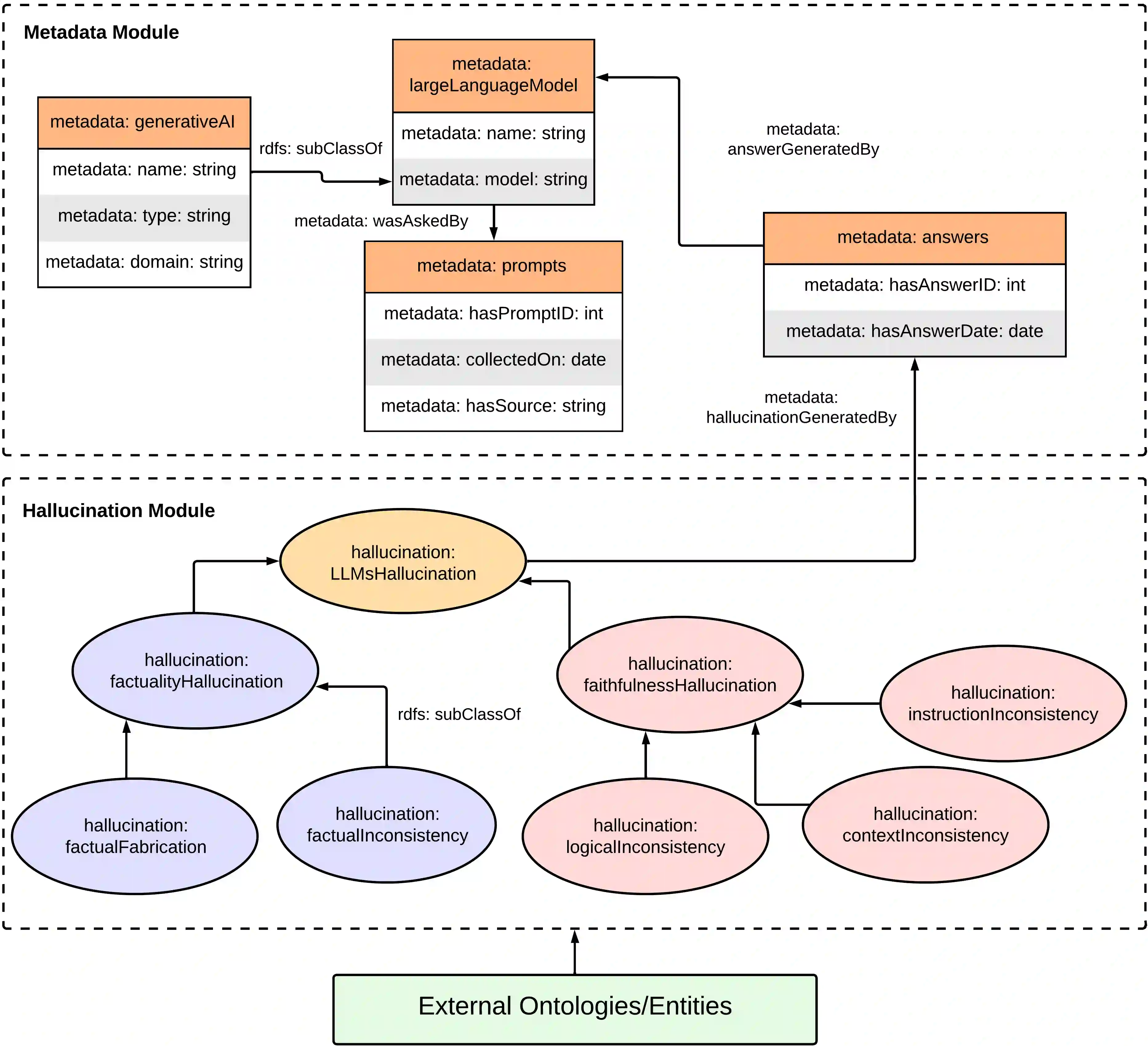
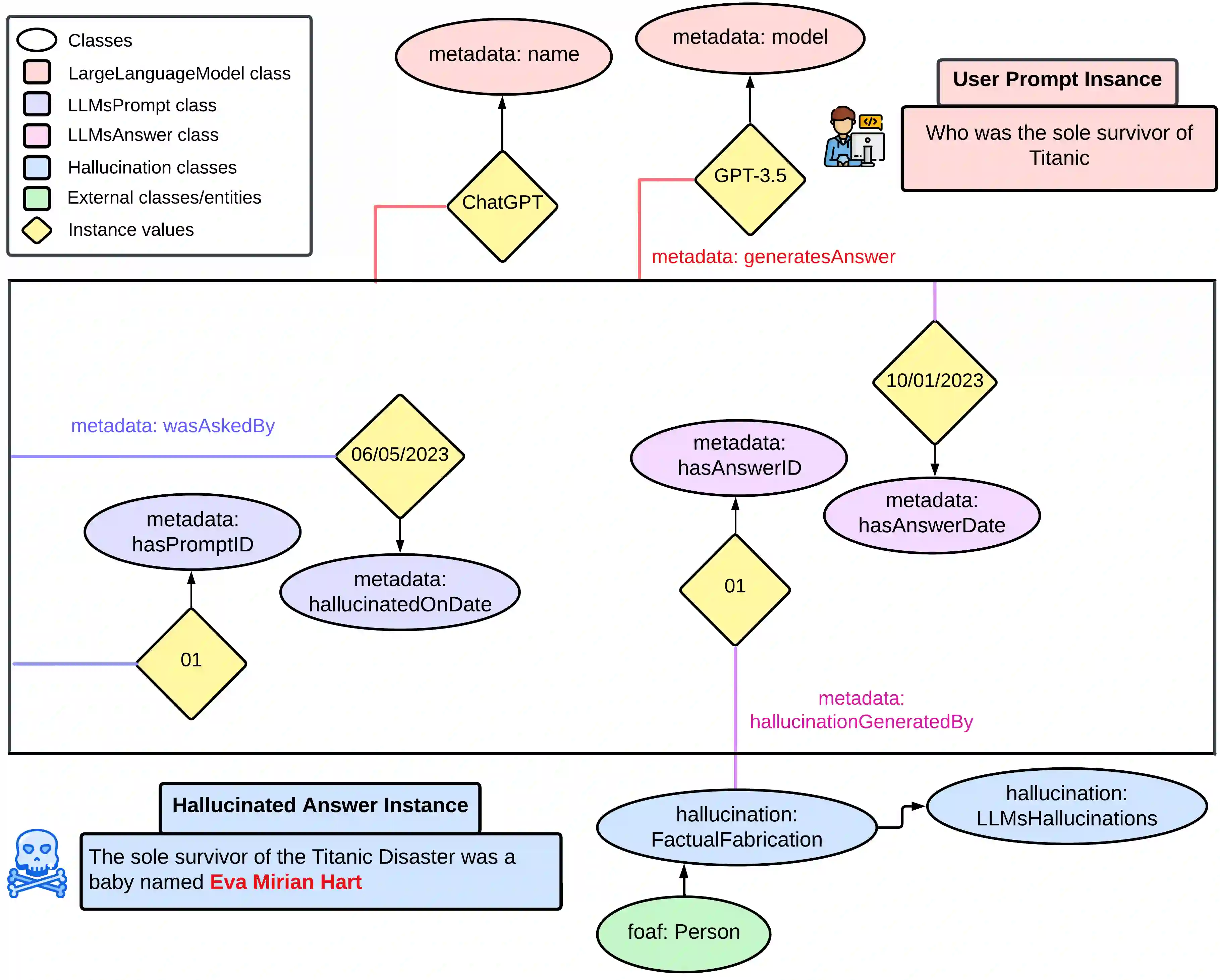
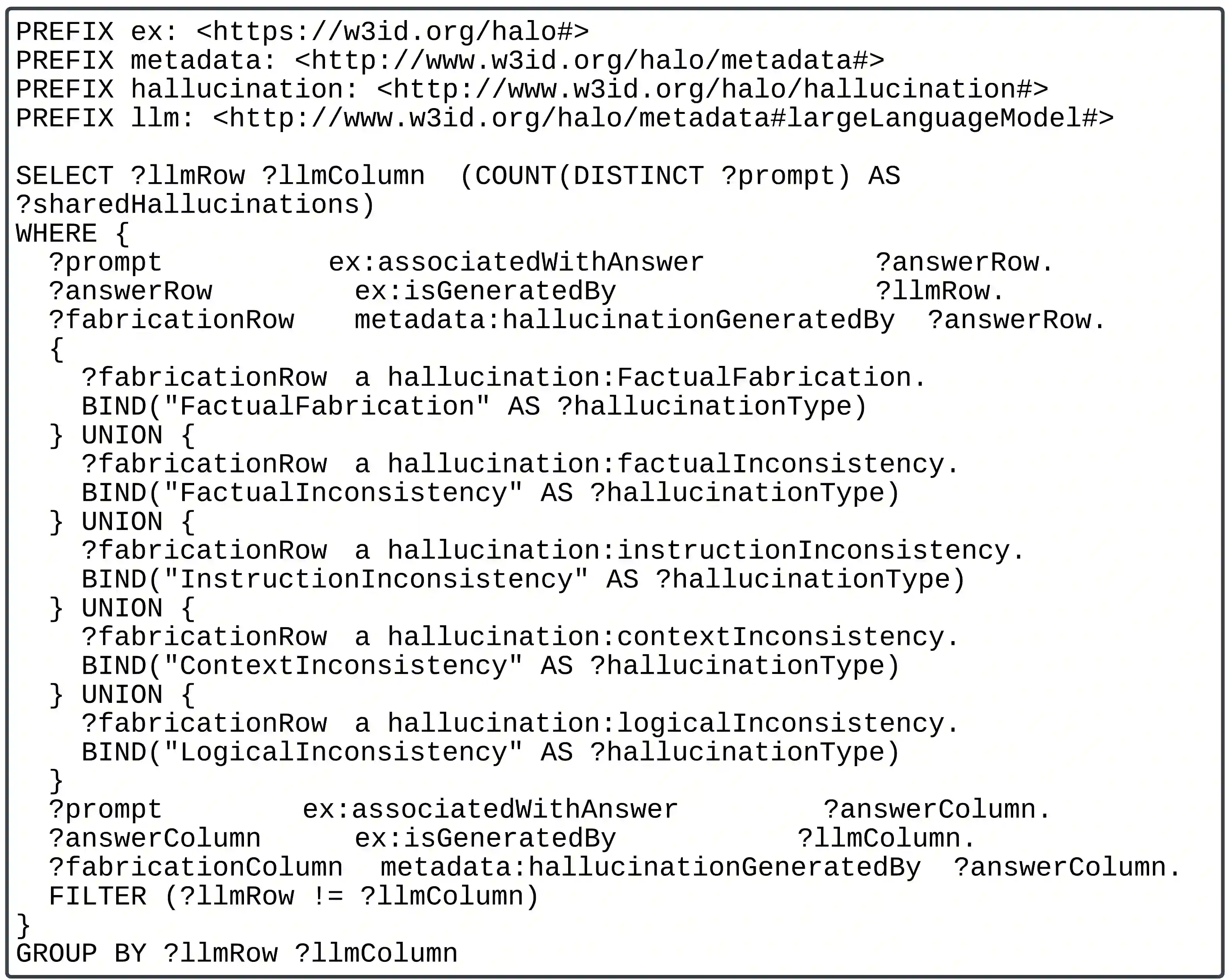
Recent progress in generative AI, including large language models (LLMs) like ChatGPT, has opened up significant opportunities in fields ranging from natural language processing to knowledge discovery and data mining. However, there is also a growing awareness that the models can be prone to problems such as making information up or `hallucinations', and faulty reasoning on seemingly simple problems. Because of the popularity of models like ChatGPT, both academic scholars and citizen scientists have documented hallucinations of several different types and severity. Despite this body of work, a formal model for describing and representing these hallucinations (with relevant meta-data) at a fine-grained level, is still lacking. In this paper, we address this gap by presenting the Hallucination Ontology or HALO, a formal, extensible ontology written in OWL that currently offers support for six different types of hallucinations known to arise in LLMs, along with support for provenance and experimental metadata. We also collect and publish a dataset containing hallucinations that we inductively gathered across multiple independent Web sources, and show that HALO can be successfully used to model this dataset and answer competency questions.
翻译:摘要:生成式人工智能的最新进展,包括ChatGPT等大型语言模型,已在自然语言处理、知识发现与数据挖掘等领域开辟了重大机遇。然而,人们也日益认识到这些模型存在易产生问题,例如捏造信息或"幻觉",以及在看似简单的问题上出现错误推理。由于ChatGPT等模型的普及,学术学者和公民科学家都已记录下多种不同类型和严重程度的幻觉现象。尽管已有大量相关研究,但目前仍缺乏一种能够细粒度描述和表示这些幻觉(并附带相关元数据)的正式模型。本文通过提出"幻觉本体"(HALO)来填补这一空白——这是一种用OWL编写的可扩展形式化本体,当前支持大型语言模型中已知的六种幻觉类型,并具备来源和实验元数据支持。我们还收集并发布了一个数据集,其中包含从多个独立网络来源归纳整理的幻觉实例,并证明HALO可成功用于建模该数据集并回答能力问题。




相关内容





 微信扫码咨询专知VIP会员