

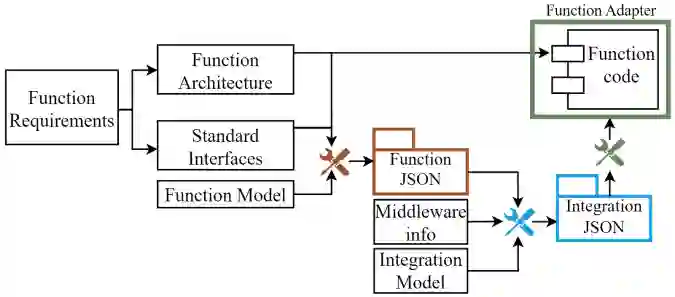
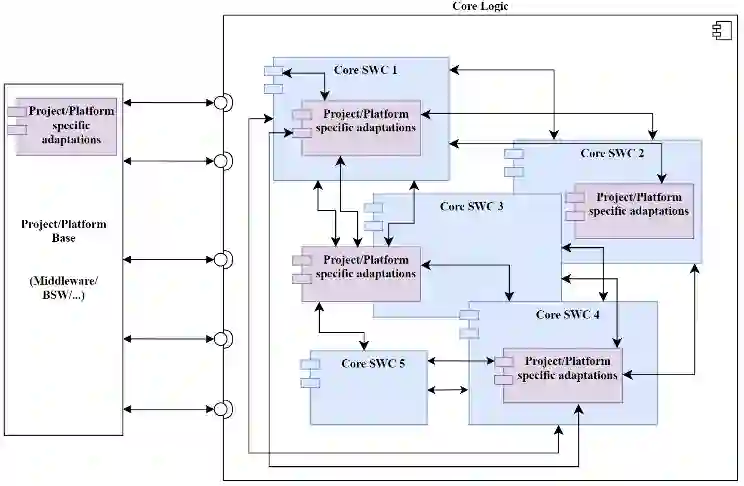
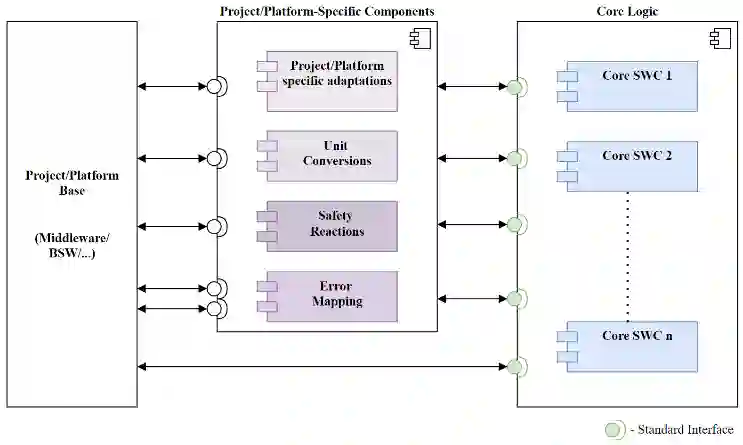
The automotive industry is currently undergoing a major transformation with respect to the Electric/Electronic (E/E) and software architecture, driven by a significant increase in the complexity of the technological stack within a vehicle. This complexity acts as a driving force for Software-Defined Vehicles (SDVs) leading to the evolution of the automotive E/E architectures from decentralized configuration comprising multiple Electronic Control Units (ECUs) towards a more integrated configuration comprising a smaller number of ECUs, domain controllers, gateways, and High-Performance Computers (HPCs) [2]. This transition along with several other reasons have resulted in heterogeneous software platforms such as AUTOSAR Classic, AUTOSAR Adaptive, and prototypical frameworks like ROS 2. It is therefore essential to develop applications that are both hardware- and platform/middleware-agnostic to attain development and integration efficiency. This work presents an application development and integration concept to facilitate developing applications as Software as a Product (SaaP), while simultaneously ensuring efficient integration onto multiple software architecture platforms. The concept involves designing applications in a hardware- and software platform-agnostic manner and standardizing application interfaces [6]. It also includes describing the relevant aspects of the application and corresponding middleware in a machine-readable format to aid the integration of developed applications. Additionally, tools are developed to facilitate semi-automation of the development and integration processes. An example application has been developed and integrated onto AUTOSAR Adaptive and ROS 2, demonstrating the applicability of the approach. Finally, metrics are presented to show the efficiency of the overall concept.
翻译:当前,汽车行业正经历一场由车辆内部技术栈复杂性显著增加所驱动的电气/电子(E/E)与软件架构的重大变革。这种复杂性推动了软件定义汽车(SDVs)的发展,促使汽车E/E架构从包含多个电子控制单元(ECUs)的分散式配置,向包含更少数量的ECUs、域控制器、网关及高性能计算机(HPCs)的更集成化配置演进[2]。这一转变连同其他若干因素,导致了异构软件平台的出现,例如AUTOSAR Classic、AUTOSAR Adaptive以及原型框架如ROS 2。因此,开发既硬件无关又平台/中间件无关的应用程序,对于实现开发与集成效率至关重要。本研究提出了一种应用程序开发与集成概念,旨在促进以产品化软件(SaaP)的形式开发应用程序,同时确保其能高效集成到多种软件架构平台。该概念包括以硬件和软件平台无关的方式设计应用程序,并标准化应用程序接口[6]。它还涉及以机器可读的格式描述应用程序及相应中间件的相关方面,以辅助已开发应用程序的集成。此外,还开发了工具以促进开发与集成过程的半自动化。一个示例应用程序已被开发并集成到AUTOSAR Adaptive和ROS 2上,证明了该方法的适用性。最后,本文提出了相关指标以展示整体概念的高效性。




相关内容





 微信扫码咨询专知VIP会员