

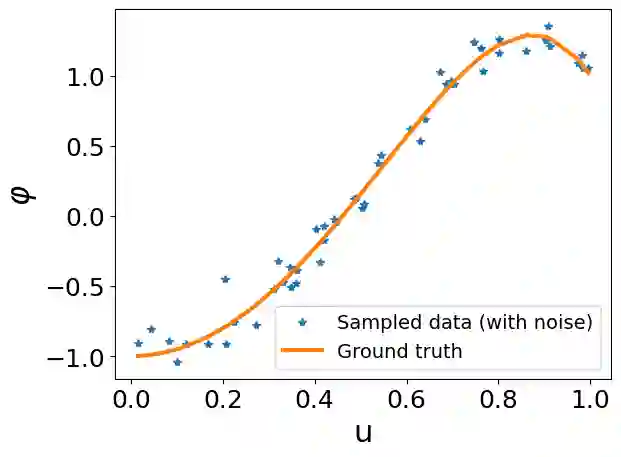
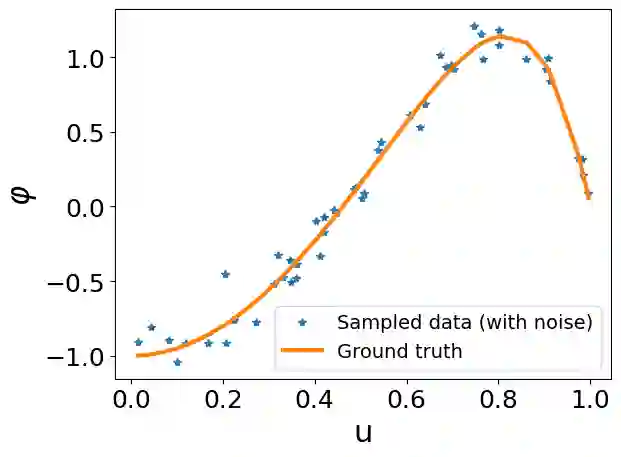
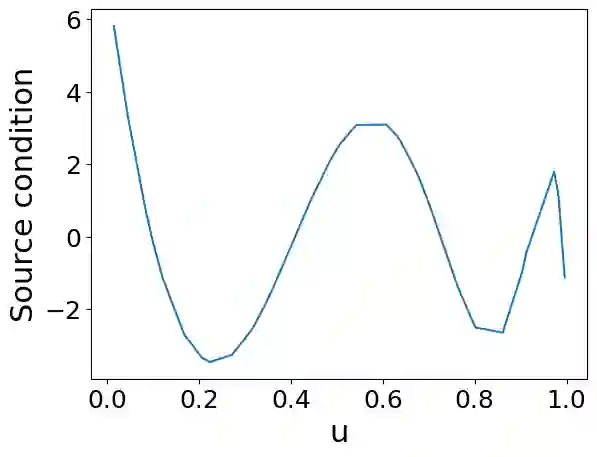
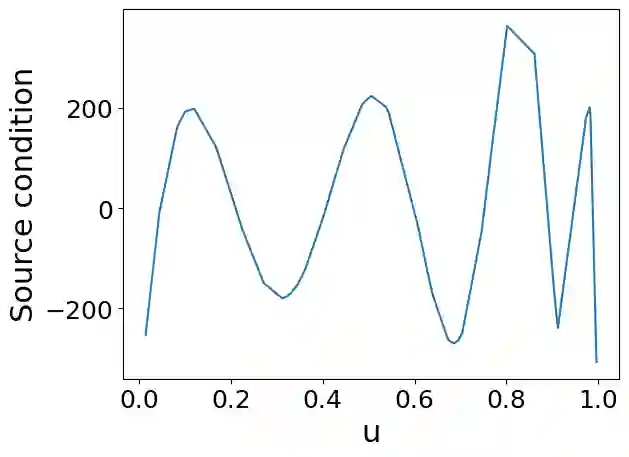
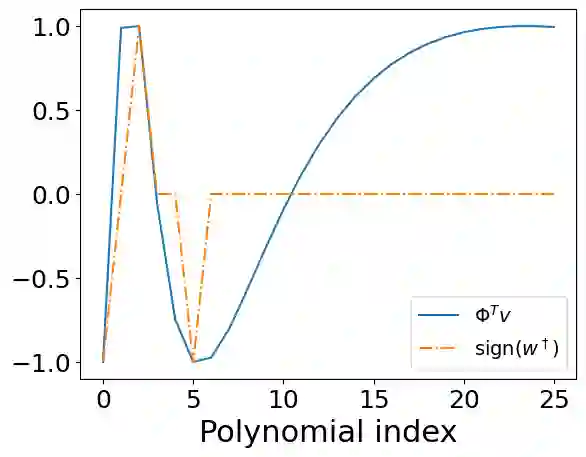
Source conditions are a key tool in regularisation theory that are needed to derive error estimates and convergence rates for ill-posed inverse problems. In this paper, we provide a recipe to practically compute source condition elements as the solution of convex minimisation problems that can be solved with first-order algorithms. We demonstrate the validity of our approach by testing it on two inverse problem case studies in machine learning and image processing: sparse coefficient estimation of a polynomial via LASSO regression and recovering an image from a subset of the coefficients of its discrete Fourier transform. We further demonstrate that the proposed approach can easily be modified to solve the machine learning task of identifying the optimal sampling pattern in the Fourier domain for a given image and variational regularisation method, which has applications in the context of sparsity promoting reconstruction from magnetic resonance imaging data.
翻译:源条件是正则化理论中的关键工具,用于推导不适定反问题的误差估计和收敛速率。本文提供了一种实用方案,通过求解可利用一阶算法处理的凸最小化问题,实际计算源条件要素。我们通过两个机器学习与图像处理领域的反问题案例研究验证了该方法的有效性:基于LASSO回归的多项式稀疏系数估计,以及从离散傅里叶变换系数子集中恢复图像。我们进一步证明,所提方法可轻松修改以解决机器学习任务——针对给定图像和变分正则化方法,在傅里叶域中识别最优采样模式,该技术可应用于磁共振成像数据稀疏性促进重建场景。




相关内容




 微信扫码咨询专知VIP会员