

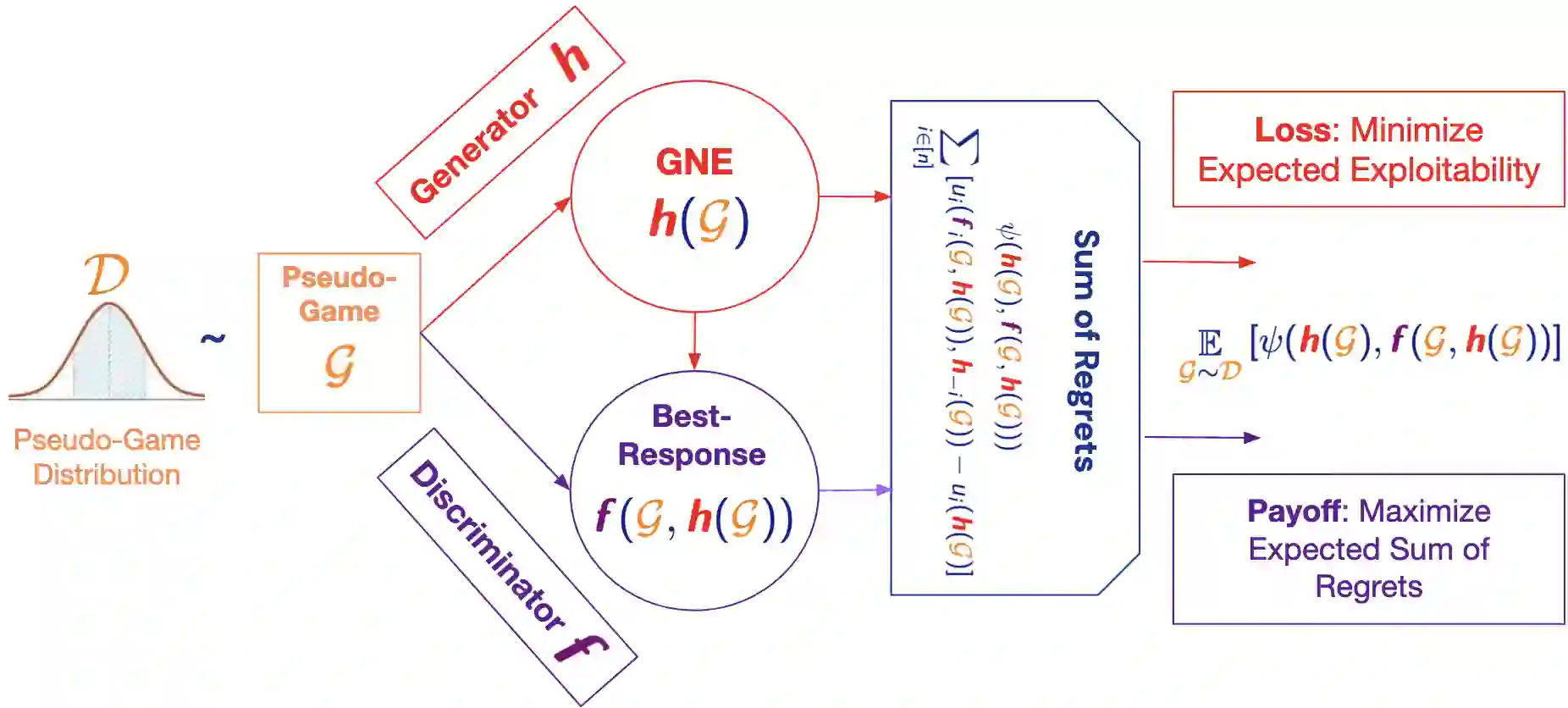
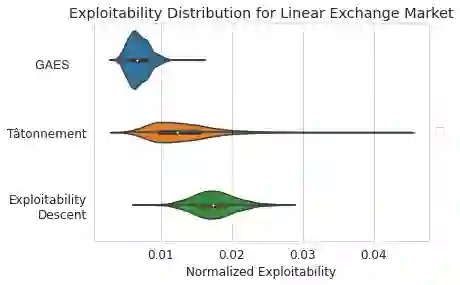
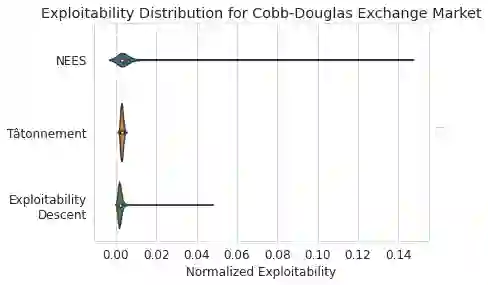
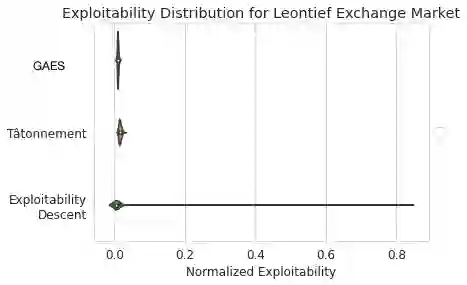
We introduce the use of generative adversarial learning to compute equilibria in general game-theoretic settings, specifically the \emph{generalized Nash equilibrium} (GNE) in \emph{pseudo-games}, and its specific instantiation as the \emph{competitive equilibrium} (CE) in Arrow-Debreu competitive economies. Pseudo-games are a generalization of games in which players' actions affect not only the payoffs of other players but also their feasible action spaces. Although the computation of GNE and CE is intractable in the worst-case, i.e., PPAD-hard, in practice, many applications only require solutions with high accuracy in expectation over a distribution of problem instances. We introduce Generative Adversarial Equilibrium Solvers (GAES): a family of generative adversarial neural networks that can learn GNE and CE from only a sample of problem instances. We provide computational and sample complexity bounds, and apply the framework to finding Nash equilibria in normal-form games, CE in Arrow-Debreu competitive economies, and GNE in an environmental economic model of the Kyoto mechanism.
翻译:我们引入了生成对抗学习用于计算一般博弈论环境中的均衡,具体包括伪博弈中的广义纳什均衡(GNE)及其在阿罗-德布鲁竞争经济中的特例——竞争均衡(CE)。伪博弈是博弈的一种推广形式,其中玩家的行动不仅影响其他玩家的收益,还影响其可行行动空间。尽管在最坏情况下GNE和CE的计算是棘手的(即PPAD-难问题),但在实践中,许多应用仅需要在问题实例的分布上获得高精度的期望解。我们提出了生成对抗均衡求解器(GAES):一类生成对抗神经网络,能够仅从问题实例的样本中学习GNE和CE。我们给出了计算复杂度和样本复杂度界,并将该框架应用于标准式博弈的纳什均衡求解、阿罗-德布鲁竞争经济中的CE求解,以及京都机制环境经济模型中的GNE求解。




相关内容



 微信扫码咨询专知VIP会员