

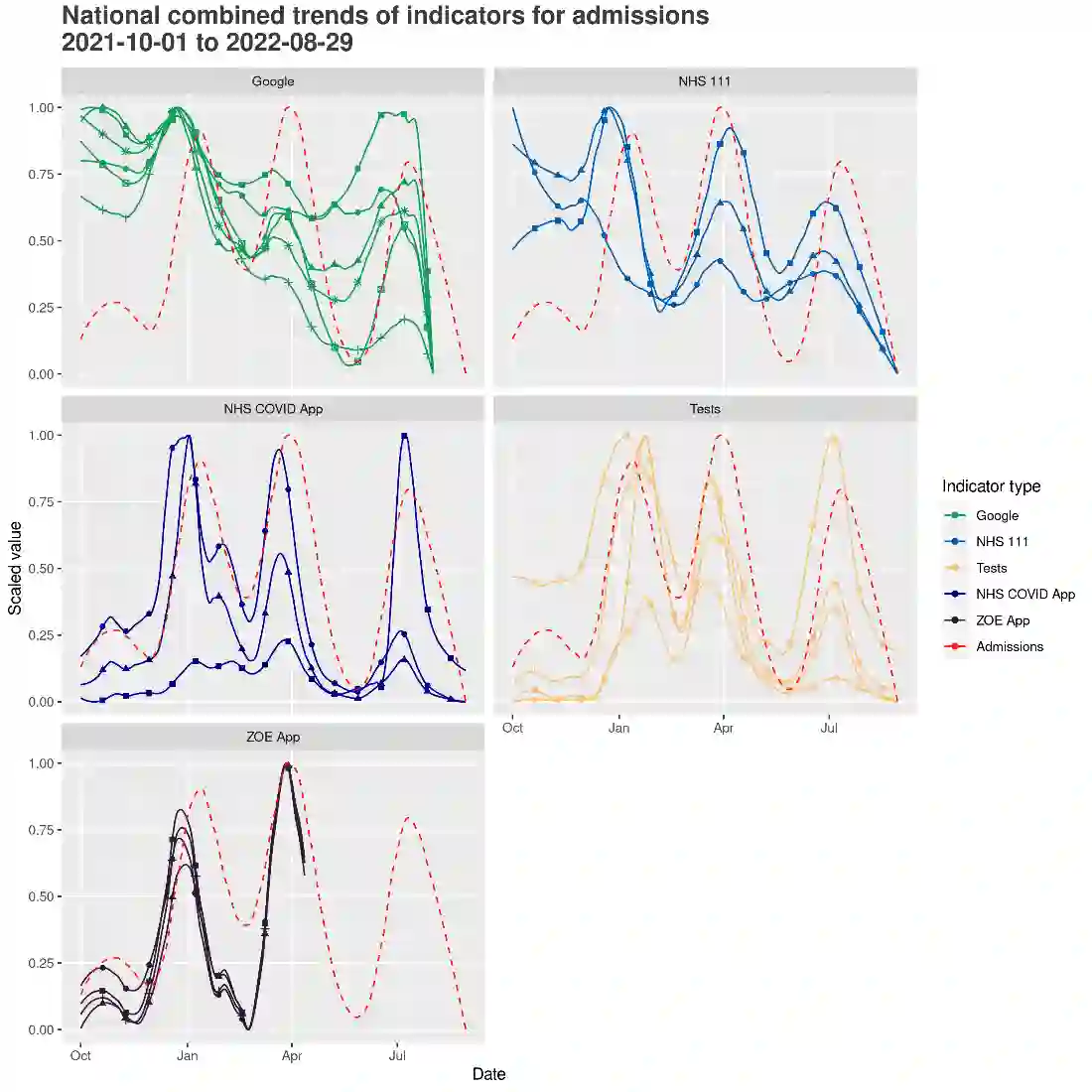
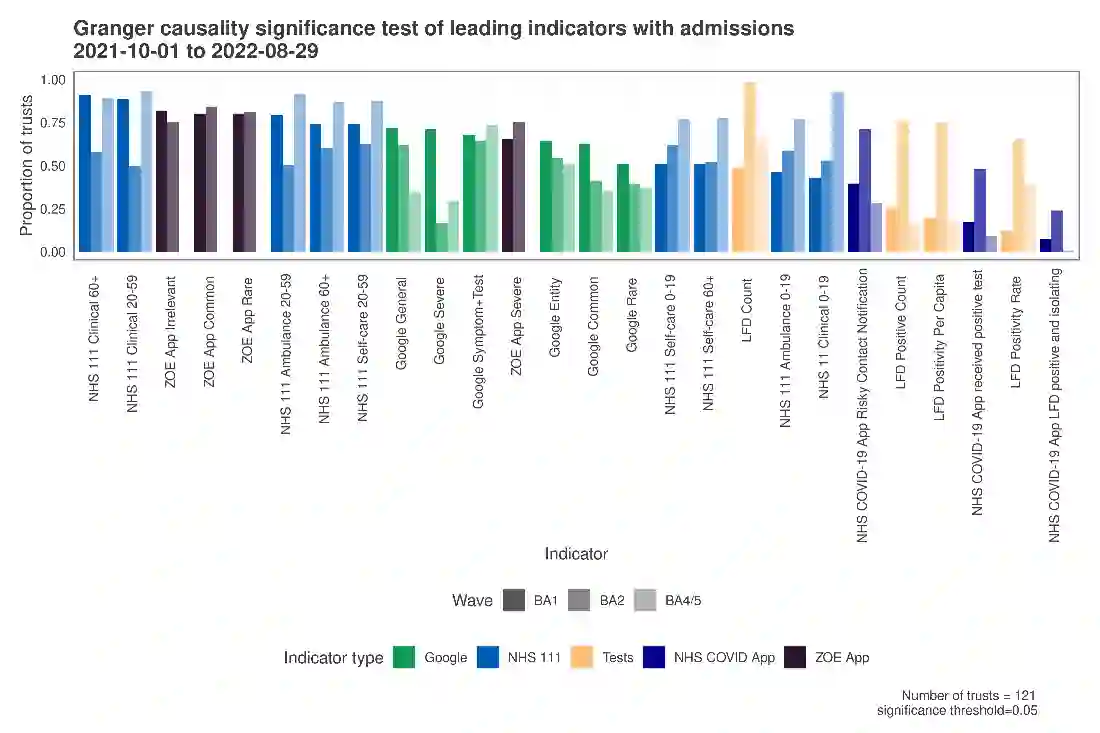
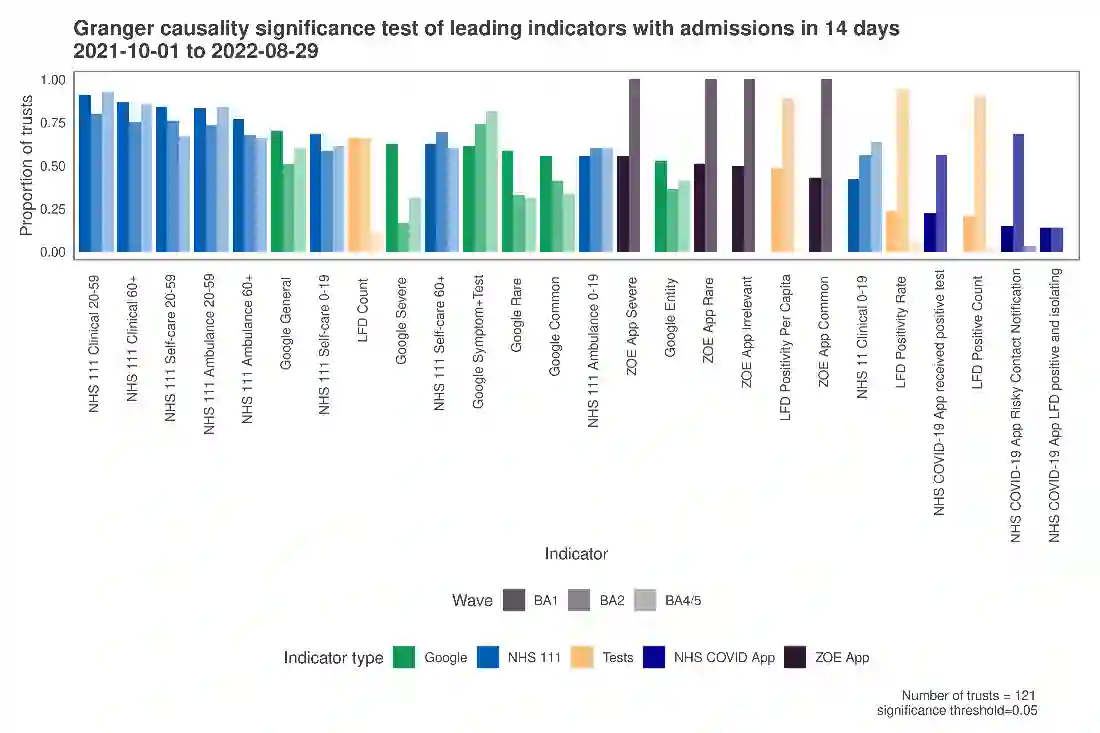
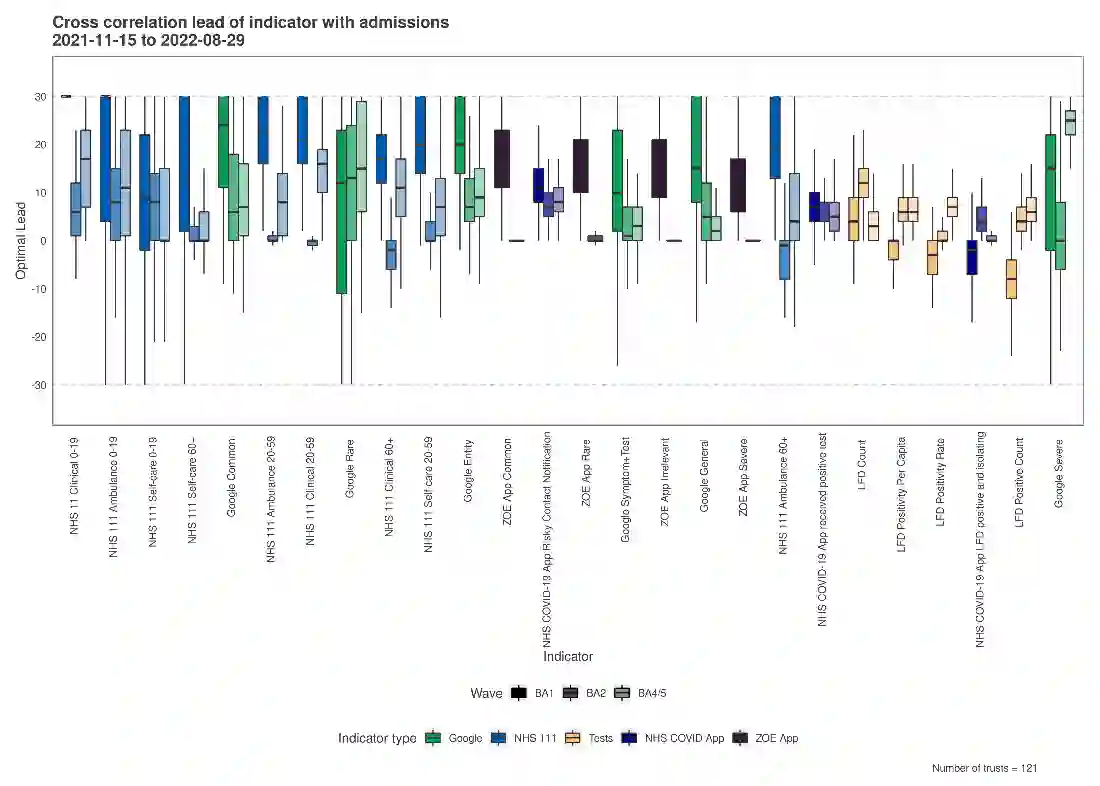
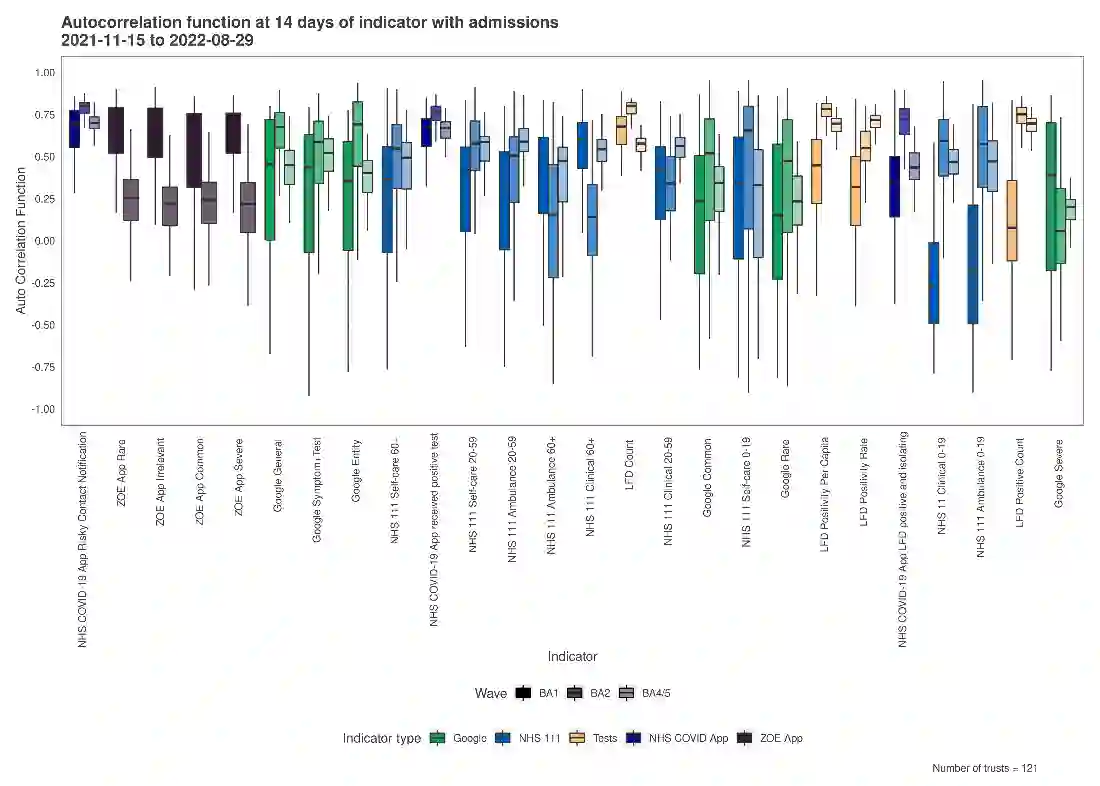
Following the UK Government's Living with COVID-19 Strategy and the end of universal testing, hospital admissions are an increasingly important measure of COVID-19 pandemic pressure. Understanding leading indicators of admissions at National Health Service (NHS) Trust, regional and national geographies help health services plan capacity needs and prepare for ongoing pressures. We explored the spatio-temporal relationships of leading indicators of hospital pressure across successive waves of SARS-CoV-2 incidence in England. This includes an analysis of internet search volume values from Google Trends, NHS triage calls and online queries, the NHS COVID-19 App, lateral flow devices and the ZOE App. Data sources were analysed for their feasibility as leading indicators using linear and non-linear methods; granger causality, cross correlations and dynamic time warping at fine spatial scales. Consistent temporal and spatial relationships were found for some of the leading indicators assessed across resurgent waves of COVID-19. Google Trends and NHS queries consistently led admissions in over 70% of Trusts, with lead times ranging from 5-20 days, whereas an inconsistent relationship was found for the ZOE app, NHS COVID-19 App, and rapid testing, that diminished with granularity, showing limited autocorrelation of leads between -7 to 7 days. This work shows that novel syndromic surveillance data has utility for understanding the expected hospital burden at fine spatial scales. The analysis shows at low level geographies that some surveillance sources can predict hospital admissions, though care must be taken in relying on the lead times and consistency between waves.
翻译:随着英国政府“与新冠共存”战略的实施及全民检测的终止,住院人数已成为衡量COVID-19大流行压力的重要指标。理解英国国家医疗服务体系(NHS)信托机构、区域及全国范围内入院趋势的先导指标,有助于医疗机构规划床位需求并应对持续压力。本研究探索了英格兰地区SARS-CoV-2发病率连续浪潮下,医院压力先导指标的时空关系。分析涵盖了来自Google Trends的互联网搜索量数据、NHS分诊电话及在线咨询量、NHS COVID-19应用程序、侧流检测设备及ZOE应用程序。采用线性与非线性方法(格兰杰因果检验、互相关分析及动态时间规整)在精细空间尺度上评估各数据源作为先导指标的可行性。研究发现,部分先导指标在COVID-19复发性疫情浪潮中呈现一致的时空关联性:Google Trends和NHS咨询量在超过70%的信托机构中领先入院指标,领先时间范围为5-20天;而ZOE应用程序、NHS COVID-19应用程序及快速检测则呈现不稳定的关联性,随着空间粒度细化其相关性减弱,领先时间在-7至7天范围内自相关性有限。研究表明,新型症状监测数据在精细空间尺度上具有预测医院负荷的实用价值。本分析揭示,在低层级地理区域中,部分监测源可预测入院趋势,但需谨慎依赖各疫情浪潮间领先时间及一致性的稳定性。




相关内容




 微信扫码咨询专知VIP会员