

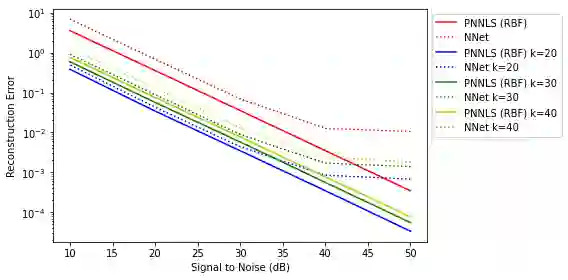
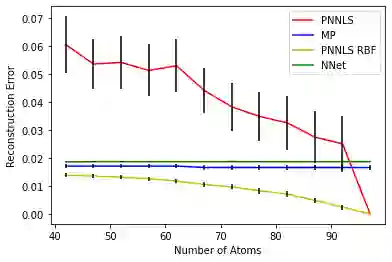
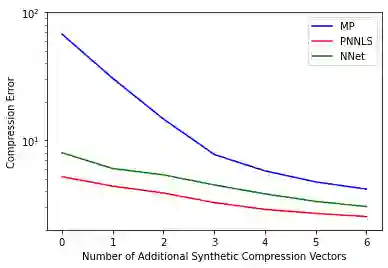
Hyperspectral measurements from long range sensors can give a detailed picture of the items, materials, and chemicals in a scene but analysis can be difficult, slow, and expensive due to high spatial and spectral resolutions of state-of-the-art sensors. As such, sparsity is important to enable the future of spectral compression and analytics. It has been observed that environmental and atmospheric effects, including scattering, can produce nonlinear effects posing challenges for existing source separation and compression methods. We present a novel transformation into Hilbert spaces for pruning and constructing sparse representations via non-negative least squares minimization. Then we introduce max likelihood compression vectors to decrease information loss. Our approach is benchmarked against standard pruning and least squares as well as deep learning methods. Our methods are evaluated in terms of overall spectral reconstruction error and compression rate using real and synthetic data. We find that pruning least squares methods converge quickly unlike matching pursuit methods. We find that Hilbert space pruning can reduce error by as much as 40% of the error of standard pruning and also outperform neural network autoencoders.
翻译:远距离传感器获取的高光谱测量数据能够详细描绘场景中的物体、材料和化学物质分布,但最先进传感器的高空间与光谱分辨率特性导致数据分析困难、处理速度慢且成本高昂。因此,稀疏性对于实现未来光谱压缩与分析技术至关重要。研究表明,包括散射在内的环境与大气效应会产生非线性影响,对现有的源分离和压缩方法构成挑战。我们提出一种新颖的希尔伯特空间变换方法,通过非负最小二乘最小化实现稀疏表示的剪枝与构建,并引入最大似然压缩向量以降低信息损失。该方法与标准剪枝方法、最小二乘法以及深度学习方法进行性能对比,采用真实与合成数据从整体光谱重构误差和压缩率两个维度评估。实验发现:剪枝最小二乘法相比匹配追踪法具有更快的收敛速度;希尔伯特空间剪枝可将标准剪枝方法的误差降低40%,且性能优于神经网络自编码器。




相关内容


 微信扫码咨询专知VIP会员