

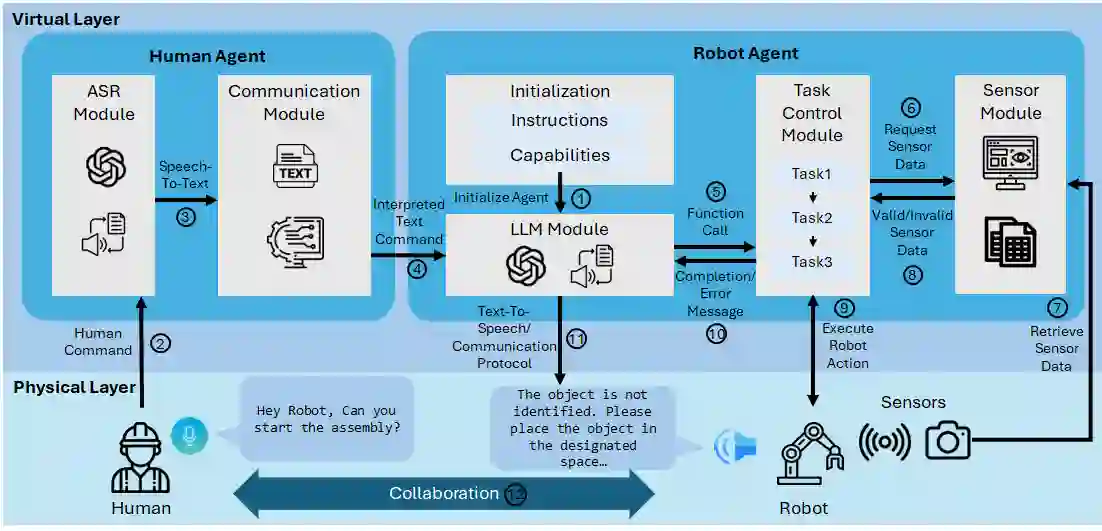
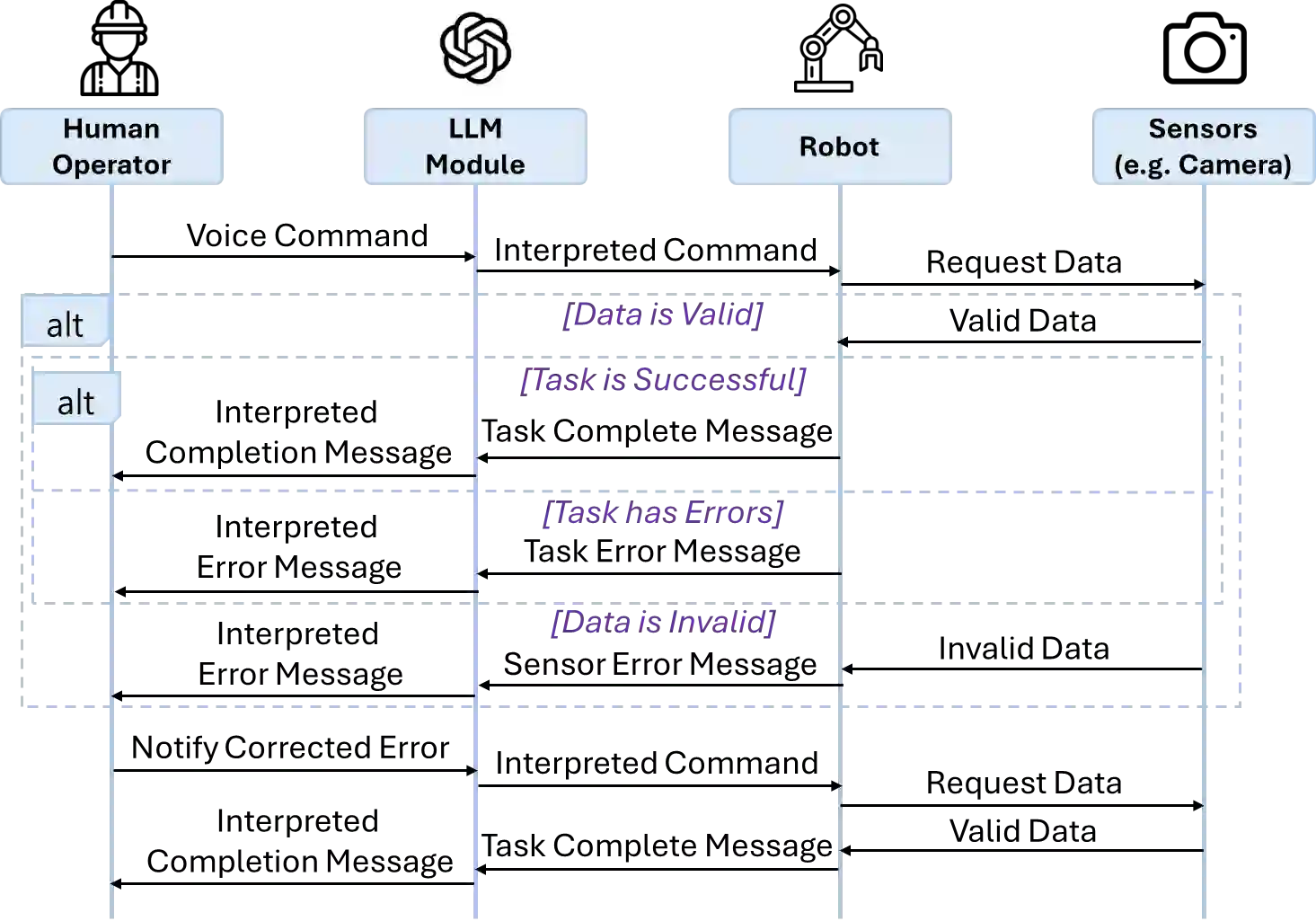
The development of human-robot collaboration has the ability to improve manufacturing system performance by leveraging the unique strengths of both humans and robots. On the shop floor, human operators contribute with their adaptability and flexibility in dynamic situations, while robots provide precision and the ability to perform repetitive tasks. However, the communication gap between human operators and robots limits the collaboration and coordination of human-robot teams in manufacturing systems. Our research presents a human-robot collaborative assembly framework that utilizes a large language model for enhancing communication in manufacturing environments. The framework facilitates human-robot communication by integrating voice commands through natural language for task management. A case study for an assembly task demonstrates the framework's ability to process natural language inputs and address real-time assembly challenges, emphasizing adaptability to language variation and efficiency in error resolution. The results suggest that large language models have the potential to improve human-robot interaction for collaborative manufacturing assembly applications.
翻译:人机协作的发展能够通过结合人类与机器人各自的独特优势来提升制造系统的性能。在车间现场,人类操作员凭借其在动态情境下的适应性与灵活性做出贡献,而机器人则提供精确性及执行重复性任务的能力。然而,人类操作员与机器人之间的沟通鸿沟限制了制造系统中人机团队的协作与协调。本研究提出了一种人机协同装配框架,该框架利用大型语言模型来增强制造环境中的通信。该框架通过集成基于自然语言的语音指令进行任务管理,从而促进人机通信。一项针对装配任务的案例研究展示了该框架处理自然语言输入并应对实时装配挑战的能力,突出了其对语言变异的适应性以及在错误解决方面的效率。结果表明,大型语言模型有潜力改善面向协同制造装配应用的人机交互。





相关内容





 微信扫码咨询专知VIP会员