

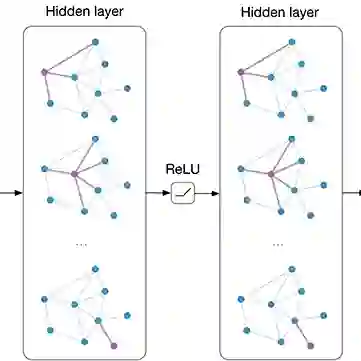
Graph Convolutional Networks (GCN) are Graph Neural Networks where the convolutions are applied over a graph. In contrast to Convolutional Neural Networks, GCN's are designed to perform inference on graphs, where the number of nodes can vary, and the nodes are unordered. In this study, we address two important challenges related to GCNs: i) oversmoothing; and ii) the utilization of node relational properties (i.e., heterophily and homophily). Oversmoothing is the degradation of the discriminative capacity of nodes as a result of repeated aggregations. Heterophily is the tendency for nodes of different classes to connect, whereas homophily is the tendency of similar nodes to connect. We propose a new strategy for addressing these challenges in GCNs based on Transfer Entropy (TE), which measures of the amount of directed transfer of information between two time varying nodes. Our findings indicate that using node heterophily and degree information as a node selection mechanism, along with feature-based TE calculations, enhances accuracy across various GCN models. Our model can be easily modified to improve classification accuracy of a GCN model. As a trade off, this performance boost comes with a significant computational overhead when the TE is computed for many graph nodes.
翻译:图卷积网络(GCN)是一种在图结构上应用卷积操作的图神经网络。与卷积神经网络不同,GCN专为图数据推理而设计,其中节点数量可变且节点无序。本研究针对GCN面临的两个重要挑战展开探讨:i)过度平滑;ii)节点关系特性(即异配性与同配性)的利用。过度平滑是指因重复聚合操作导致的节点判别能力退化。异配性指不同类别节点间的连接倾向,而同配性指相似节点间的连接倾向。我们提出一种基于转移熵(TE)的新策略来解决GCN中的这些挑战,TE用于度量两个时变节点间有向信息传递的量。研究结果表明,将节点异配性与度信息作为节点选择机制,结合基于特征的TE计算,能够提升多种GCN模型的准确率。我们的模型可轻松改进以提升GCN模型的分类精度。作为权衡,当对大量图节点计算TE时,这种性能提升会带来显著的计算开销。




相关内容




 微信扫码咨询专知VIP会员