

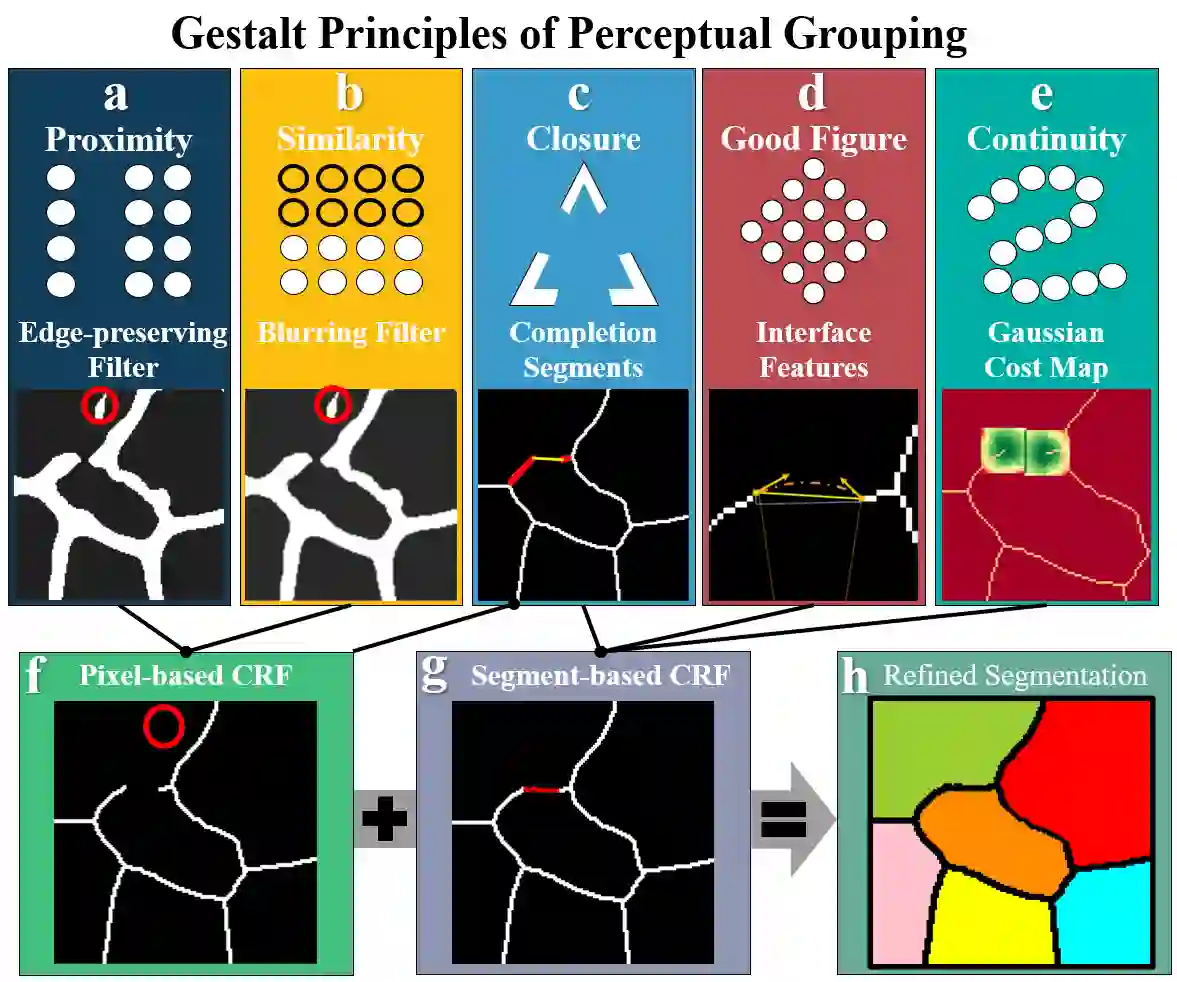
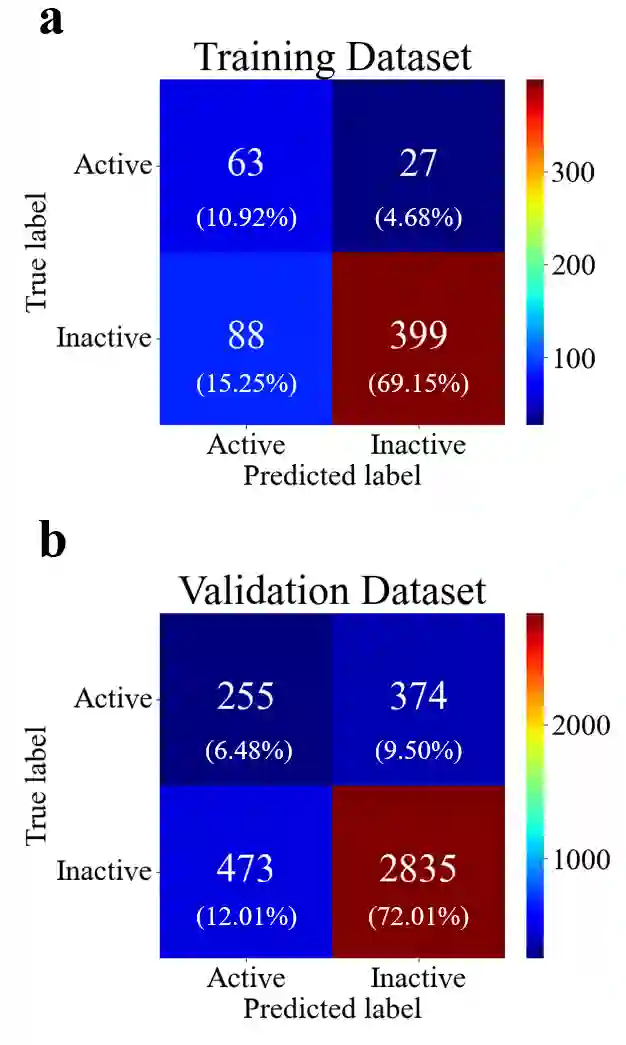
Accurate segmentation of interconnected line networks, such as grain boundaries in polycrystalline material microstructures, poses a significant challenge due to the fragmented masks produced by conventional computer vision algorithms, including convolutional neural networks. These algorithms struggle with thin masks, often necessitating intricate post-processing for effective contour closure and continuity. Addressing this issue, this paper introduces a fast, high-fidelity post-processing technique, leveraging domain knowledge about grain boundary connectivity and employing conditional random fields and perceptual grouping rules. This approach significantly enhances segmentation mask accuracy, achieving a 79% segment identification accuracy in validation with a U-Net model on electron microscopy images of a polycrystalline oxide. Additionally, a novel grain alignment metric is introduced, showing a 51% improvement in grain alignment, providing a more detailed assessment of segmentation performance for complex microstructures. This method not only enables rapid and accurate segmentation but also facilitates an unprecedented level of data analysis, significantly improving the statistical representation of grain boundary networks, making it suitable for a range of disciplines where precise segmentation of interconnected line networks is essential.
翻译:多晶材料微观结构中晶界等互联线网络的精确分割面临重大挑战,因为传统计算机视觉算法(包括卷积神经网络)会产生碎片化掩膜。这类算法难以处理细薄的掩膜结构,通常需要复杂的后处理来实现有效的轮廓闭合与连续性。针对这一问题,本文提出一种快速高保真的后处理技术,该技术利用晶界连通性的领域知识,结合条件随机场与感知分组规则。该方法显著提升了分割掩膜的精度,在对多晶氧化物电子显微镜图像使用U-Net模型进行验证时,实现了79%的线段识别准确率。此外,本文引入了一种新颖的晶粒对齐度量指标,该指标显示晶粒对齐程度提升了51%,为复杂微观结构的分割性能提供了更精细的评估。该方法不仅实现了快速精确的分割,还促成了前所未有的数据分析水平,显著改善了晶界网络的统计表征,适用于需要精确分割互联线网络的多个学科领域。






相关内容




 微信扫码咨询专知VIP会员