

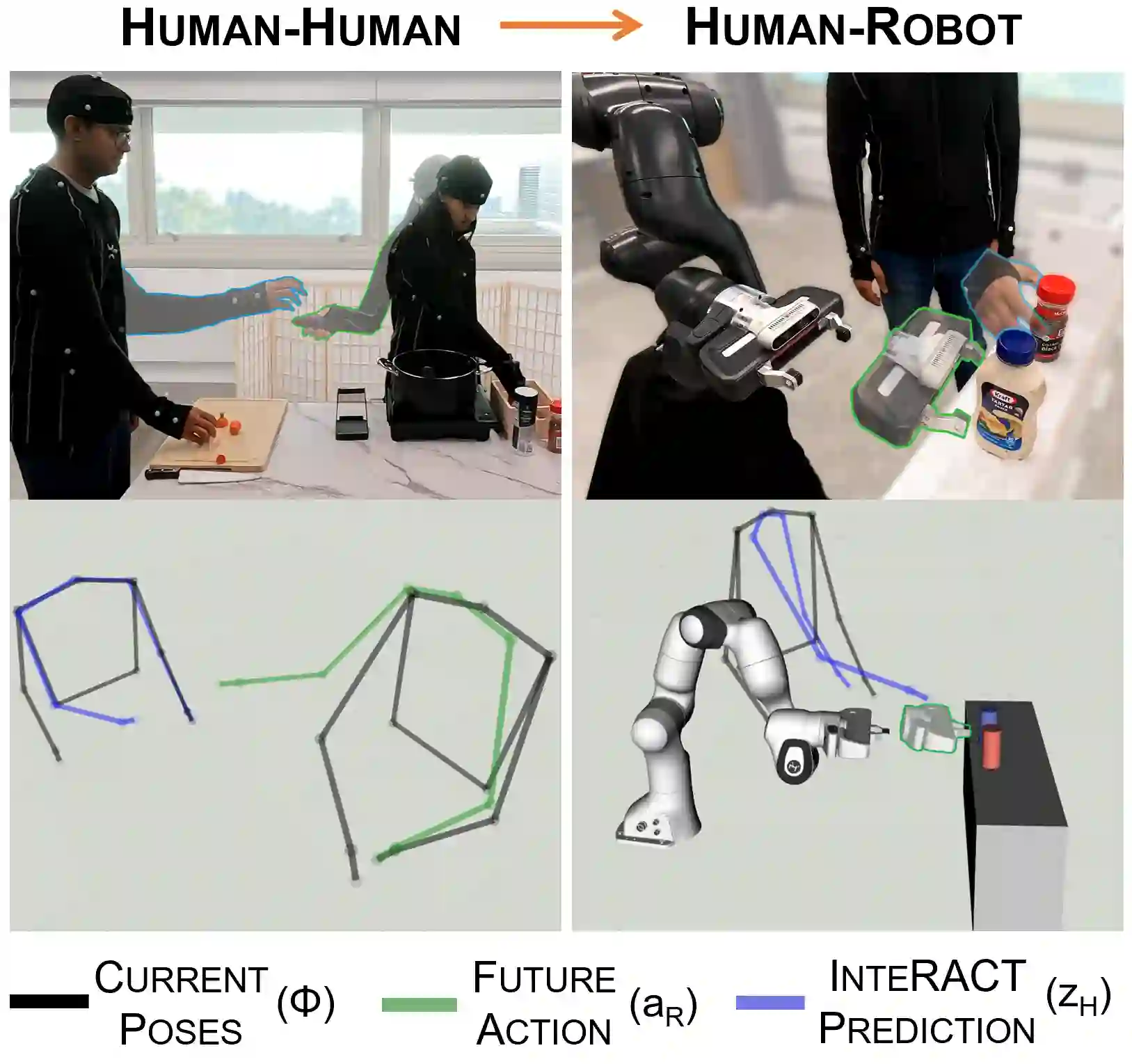
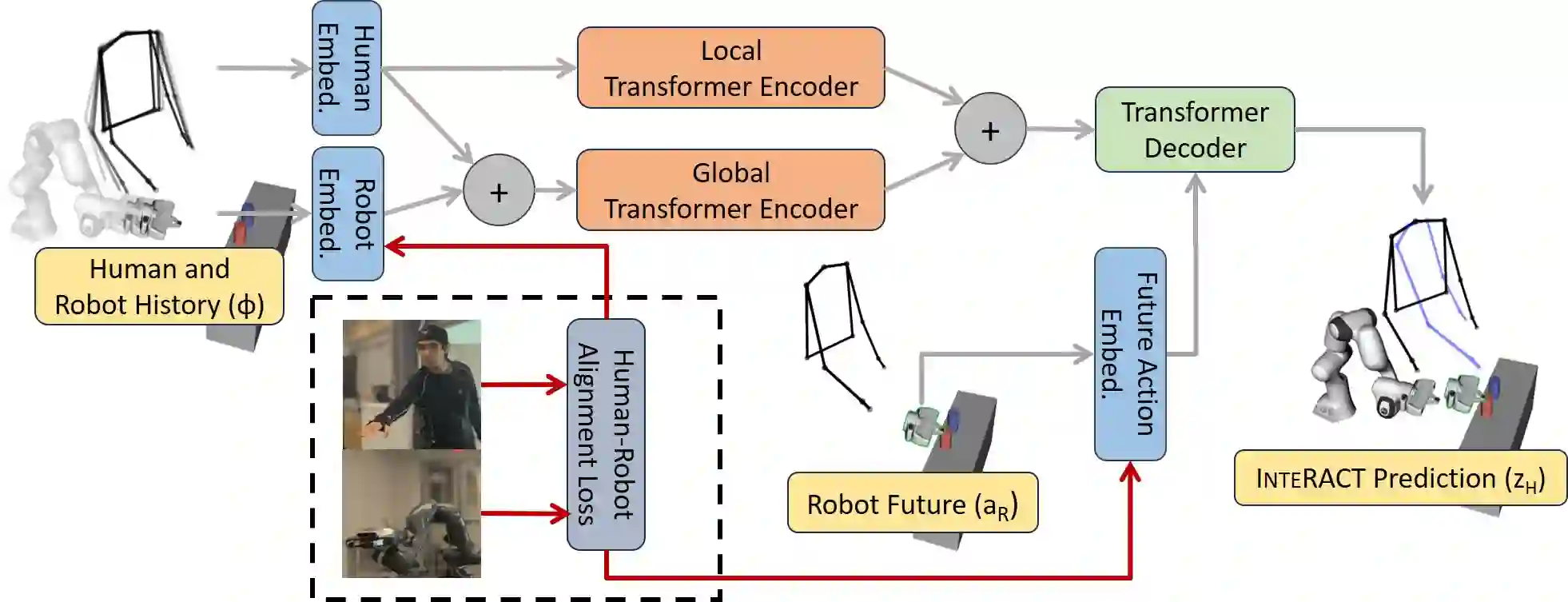
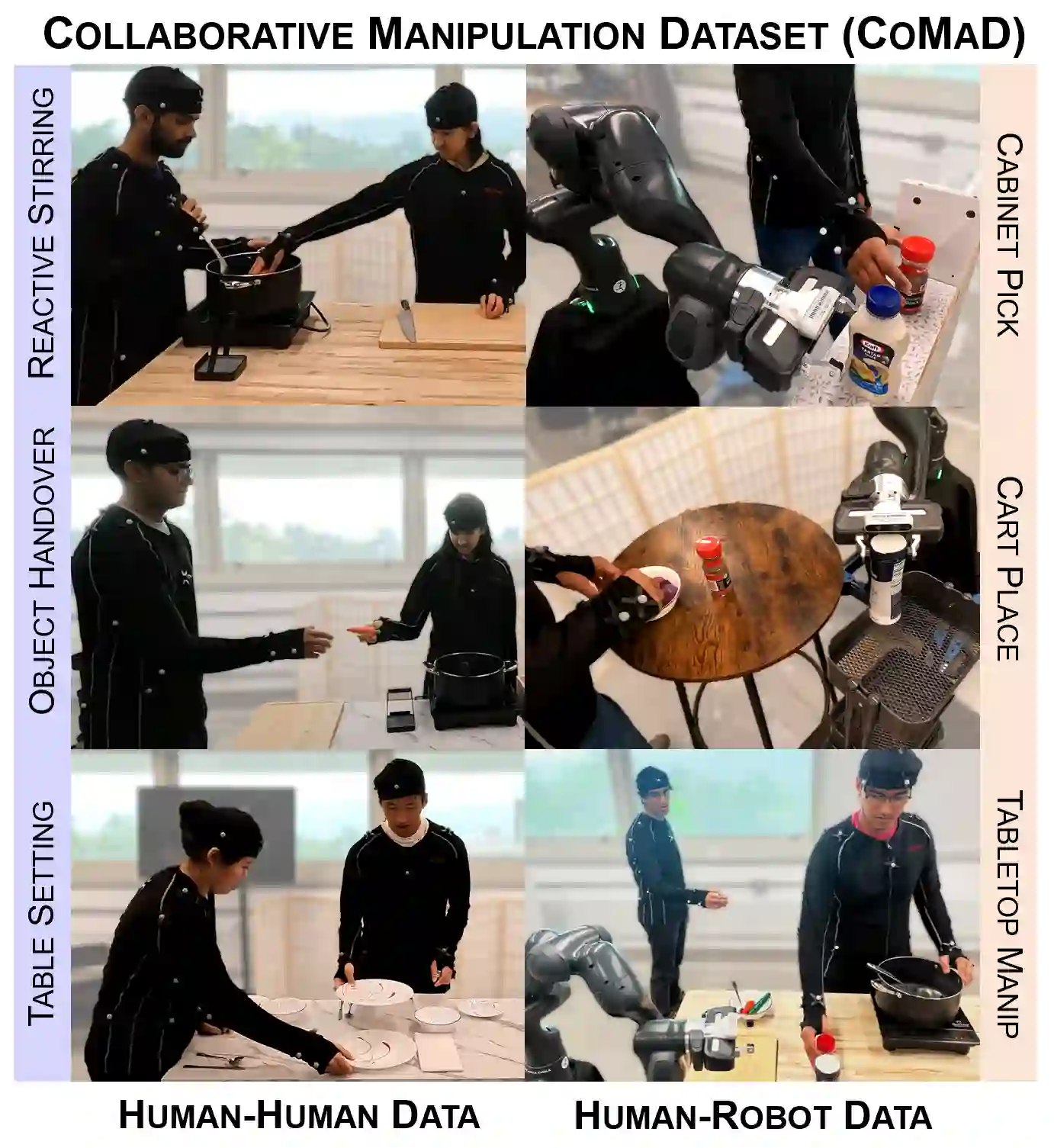
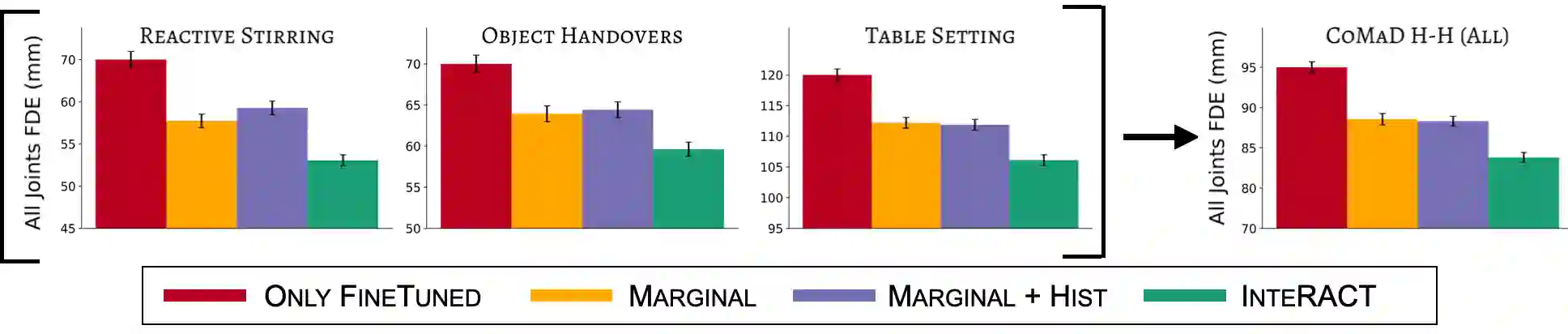
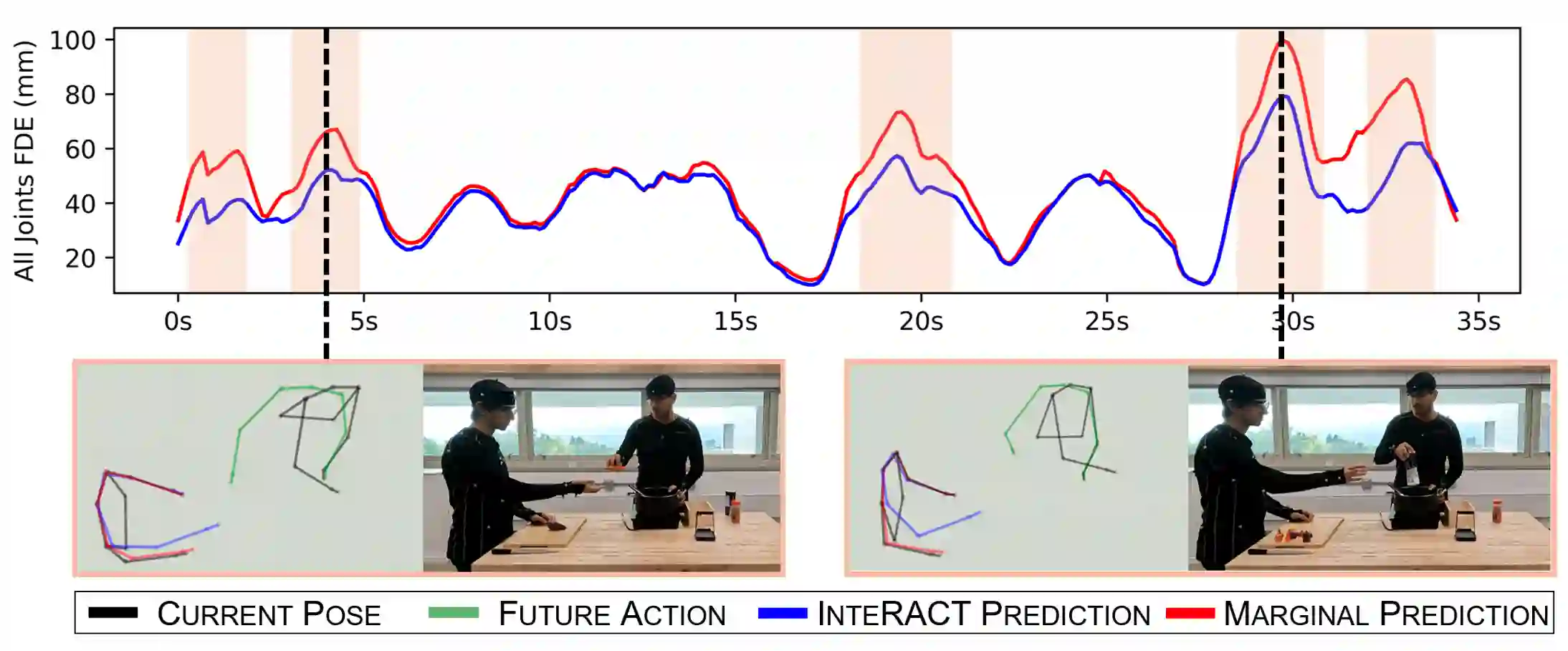
In collaborative human-robot manipulation, a robot must predict human intents and adapt its actions accordingly to smoothly execute tasks. However, the human's intent in turn depends on actions the robot takes, creating a chicken-or-egg problem. Prior methods ignore such inter-dependency and instead train marginal intent prediction models independent of robot actions. This is because training conditional models is hard given a lack of paired human-robot interaction datasets. Can we instead leverage large-scale human-human interaction data that is more easily accessible? Our key insight is to exploit a correspondence between human and robot actions that enables transfer learning from human-human to human-robot data. We propose a novel architecture, InteRACT, that pre-trains a conditional intent prediction model on large human-human datasets and fine-tunes on a small human-robot dataset. We evaluate on a set of real-world collaborative human-robot manipulation tasks and show that our conditional model improves over various marginal baselines. We also introduce new techniques to tele-operate a 7-DoF robot arm and collect a diverse range of human-robot collaborative manipulation data, which we open-source.
翻译:在人机协作操作中,机器人必须预测人类意图并根据意图调整自身动作以流畅执行任务。然而,人类的意图又取决于机器人采取的动作,这形成了"鸡与蛋"的难题。现有方法忽略这种相互依赖关系,转而训练与机器人动作无关的边际意图预测模型。这种条件模型的训练困难源于缺乏配对的人机交互数据集。我们能否转而利用更易获取的大规模人人交互数据?核心洞见在于发掘人类与机器人动作之间的对应关系,从而将学习从人人交互数据迁移至人机交互数据。我们提出新颖架构InteRACT,该架构在大型人人数据集上预训练条件意图预测模型,并在小型人机数据集上进行微调。通过一系列真实世界的人机协作操作任务评估,我们的条件模型相比各类边际基线模型展现出显著优势。此外,我们引入新技术实现七自由度机器人臂的遥操作,并采集了多样化的真实人机协作操作数据(已开源)。




相关内容




 微信扫码咨询专知VIP会员