

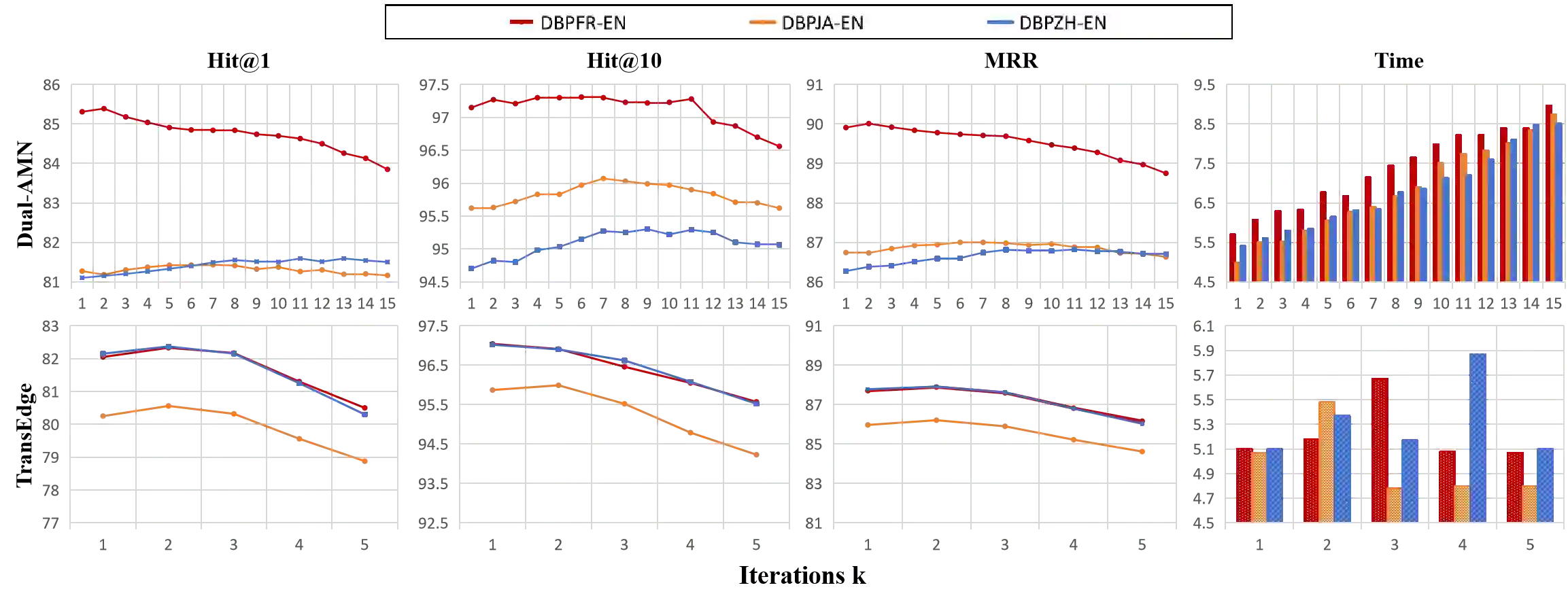
Entity alignment (EA), a pivotal process in integrating multi-source Knowledge Graphs (KGs), seeks to identify equivalent entity pairs across these graphs. Most existing approaches regard EA as a graph representation learning task, concentrating on enhancing graph encoders. However, the decoding process in EA - essential for effective operation and alignment accuracy - has received limited attention and remains tailored to specific datasets and model architectures, necessitating both entity and additional explicit relation embeddings. This specificity limits its applicability, particularly in GNN-based models. To address this gap, we introduce a novel, generalized, and efficient decoding approach for EA, relying solely on entity embeddings. Our method optimizes the decoding process by minimizing Dirichlet energy, leading to the gradient flow within the graph, to maximize graph homophily. The discretization of the gradient flow produces a fast and scalable approach, termed Triple Feature Propagation (TFP). TFP innovatively generalizes adjacency matrices to multi-views matrices:entity-to-entity, entity-to-relation, relation-to-entity, and relation-to-triple. The gradient flow through generalized matrices enables TFP to harness the multi-view structural information of KGs. Rigorous experimentation on diverse public datasets demonstrates that our approach significantly enhances various EA methods. Notably, the approach achieves these advancements with less than 6 seconds of additional computational time, establishing a new benchmark in efficiency and adaptability for future EA methods.
翻译:实体对齐(EA)是整合多源知识图谱(KG)的关键过程,旨在跨图谱识别等价实体对。现有方法大多将EA视为图表示学习任务,侧重于增强图编码器。然而,EA中的解码过程——对有效操作和对齐精度至关重要——却鲜受关注,且通常针对特定数据集和模型架构进行定制,需同时使用实体嵌入和额外的显式关系嵌入。这种特异性限制了其适用性,尤其在基于GNN的模型中。为解决此问题,我们提出一种新颖、通用且高效的EA解码方法,其仅依赖于实体嵌入。该方法通过最小化狄利克雷能量(即图上的梯度流)来优化解码过程,从而最大化图同质性。对梯度流进行离散化产生了一种快速且可扩展的方法,称为三重特征传播(TFP)。TFP创新性地将邻接矩阵推广至多视图矩阵:实体-实体、实体-关系、关系-实体和关系-三元组。通过广义矩阵上的梯度流,TFP能够利用KG的多视图结构信息。在多个公开数据集上的严格实验表明,我们的方法显著提升了多种EA方法的性能。值得注意的是,该方法仅需不到6秒的额外计算时间即可实现这些改进,为未来EA方法的效率与适应性设立了新基准。




相关内容




 微信扫码咨询专知VIP会员