

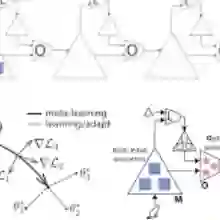
Breaking safety constraints in control systems can lead to potential risks, resulting in unexpected costs or catastrophic damage. Nevertheless, uncertainty is ubiquitous, even among similar tasks. In this paper, we develop a novel adaptive safe control framework that integrates meta learning, Bayesian models, and control barrier function (CBF) method. Specifically, with the help of CBF method, we learn the inherent and external uncertainties by a unified adaptive Bayesian linear regression (ABLR) model, which consists of a forward neural network (NN) and a Bayesian output layer. Meta learning techniques are leveraged to pre-train the NN weights and priors of the ABLR model using data collected from historical similar tasks. For a new control task, we refine the meta-learned models using a few samples, and introduce pessimistic confidence bounds into CBF constraints to ensure safe control. Moreover, we provide theoretical criteria to guarantee probabilistic safety during the control processes. To validate our approach, we conduct comparative experiments in various obstacle avoidance scenarios. The results demonstrate that our algorithm significantly improves the Bayesian model-based CBF method, and is capable for efficient safe exploration even with multiple uncertain constraints.
翻译:突破控制系统的安全约束可能导致潜在风险,引发意外成本或灾难性破坏。然而,不确定性普遍存在,即使在相似任务中也是如此。本文提出一种新颖的自适应安全控制框架,融合了元学习、贝叶斯模型和控制障碍函数(CBF)方法。具体而言,借助CBF方法,我们通过统一的贝叶斯自适应线性回归(ABLR)模型学习固有不确定性和外部不确定性,该模型由前馈神经网络(NN)和贝叶斯输出层构成。利用历史相似任务中收集的数据,采用元学习技术对ABLR模型的神经网络权重和先验进行预训练。对于新的控制任务,我们使用少量样本微调元学习模型,并在CBF约束中引入悲观置信界以确保安全控制。此外,我们提供了理论准则来保证控制过程中的概率安全性。为验证所提方法,我们在多种避障场景中开展了对比实验。结果表明,我们的算法显著改进了基于贝叶斯模型的CBF方法,即使面对多重不确定约束也能实现高效的安全探索。




相关内容




 微信扫码咨询专知VIP会员