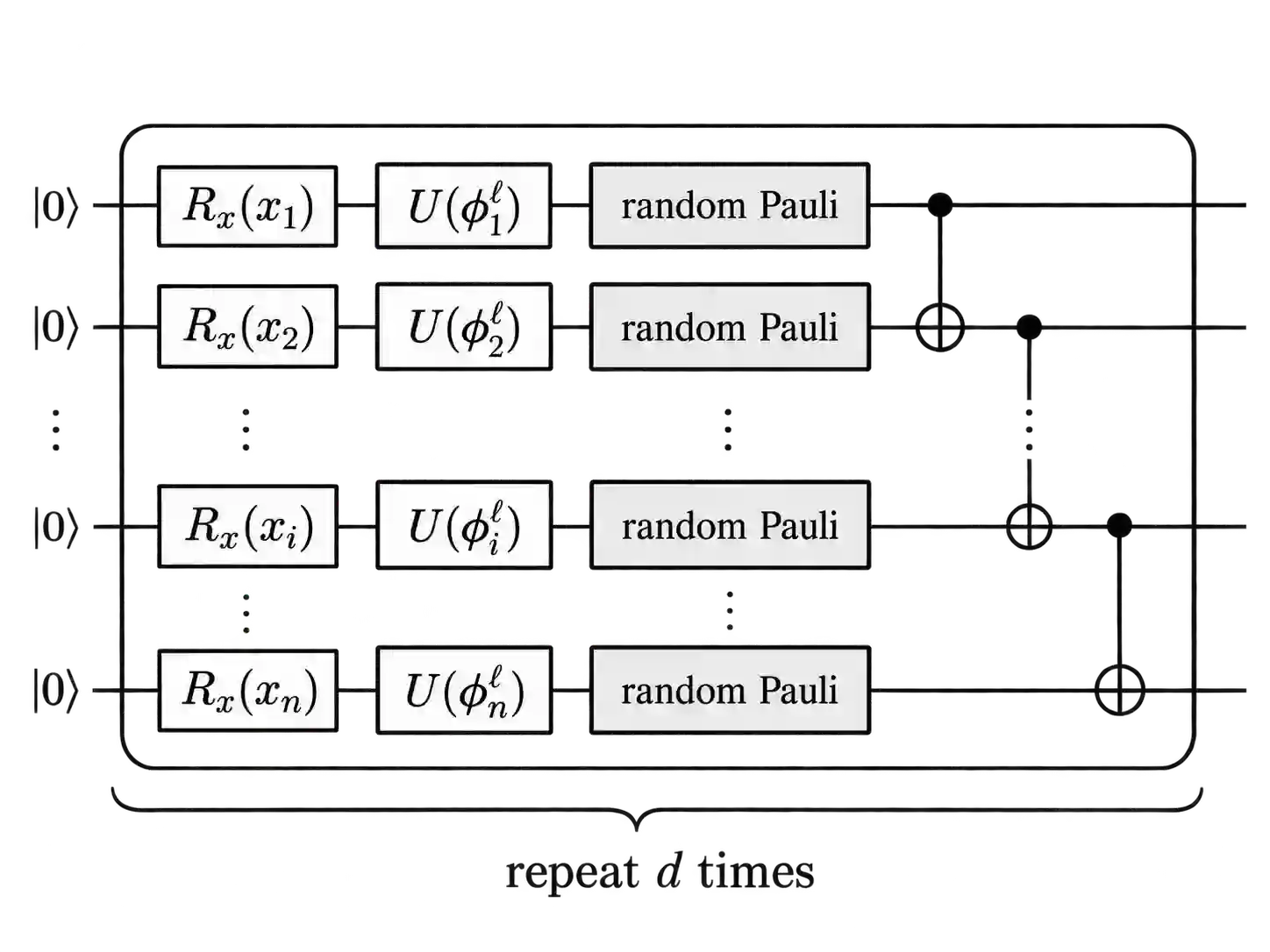
Quantum error mitigation (QEM) can recover information about ideal quantum computations from noisy circuit executions, but may require a large sampling overhead. Fundamental lower bounds show that recovering noiseless observables without problem-specific information can require superpolynomially many samples, with exponential overhead for broad classes of noisy circuits. However, problem-specific information can reduce the number of samples needed to obtain the required answer. We investigate this possibility in supervised quantum machine learning, where labeled examples provide information about the function to be learned. Binary classification provides such a setting, since correct prediction depends on the sign and margin of the classifier output rather than on accurate reconstruction of every noiseless expectation value. We develop a theoretical and empirical framework for comparing boosting of noisy parameterized quantum circuits with probabilistic error cancellation (PEC), requiring both methods to reach the same learning target. For the specified circuit architectures under Pauli noise, we establish a common hypothesis-class complexity bound: matching empirical margin loss gives the same upper bound on expected classification risk. We derive resource criteria and evaluate AdaBoostR and Real AdaBoost in finite-shot teacher-student simulations across circuit depth and physical noise strength. Under the same classification-accuracy target, boosting requires fewer circuit executions as depth and noise increase. Boosting also achieves higher test accuracy than the corresponding reference. For the supervised-learning problems studied, these results demonstrate a task-dependent resource advantage: exploiting information retained in noisy outputs can avoid the cost of ideal-output reconstruction without sacrificing observed classification performance.


翻译:暂无翻译
0
下载
关闭预览

相关内容

量子增强计算机视觉:超越经典算法
专知会员服务
24+阅读 · 2025年10月9日
Stabilizing Transformers for Reinforcement Learning
专知会员服务
61+阅读 · 2019年10月17日
Hierarchically Structured Meta-learning
CreateAMind
27+阅读 · 2019年5月22日
Transferring Knowledge across Learning Processes
CreateAMind
29+阅读 · 2019年5月18日
Unsupervised Learning via Meta-Learning
CreateAMind
44+阅读 · 2019年1月3日
A Technical Overview of AI & ML in 2018 & Trends for 2019
待字闺中
18+阅读 · 2018年12月24日
Hierarchical Imitation - Reinforcement Learning
CreateAMind
19+阅读 · 2018年5月25日
腾讯:机器学习构建通用的数据异常检测平台
全球人工智能
11+阅读 · 2018年5月1日
Andrew NG的新书《Machine Learning Yearning》
我爱机器学习
11+阅读 · 2016年12月7日
国家自然科学基金
0+阅读 · 2017年12月31日
国家自然科学基金
1+阅读 · 2015年12月31日
国家自然科学基金
0+阅读 · 2015年12月31日
国家自然科学基金
2+阅读 · 2015年12月31日
国家自然科学基金
3+阅读 · 2015年12月31日
国家自然科学基金
0+阅读 · 2015年12月31日
国家自然科学基金
2+阅读 · 2015年12月31日
国家自然科学基金
0+阅读 · 2015年12月31日
国家自然科学基金
0+阅读 · 2015年12月31日
国家自然科学基金
0+阅读 · 2014年12月31日
VIP会员
最新内容
北约400亿美元反无人机能力投资建设
专知会员服务
2+阅读 · 今天15:19
反小型无人机系统方案评估(27页)
专知会员服务
3+阅读 · 今天15:12
乌克兰无人机饱和战场中的错误教训
专知会员服务
18+阅读 · 11月17日
面向最后一战术英里:美军无人机创新尝试
专知会员服务
14+阅读 · 11月17日
《美空军2026条令文件:对海压制作战》
专知会员服务
31+阅读 · 11月9日
人工智能与战争的未来
专知会员服务
14+阅读 · 11月8日
《Agent Mosaic:识别智能体LLM系统中的机密泄露》
专知会员服务
14+阅读 · 11月8日
相关资讯
Hierarchically Structured Meta-learning
CreateAMind
27+阅读 · 2019年5月22日
Transferring Knowledge across Learning Processes
CreateAMind
29+阅读 · 2019年5月18日
Unsupervised Learning via Meta-Learning
CreateAMind
44+阅读 · 2019年1月3日
A Technical Overview of AI & ML in 2018 & Trends for 2019
待字闺中
18+阅读 · 2018年12月24日
Hierarchical Imitation - Reinforcement Learning
CreateAMind
19+阅读 · 2018年5月25日
腾讯:机器学习构建通用的数据异常检测平台
全球人工智能
11+阅读 · 2018年5月1日
Andrew NG的新书《Machine Learning Yearning》
我爱机器学习
11+阅读 · 2016年12月7日
相关基金
国家自然科学基金
0+阅读 · 2017年12月31日
国家自然科学基金
1+阅读 · 2015年12月31日
国家自然科学基金
0+阅读 · 2015年12月31日
国家自然科学基金
2+阅读 · 2015年12月31日
国家自然科学基金
3+阅读 · 2015年12月31日
国家自然科学基金
0+阅读 · 2015年12月31日
国家自然科学基金
2+阅读 · 2015年12月31日
国家自然科学基金
0+阅读 · 2015年12月31日
国家自然科学基金
0+阅读 · 2015年12月31日
国家自然科学基金
0+阅读 · 2014年12月31日
Top
微信扫码咨询专知VIP会员