

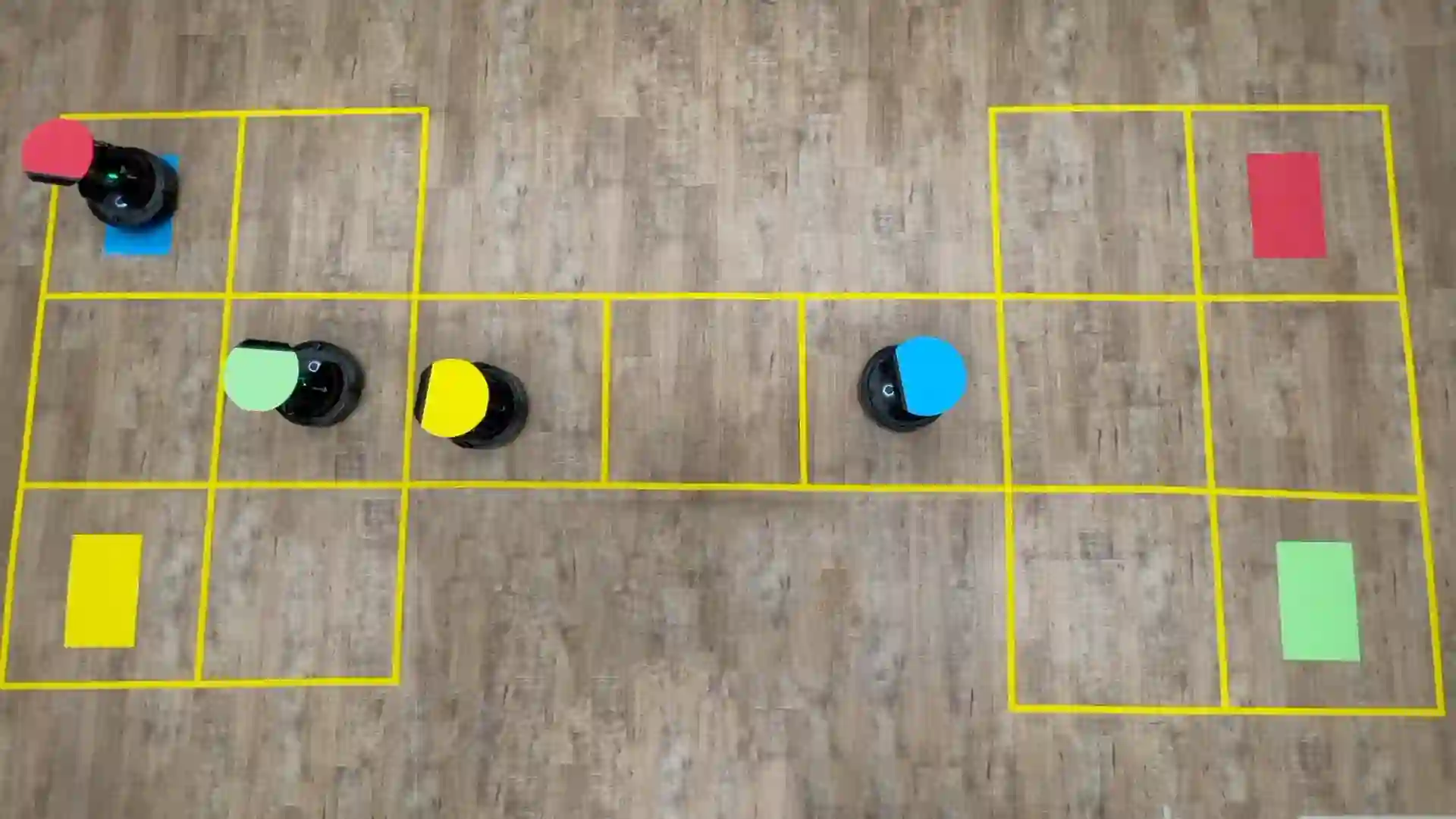
Relational networks within a team play a critical role in the performance of many real-world multi-robot systems. To successfully accomplish tasks that require cooperation and coordination, different agents (e.g., robots) necessitate different priorities based on their positioning within the team. Yet, many of the existing multi-robot cooperation algorithms regard agents as interchangeable and lack a mechanism to guide the type of cooperation strategy the agents should exhibit. To account for the team structure in cooperative tasks, we propose a novel algorithm that uses a relational network comprising inter-agent relationships to prioritize certain agents over others. Through appropriate design of the team's relational network, we can guide the cooperation strategy, resulting in the emergence of new behaviors that accomplish the specified task. We conducted six experiments in a multi-robot setting with a cooperative task. Our results demonstrate that the proposed method can effectively influence the type of solution that the algorithm converges to by specifying the relationships between the agents, making it a promising approach for tasks that require cooperation among agents with a specified team structure.
翻译:团队中的关系网络在许多现实多机器人系统的性能中扮演着关键角色。为成功完成需要合作与协调的任务,不同智能体(如机器人)需根据其在团队中的位置具有不同优先级。然而,现有许多多机器人协作算法将智能体视为可互换的,缺乏引导智能体应展现的协作策略类型的机制。为在协作任务中考虑团队结构,我们提出一种新算法,该算法使用包含智能体间关系的关系网络,赋予某些智能体更高优先级。通过适当设计团队的关系网络,我们能够引导协作策略,从而涌现出完成特定任务的新行为。我们在多机器人场景中针对一项协作任务进行了六项实验。结果表明,所提方法可通过指定智能体间关系有效影响算法收敛到的解的类型,使其成为需要具有特定团队结构的智能体间协作任务的一种有前景的方法。




相关内容



 微信扫码咨询专知VIP会员