

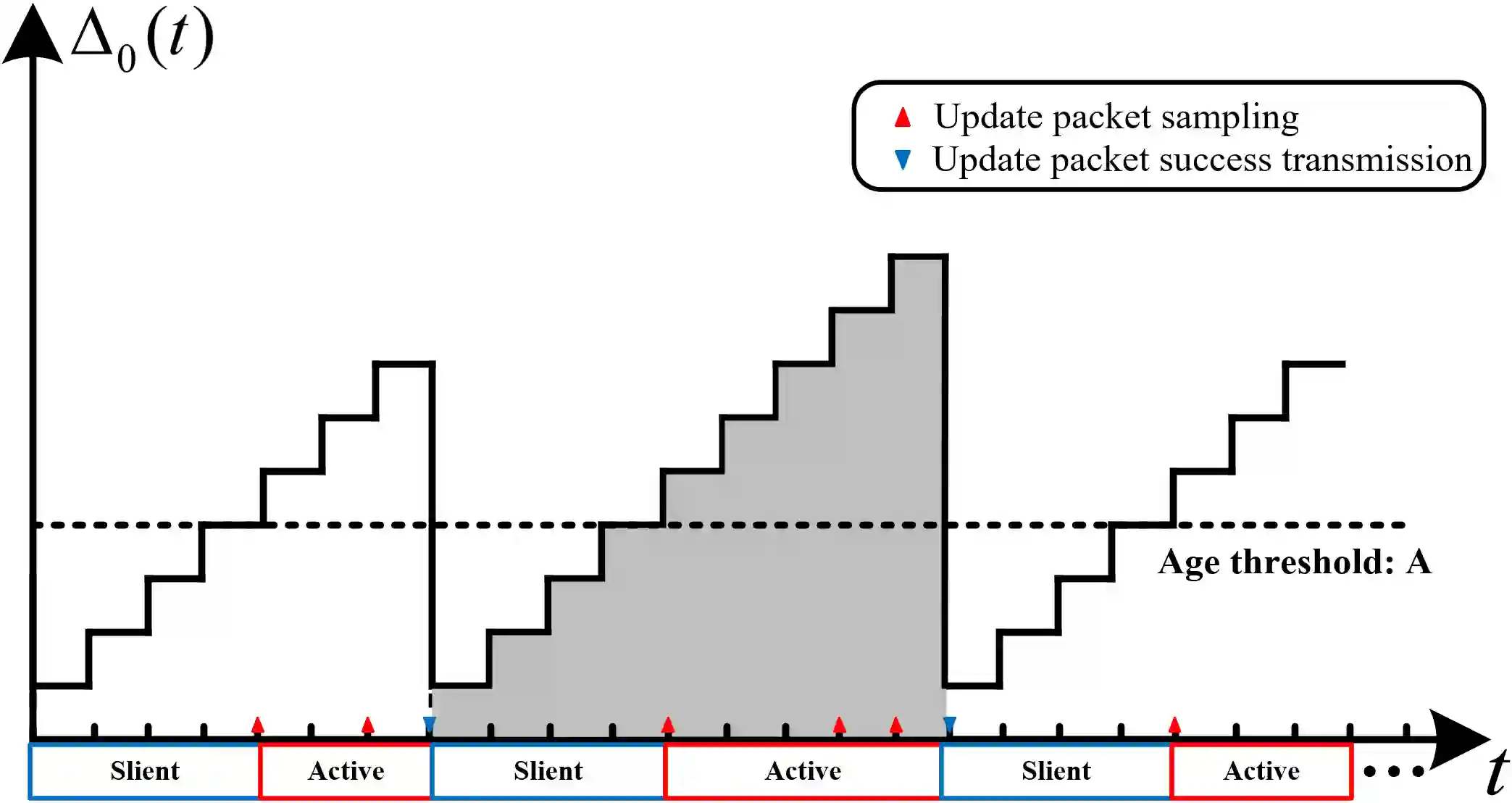
We optimize the Age of Information (AoI) in mobile networks using the age-threshold slotted ALOHA (TSA) protocol. The network comprises multiple source-destination pairs, where each source sends a sequence of status update packets to its destination over a shared spectrum. The TSA protocol stipulates that a source node must remain silent until its AoI reaches a predefined threshold, after which the node accesses the radio channel with a certain probability. Using stochastic geometry tools, we derive analytical expressions for the transmission success probability, mean peak AoI, and time-average AoI. Subsequently, we obtain closed-form expressions for the optimal update rate and age threshold that minimize the mean peak and time-average AoI, respectively. In addition, we establish a scaling law for the mean peak AoI and time-average AoI in mobile networks, revealing that the optimal mean peak AoI and time-average AoI increase linearly with the deployment density. Notably, the growth rate of time-average AoI under TSA is half of that under conventional slotted ALOHA. When considering the optimal mean peak AoI, the TSA protocol exhibits comparable performance to the traditional slotted ALOHA protocol. These findings conclusively affirm the advantage of TSA in reducing higher-order AoI, particularly in densely deployed networks.
翻译:我们采用年龄阈值时隙ALOHA(TSA)协议优化移动网络中的信息年龄(AoI)。该网络包含多个源-目的地对,每个源节点通过共享频谱向目标节点发送一系列状态更新数据包。TSA协议规定:源节点在其AoI达到预设阈值前必须保持静默,之后节点以特定概率接入无线信道。借助随机几何工具,我们推导出传输成功概率、平均峰值AoI及时间平均AoI的解析表达式。进一步地,我们分别得到了最小化平均峰值AoI和时间平均AoI的最优更新率与年龄阈值的闭式解。此外,我们建立了移动网络中平均峰值AoI与时间平均AoI的标度律,揭示出最优平均峰值AoI与时间平均AoI随部署密度线性增长。值得注意的是,TSA协议下时间平均AoI的增长率仅为传统时隙ALOHA协议的一半。在考虑最优平均峰值AoI时,TSA协议展现出与传统时隙ALOHA协议相当的性能。这些结论明确证实了TSA在降低高阶AoI方面的优势,尤其在密集部署网络中表现突出。




相关内容



 微信扫码咨询专知VIP会员