

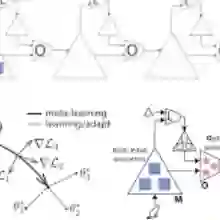
Reconfigurable intelligent surfaces (RISs) have become a promising technology to meet the requirements of energy efficiency and scalability in future six-generation (6G) communications. However, a significant challenge in RISs-aided communications is the joint optimization of active and passive beamforming at base stations (BSs) and RISs respectively. Specifically, the main difficulty is attributed to the highly non-convex optimization space of beamforming matrices at both BSs and RISs, as well as the diversity and mobility of communication scenarios. To address this, we present a greenly gradient based meta learning beamforming (GMLB) approach. Unlike traditional deep learning based methods which take channel information directly as input, GMLB feeds the gradient of sum rate into neural networks. Coherently, we design a differential regulator to address the phase shift optimization of RISs. Moreover, we use the meta learning to iteratively optimize the beamforming matrices of BSs and RISs. These techniques make the proposed method to work well without requiring energy-consuming pre-training. Simulations show that GMLB could achieve higher sum rate than that of typical alternating optimization algorithms with the energy consumption by two orders of magnitude less.
翻译:可重构智能表面(RISs)已成为满足未来第六代(6G)通信中能效与可扩展性需求的一项有前景的技术。然而,在RIS辅助通信中,一个重大挑战是基站(BS)与RIS分别对应的主动与被动波束赋形的联合优化。具体而言,主要困难源于基站与RIS处波束赋形矩阵的高度非凸优化空间,以及通信场景的多样性与移动性。为解决此问题,我们提出了一种绿色梯度基元学习波束赋形(GMLB)方法。与直接将信道信息作为输入的传统深度学习类方法不同,GMLB将和速率的梯度馈入神经网络。相应地,我们设计了一种差分调节器来处理RIS的相移优化问题。此外,我们利用元学习对基站与RIS的波束赋形矩阵进行迭代优化。这些技术使得所提方法能够在无需耗能预训练的情况下良好运行。仿真结果表明,GMLB能够实现比典型交替优化算法更高的和速率,同时能耗降低两个数量级。




相关内容




 微信扫码咨询专知VIP会员