

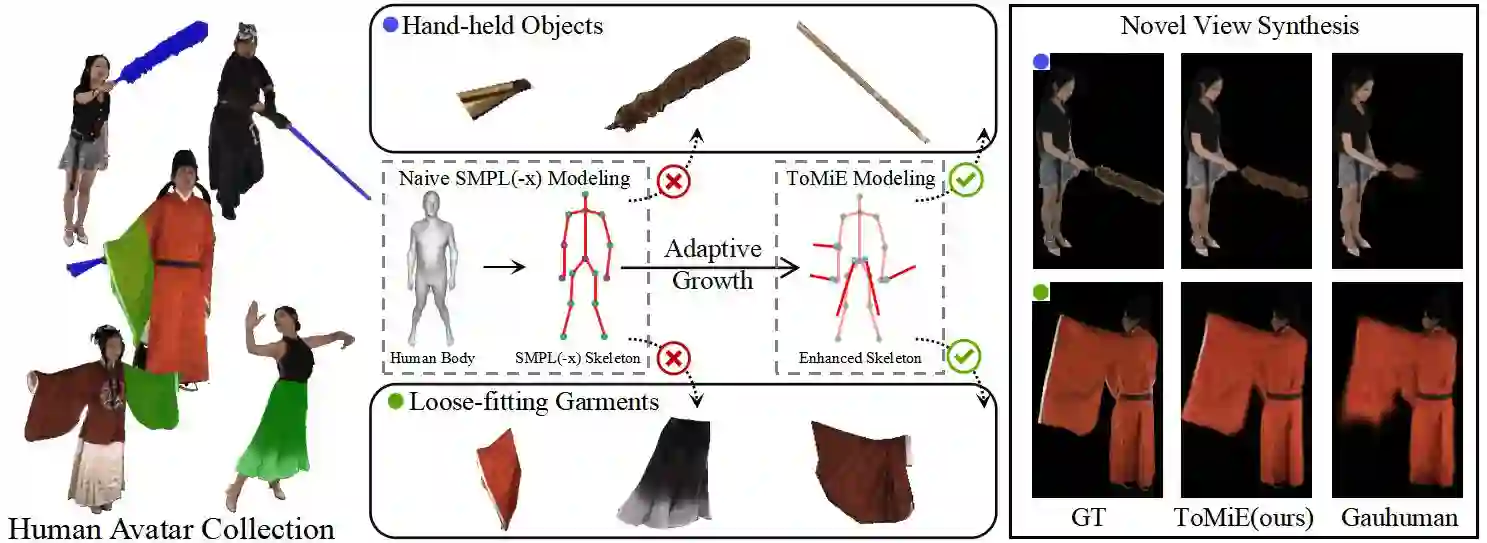
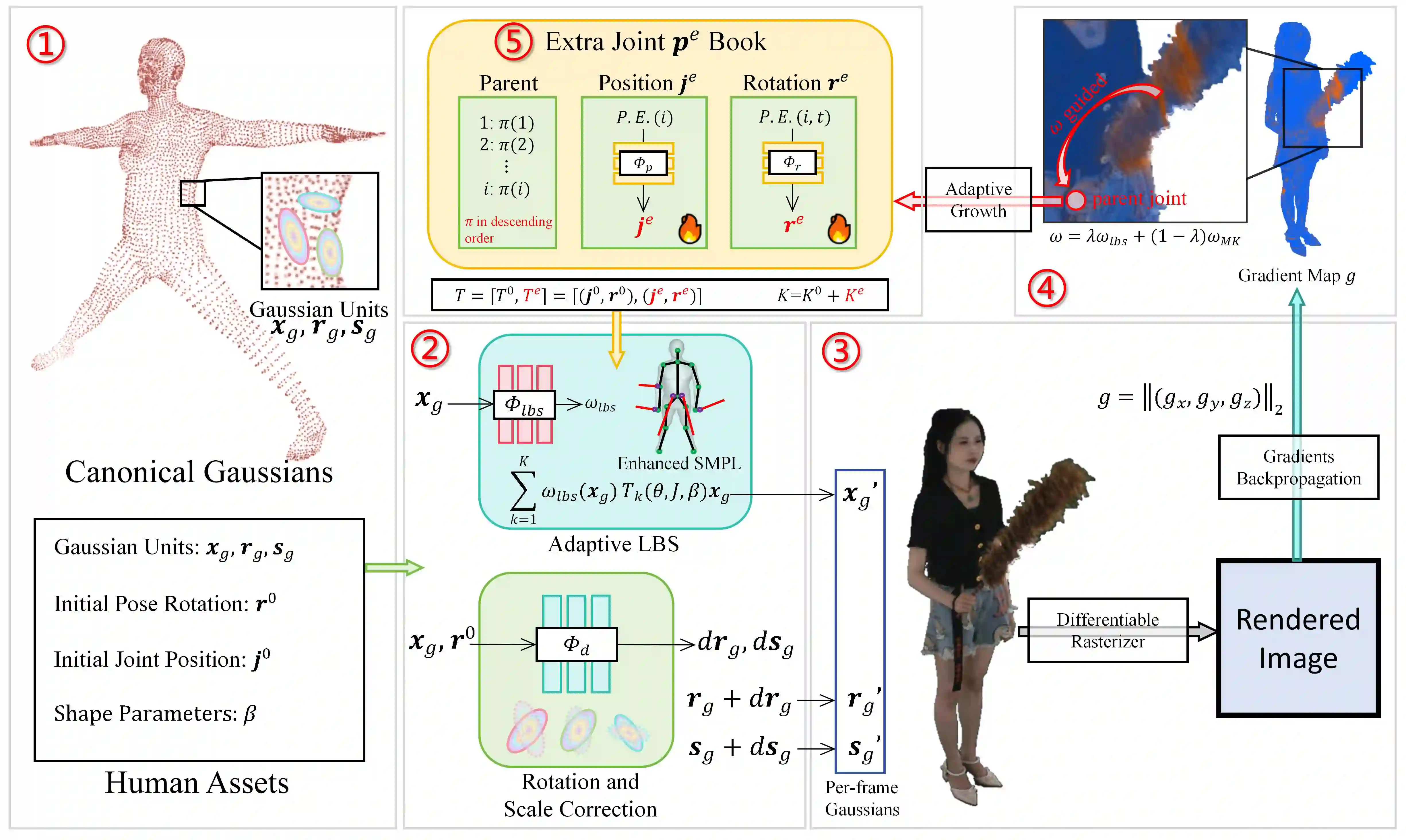
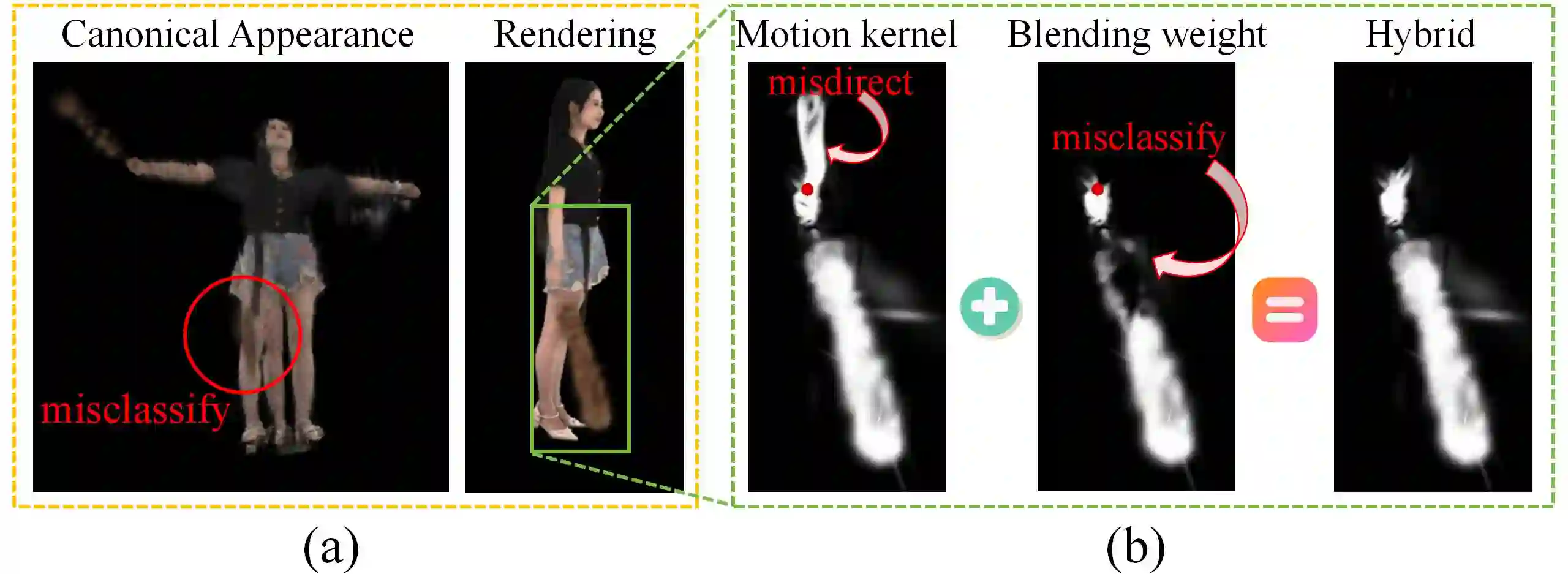
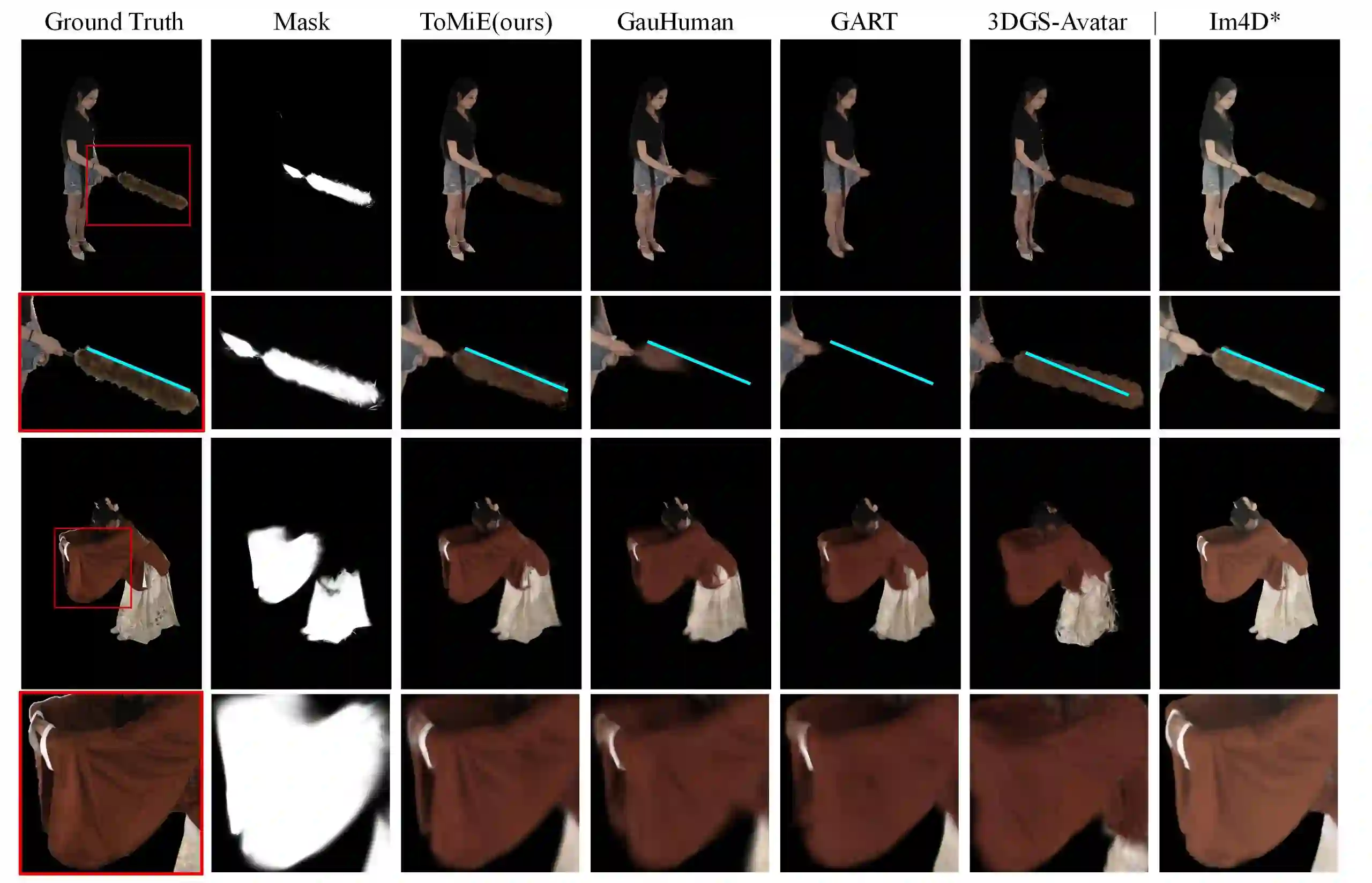
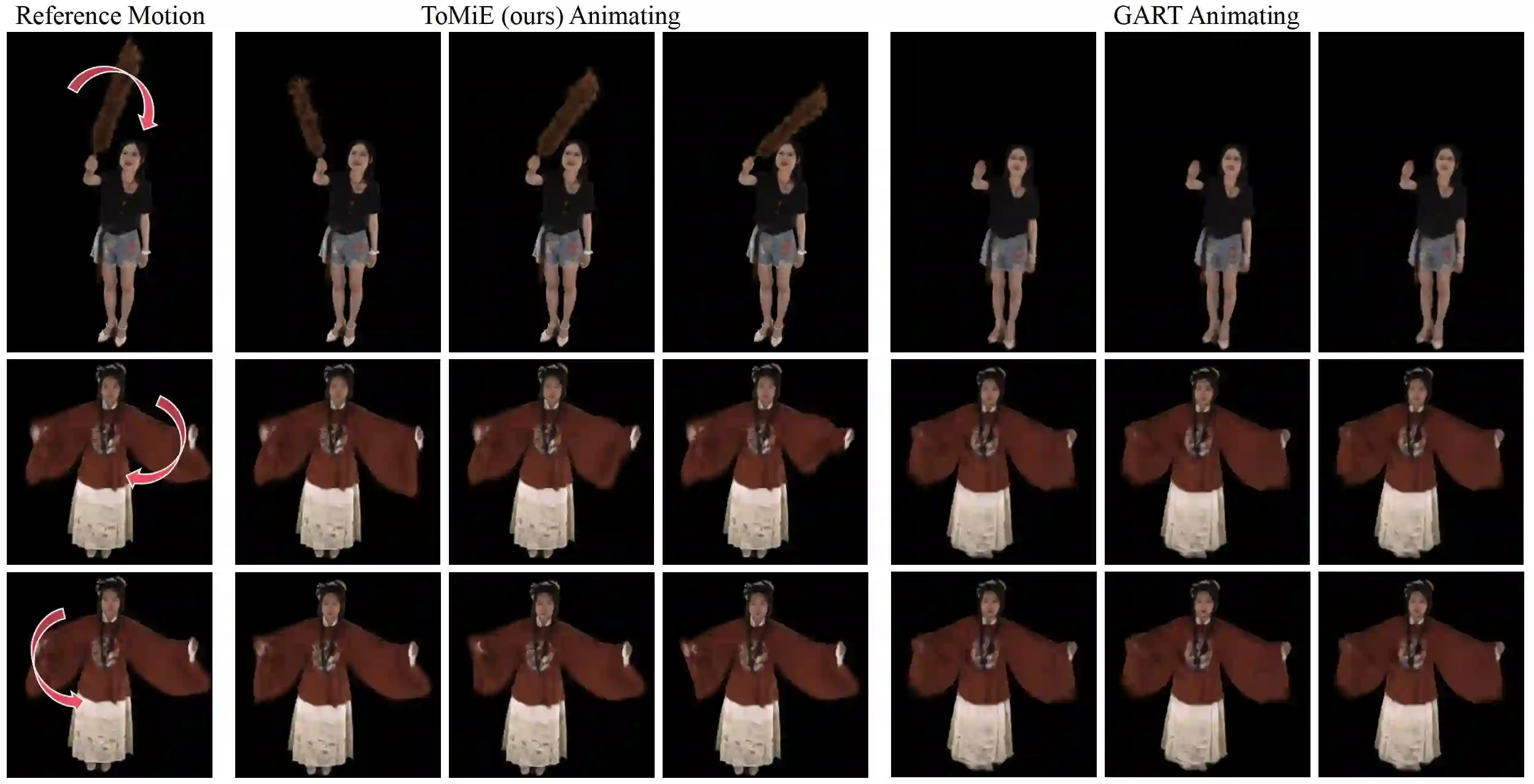
In this paper, we highlight a critical yet often overlooked factor in most 3D human tasks, namely modeling humans with complex garments. It is known that the parameterized formulation of SMPL is able to fit human skin; while complex garments, e.g., hand-held objects and loose-fitting garments, are difficult to get modeled within the unified framework, since their movements are usually decoupled with the human body. To enhance the capability of SMPL skeleton in response to this situation, we propose a modular growth strategy that enables the joint tree of the skeleton to expand adaptively. Specifically, our method, called ToMiE, consists of parent joints localization and external joints optimization. For parent joints localization, we employ a gradient-based approach guided by both LBS blending weights and motion kernels. Once the external joints are obtained, we proceed to optimize their transformations in SE(3) across different frames, enabling rendering and explicit animation. ToMiE manages to outperform other methods across various cases with garments, not only in rendering quality but also by offering free animation of grown joints, thereby enhancing the expressive ability of SMPL skeleton for a broader range of applications.
翻译:本文聚焦于当前多数三维人体任务中一个关键却常被忽视的因素,即复杂服装的人体建模。已知SMPL的参数化表达能够拟合人体皮肤;而复杂服装(如手持物体与宽松衣物)因其运动通常与人体解耦,难以在统一框架内建模。为增强SMPL骨架应对此类场景的能力,我们提出一种模块化生长策略,使骨架关节树能够自适应扩展。具体而言,我们提出的ToMiE方法包含父关节定位与外部关节优化两个模块。在父关节定位阶段,我们采用基于线性混合蒙皮权重与运动核双重引导的梯度优化方法。获得外部关节后,我们进一步在SE(3)空间中优化其跨帧变换,实现渲染与显式动画控制。实验表明,ToMiE在多种服装场景下均优于现有方法,不仅在渲染质量上表现优异,还能对生长关节进行自由动画控制,从而显著拓展了SMPL骨架在更广泛应用中的表达能力。




相关内容





 微信扫码咨询专知VIP会员