

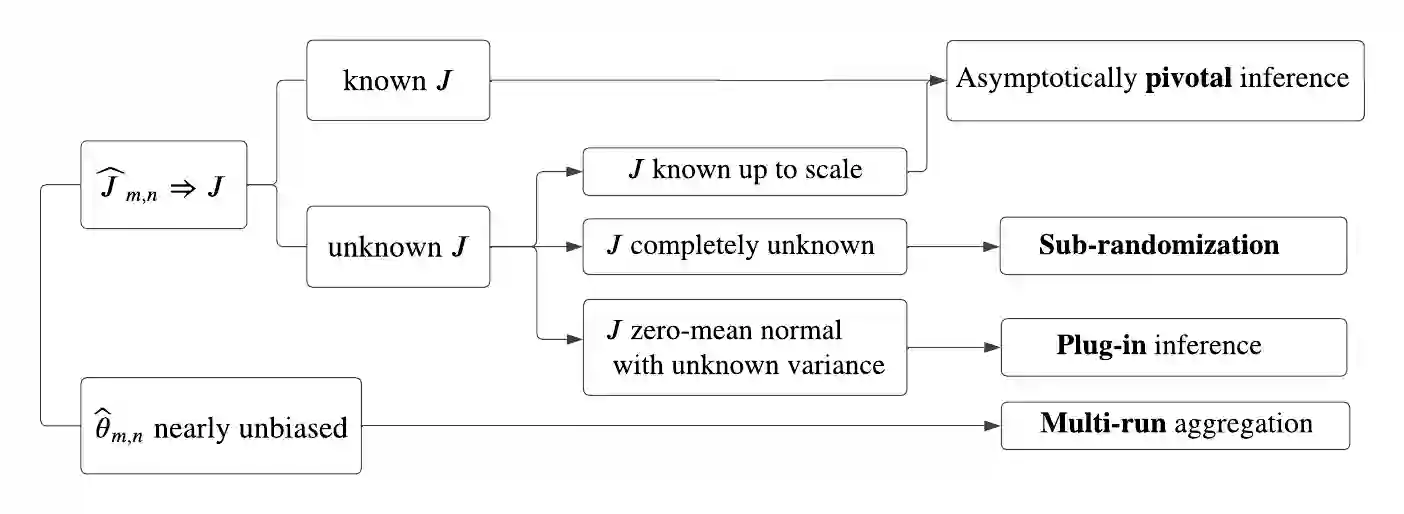
Randomized algorithms, such as randomized sketching or projections, are a promising approach to ease the computational burden in analyzing large datasets. However, randomized algorithms also produce non-deterministic outputs, leading to the problem of evaluating their accuracy. In this paper, we develop a statistical inference framework for quantifying the uncertainty of the outputs of randomized algorithms. We develop appropriate statistical methods -- sub-randomization, multi-run plug-in and multi-run aggregation inference -- by using multiple runs of the same randomized algorithm, or by estimating the unknown parameters of the limiting distribution. As an example, we develop methods for statistical inference for least squares parameters via random sketching using matrices with i.i.d.entries, or uniform partial orthogonal matrices. For this, we characterize the limiting distribution of estimators obtained via sketch-and-solve as well as partial sketching methods. The analysis of i.i.d. sketches uses a trigonometric interpolation argument to establish a differential equation for the limiting expected characteristic function and find the dependence on the kurtosis of the entries of the sketching matrix. The results are supported via a broad range of simulations.
翻译:随机化算法(如随机素描或投影)是减轻大数据集分析计算负担的一种有前景的方法。然而,随机化算法也会产生非确定性的输出,从而导致评估其准确性的问题。本文开发了一个统计推断框架,用于量化随机化算法输出的不确定性。我们通过多次运行相同的随机化算法,或估计极限分布的未知参数,提出了适当的统计方法——子随机化、多次运行插件法和多次运行聚合推断。作为示例,我们针对最小二乘参数开发了统计推断方法,通过使用独立同分布(i.i.d.)条目矩阵或均匀部分正交矩阵的随机素描实现。为此,我们刻画了通过素描-求解法以及部分素描法获得的估计量的极限分布。独立同分布素描的分析采用三角插值论证,建立极限期望特征函数的微分方程,并揭示其对素描矩阵条目峰度的依赖性。结果通过广泛模拟得到验证。




相关内容




 微信扫码咨询专知VIP会员