

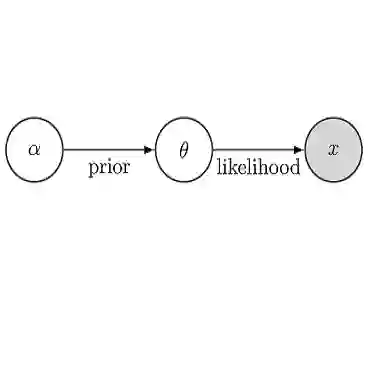
In the usual Bayesian setting, a full probabilistic model is required to link the data and parameters, and the form of this model and the inference and prediction mechanisms are specified via de Finetti's representation. In general, such a formulation is not robust to model mis-specification of its component parts. An alternative approach is to draw inference based on loss functions, where the quantity of interest is defined as a minimizer of some expected loss, and to construct posterior distributions based on the loss-based formulation; this strategy underpins the construction of the Gibbs posterior. We develop a Bayesian non-parametric approach; specifically, we generalize the Bayesian bootstrap, and specify a Dirichlet process model for the distribution of the observables. We implement this using direct prior-to-posterior calculations, but also using predictive sampling. We also study the assessment of posterior validity for non-standard Bayesian calculations, and provide an efficient way to calibrate the scaling parameter in the Gibbs posterior so that it can achieve the desired coverage rate. We show that the developed non-standard Bayesian updating procedures yield valid posterior distributions in terms of consistency and asymptotic normality under model mis-specification. Simulation studies show that the proposed methods can recover the true value of the parameter efficiently and achieve frequentist coverage even when the sample size is small. Finally, we apply our methods to evaluate the causal impact of speed cameras on traffic collisions in England.
翻译:在标准贝叶斯框架中,需要完整的概率模型来连接数据与参数,该模型的形式以及推断与预测机制通过德菲内蒂表示法加以规定。通常,这种公式对其组成部分的模型误设定缺乏稳健性。另一种替代方法是基于损失函数进行推断,将目标量定义为某个期望损失的最小值,并基于损失函数的公式构建后验分布——这一策略支撑了吉布斯后验的构建。我们发展了一种贝叶斯非参数方法:具体而言,我们推广了贝叶斯自助法,并为可观测数据的分布指定了狄利克雷过程模型。我们通过直接先验到后验计算以及预测抽样方法实现该过程。同时,我们研究了非标准贝叶斯计算的后验有效性评估问题,并提供了一种高效的方法来校准吉布斯后验中的尺度参数,使其能够达到期望的覆盖率。研究表明,所发展的非标准贝叶斯更新程序在模型误设定条件下,能够基于一致性和渐近正态性产生有效的后验分布。模拟实验显示,即使样本量较小,所提方法也能有效恢复参数真值并实现频率学派覆盖率。最后,我们将该方法应用于评估英国测速摄像头对交通事故的因果影响。




相关内容




 微信扫码咨询专知VIP会员