

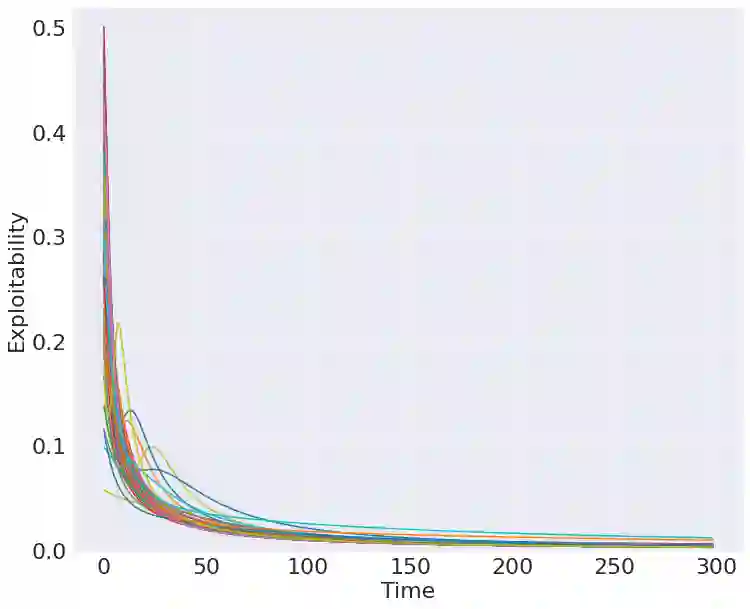
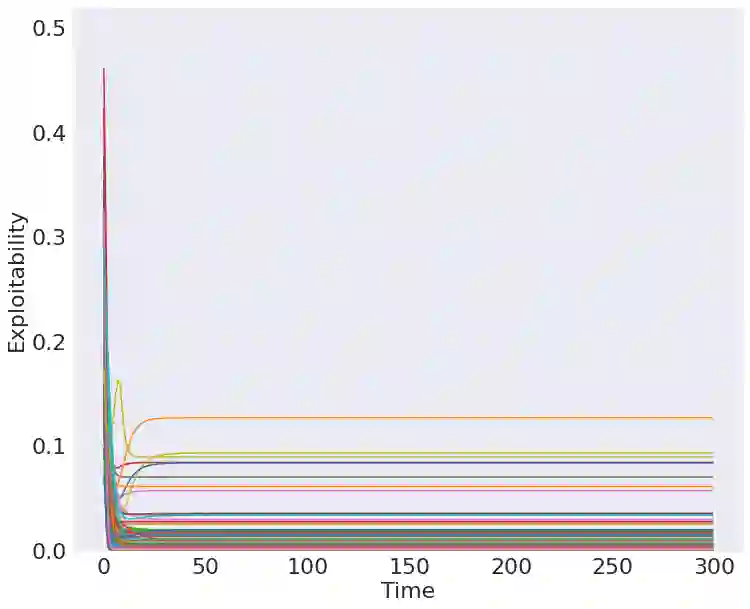
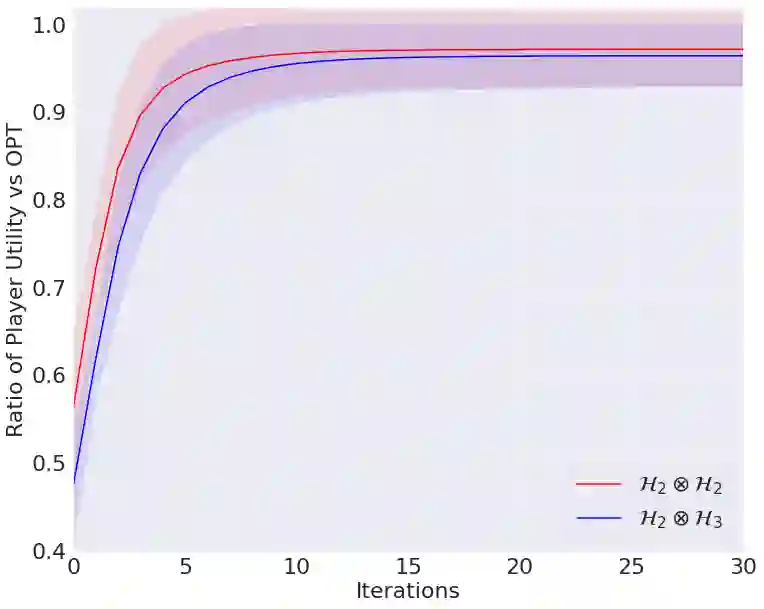
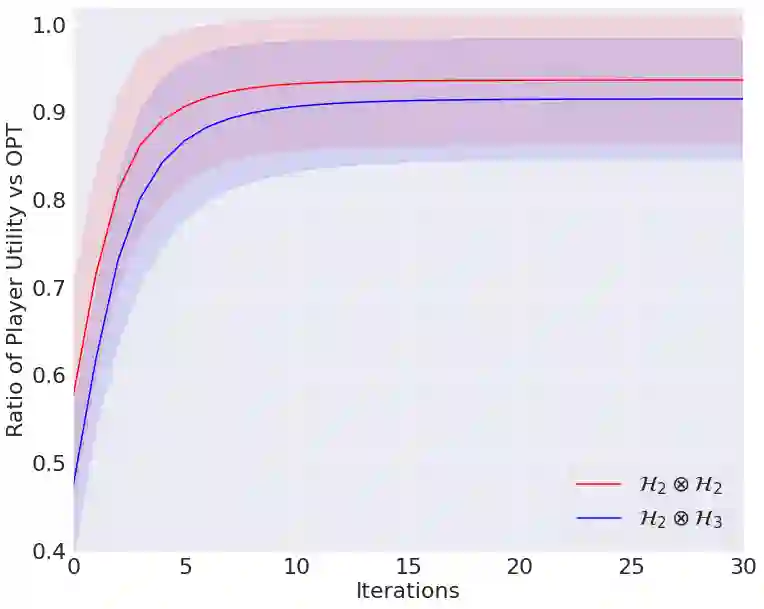
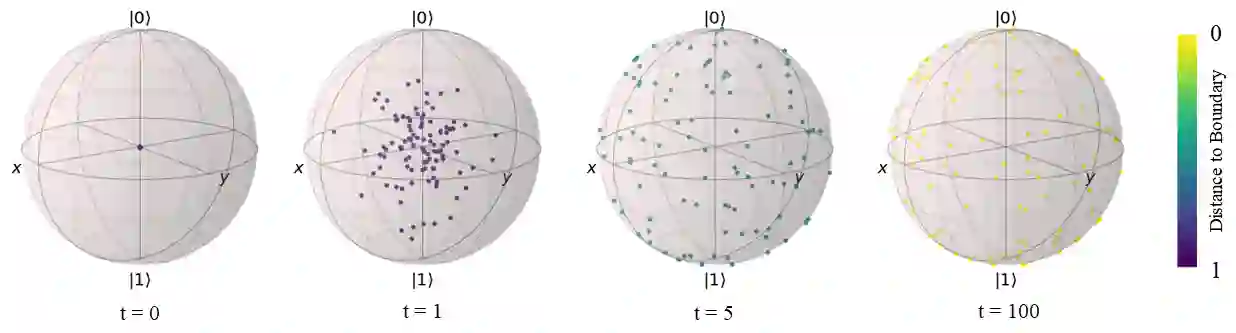
Learning in games has emerged as a powerful tool for Machine Learning with numerous applications. Several recent works have studied quantum zero-sum games, an extension of classical games where players have access to quantum resources, from a learning perspective. Going beyond the competitive regime, this work introduces quantum potential games as well as learning algorithms for this class of games. We introduce non-commutative extensions of the continuous-time replicator dynamics and the discrete-time Baum-Eagon/linear multiplicative weights update and study their convergence properties. Finally, we establish connections between quantum potential games and quantum separability, allowing us to reinterpret our learning dynamics as algorithms for the Best Separable State problem. We validate our theoretical findings through extensive experiments.
翻译:博弈学习已成为机器学习中一个强大的工具,具有众多应用。近来多项研究从学习视角探讨了量子零和博弈——该类博弈是经典博弈的推广,其中玩家可获取量子资源。超越竞争性框架,本工作引入量子势博弈及其学习算法。我们提出了连续时间复制子动力学与离散时间Baum-Eagon/线性乘法权重更新的非交换推广,并研究了它们的收敛性质。最后,我们在量子势博弈与量子可分离性之间建立了联系,从而可将我们的学习动力学重新解释为最佳可分离态问题的算法。通过大量实验验证了我们的理论发现。




相关内容

- Today (iOS and OS X): widgets for the Today view of Notification Center
- Share (iOS and OS X): post content to web services or share content with others
- Actions (iOS and OS X): app extensions to view or manipulate inside another app
- Photo Editing (iOS): edit a photo or video in Apple's Photos app with extensions from a third-party apps
- Finder Sync (OS X): remote file storage in the Finder with support for Finder content annotation
- Storage Provider (iOS): an interface between files inside an app and other apps on a user's device
- Custom Keyboard (iOS): system-wide alternative keyboards
Source: iOS 8 Extensions: Apple’s Plan for a Powerful App Ecosystem


 微信扫码咨询专知VIP会员