

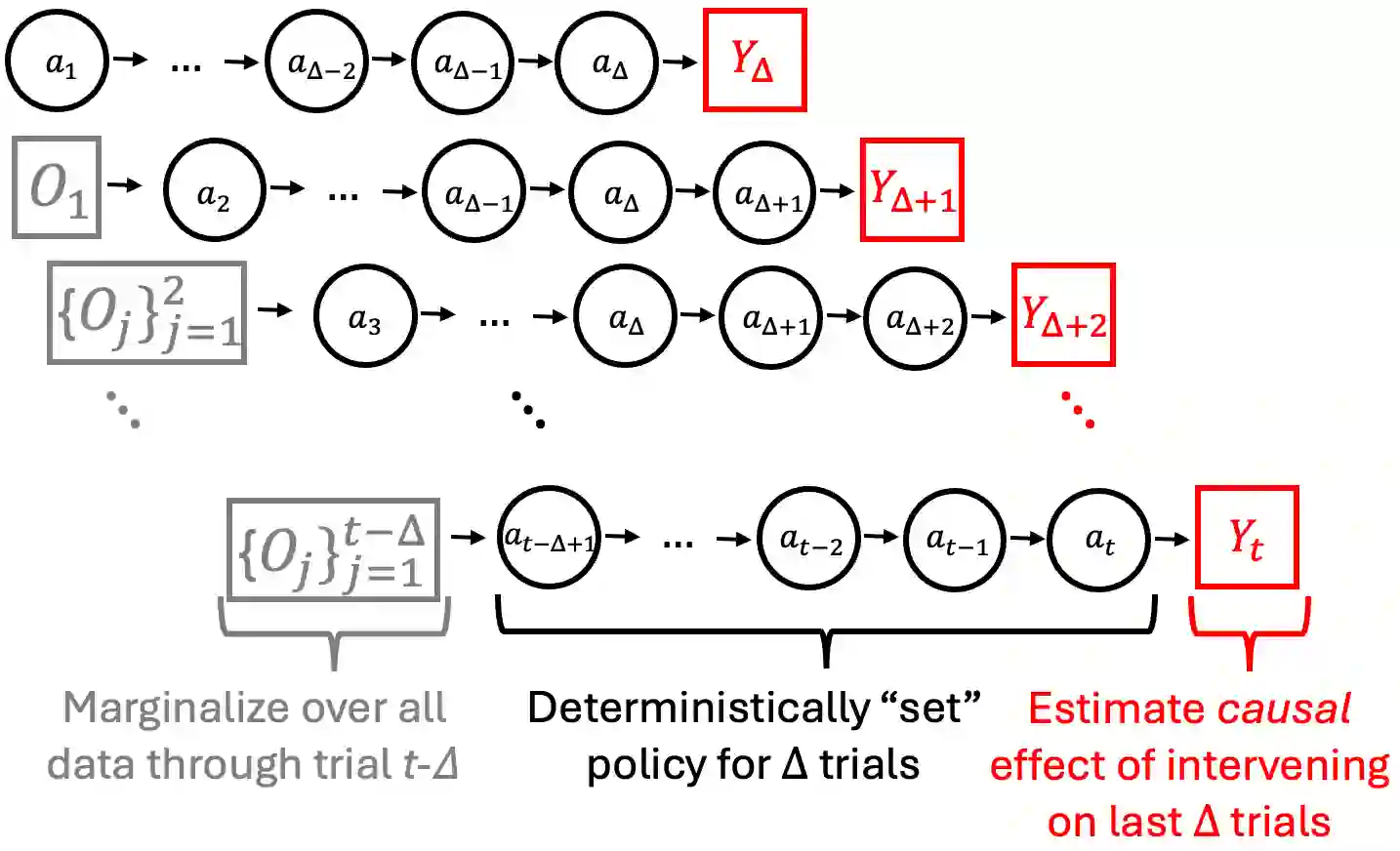
Optogenetics is a powerful neuroscience technique for studying how neural circuit manipulation affects behavior. Standard analysis conventions discard information and severely limit the scope of the causal questions that can be probed. To address this gap, we 1) draw connections to the causal inference literature on sequentially randomized experiments, 2) propose a non-parametric framework for analyzing "open-loop" (static regime) optogenetics behavioral experiments, 3) derive extensions of history-restricted marginal structural models for dynamic treatment regimes with positivity violations for "closed-loop" designs, and 4) propose a taxonomy of identifiable causal effects that encompass a far richer collection of scientific questions compared to standard methods. From another view, our work extends "excursion effect" methods, popularized recently in the mobile health literature, to enable estimation of causal contrasts for treatment sequences in the presence of positivity violations. We describe sufficient conditions for identifiability of the proposed causal estimands, and provide asymptotic statistical guarantees for a proposed inverse probability-weighted estimator, a multiply-robust estimator (for two intervention timepoints), a framework for hypothesis testing, and a computationally scalable implementation. Finally, we apply our framework to data from a recent neuroscience study and show how it provides insight into causal effects of optogenetics on behavior that are obscured by standard analyses.
翻译:光遗传学是一种强大的神经科学技术,用于研究神经回路操控如何影响行为。标准的分析惯例会丢弃信息,并严重限制可探究的因果问题的范围。为解决这一不足,我们:1)建立与序列随机化实验因果推断文献的联系;2)提出一个非参数框架用于分析“开环”(静态干预)光遗传学行为实验;3)针对“闭环”设计中存在正性违背的动态治疗干预,推导历史限制边际结构模型的扩展;4)提出一套可识别因果效应的分类法,与标准方法相比,其涵盖的科学问题范围远为丰富。从另一视角看,我们的工作扩展了近期在移动健康文献中流行的“偏移效应”方法,使其能够在存在正性违背的情况下估计治疗序列的因果对比。我们描述了所提出因果估计量可识别的充分条件,并为提出的逆概率加权估计量、多重稳健估计量(针对两个干预时间点)、假设检验框架以及计算可扩展的实现提供了渐近统计保证。最后,我们将框架应用于一项近期神经科学研究的数据,并展示其如何揭示被标准分析所掩盖的光遗传学对行为的因果效应。





相关内容



 微信扫码咨询专知VIP会员