

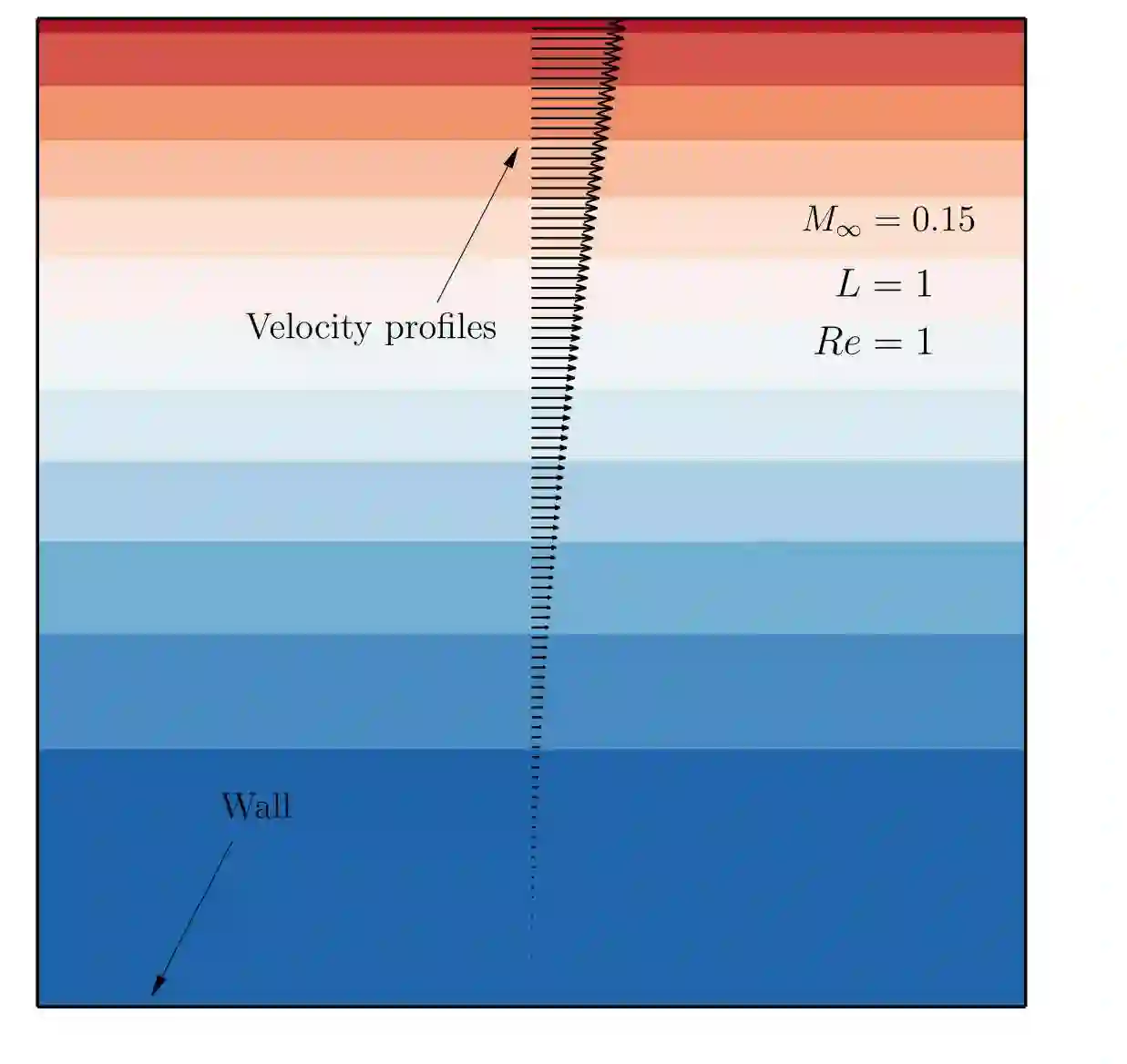
The macro-element variant of the hybridized discontinuous Galerkin (HDG) method combines advantages of continuous and discontinuous finite element discretization. In this paper, we investigate the performance of the macro-element HDG method for the analysis of compressible flow problems at moderate Reynolds numbers. To efficiently handle the corresponding large systems of equations, we explore several strategies at the solver level. On the one hand, we devise a second-layer static condensation approach that reduces the size of the local system matrix in each macro-element and hence the factorization time of the local solver. On the other hand, we employ a multi-level preconditioner based on the FGMRES solver for the global system that integrates well within a matrix-free implementation. In addition, we integrate a standard diagonally implicit Runge-Kutta scheme for time integration. We test the matrix-free macro-element HDG method for compressible flow benchmarks, including Couette flow, flow past a sphere, and the Taylor-Green vortex. Our results show that unlike standard HDG, the macro-element HDG method can operate efficiently for moderate polynomial degrees, as the local computational load can be flexibly increased via mesh refinement within a macro-element. Our results also show that due to the balance of local and global operations, the reduction in degrees of freedom, and the reduction of the global problem size and the number of iterations for its solution, the macro-element HDG method can be a competitive option for the analysis of compressible flow problems.
翻译:宏单元变体的混合间断伽辽金(HDG)方法结合了连续与非连续有限元离散化的优势。本文研究了宏单元HDG方法在中雷诺数可压缩流问题分析中的性能。为高效处理相应的大型方程组,我们在求解器层面探索了多种策略。一方面,我们设计了第二层静态凝聚方法,通过减小每个宏单元内局部系统矩阵的规模来缩短局部求解器的因式分解时间。另一方面,我们采用基于FGMRES求解器的多级预处理器处理全局系统,该预处理器能很好地融入无矩阵实现框架。此外,我们集成了标准对角隐式龙格-库塔格式进行时间积分。我们测试了无矩阵宏单元HDG方法在可压缩流基准问题中的表现,包括库埃特流、绕球流以及泰勒-格林涡。结果表明,与标准HDG不同,宏单元HDG方法能在中等多项式阶数下高效运行,因为可通过宏单元内的网格细化灵活增加局部计算负载。结果还表明,由于局部与全局运算的平衡、自由度的减少、全局问题规模的缩减及其求解迭代次数的降低,宏单元HDG方法可成为可压缩流问题分析中具有竞争力的选择。





相关内容




 微信扫码咨询专知VIP会员