

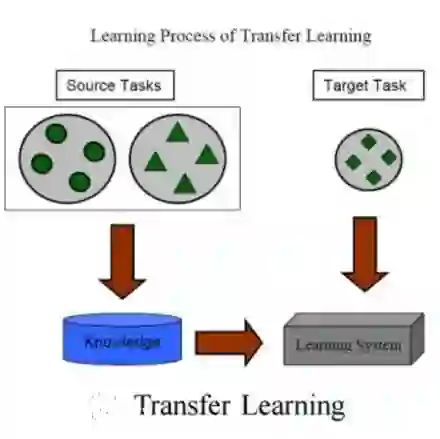
In the field of surrogate modeling, polynomial chaos expansion (PCE) allows practitioners to construct inexpensive yet accurate surrogates to be used in place of the expensive forward model simulations. For black-box simulations, non-intrusive PCE allows the construction of these surrogates using a set of simulation response evaluations. In this context, the PCE coefficients can be obtained using linear regression, which is also known as point collocation or stochastic response surfaces. Regression exhibits better scalability and can handle noisy function evaluations in contrast to other non-intrusive approaches, such as projection. However, since over-sampling is generally advisable for the linear regression approach, the simulation requirements become prohibitive for expensive forward models. We propose to leverage transfer learning whereby knowledge gained through similar PCE surrogate construction tasks (source domains) is transferred to a new surrogate-construction task (target domain) which has a limited number of forward model simulations (training data). The proposed transfer learning strategy determines how much, if any, information to transfer using new techniques inspired by Bayesian modeling and data assimilation. The strategy is scrutinized using numerical investigations and applied to an engineering problem from the oil and gas industry.
翻译:在替代建模领域,多项式混沌展开(PCE)使得研究人员能够构建成本低廉且精度可靠的替代模型,用以替代昂贵的前向模型模拟。针对黑箱模拟,非侵入式PCE可通过一组模拟响应评估值构建此类替代模型。在此框架下,PCE系数可通过线性回归方法获取(亦称为点配置法或随机响应面法)。与其他非侵入式方法(如投影法)相比,回归法具有更优的扩展性,且能够处理含噪声的函数评估。然而,由于线性回归方法通常需要过采样,这导致对昂贵前向模型的模拟需求变得难以实现。我们提出利用迁移学习技术,将相类PCE替代模型构建任务(源域)中获得的知识迁移至训练数据有限的新替代模型构建任务(目标域)。所提出的迁移学习策略采用基于贝叶斯建模与数据同化的新技术,精确判定需要迁移的信息量(乃至是否需要迁移)。该策略通过数值实验验证,并应用于石油天然气领域的工程问题。




相关内容




 微信扫码咨询专知VIP会员