

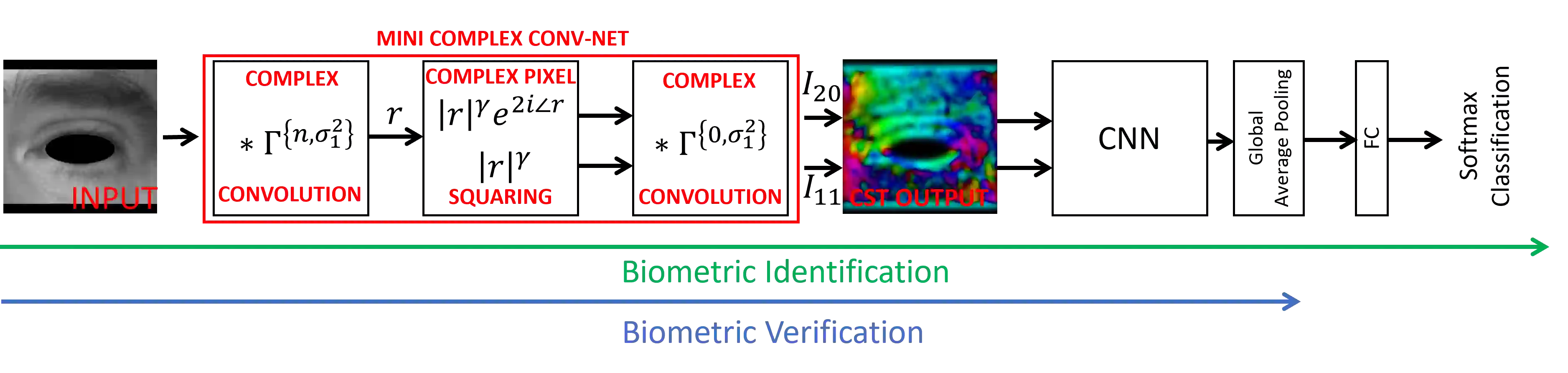
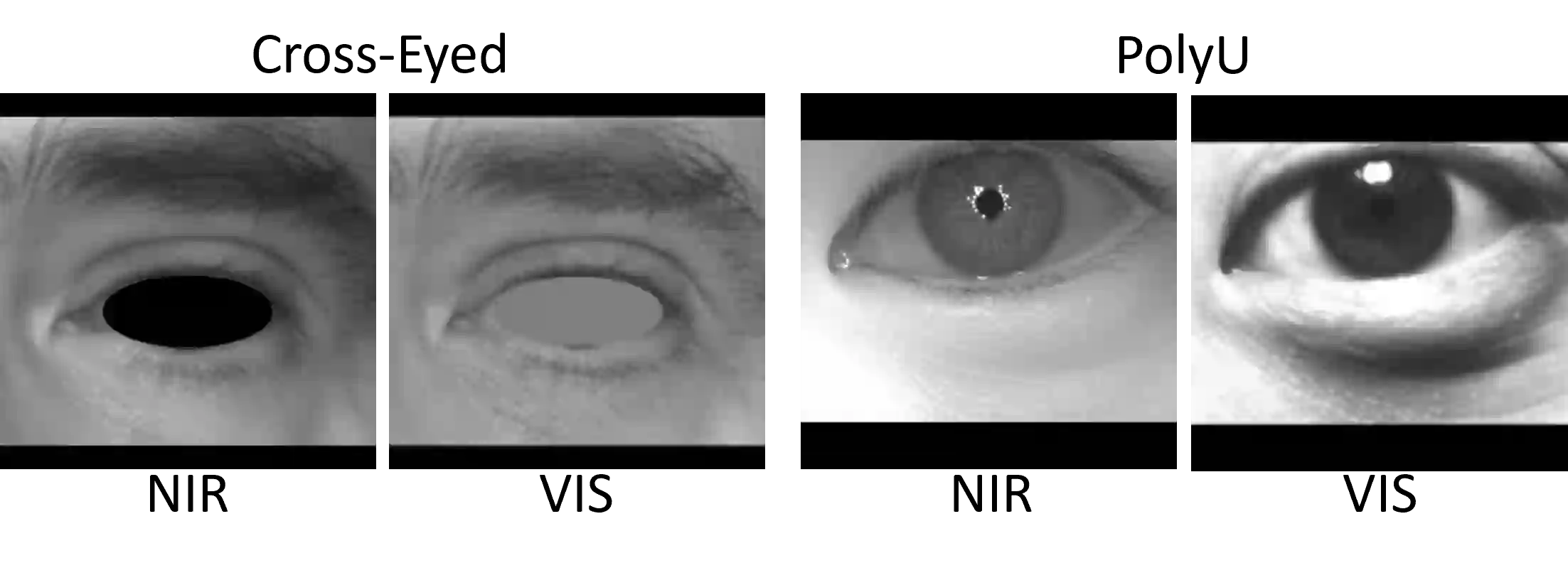
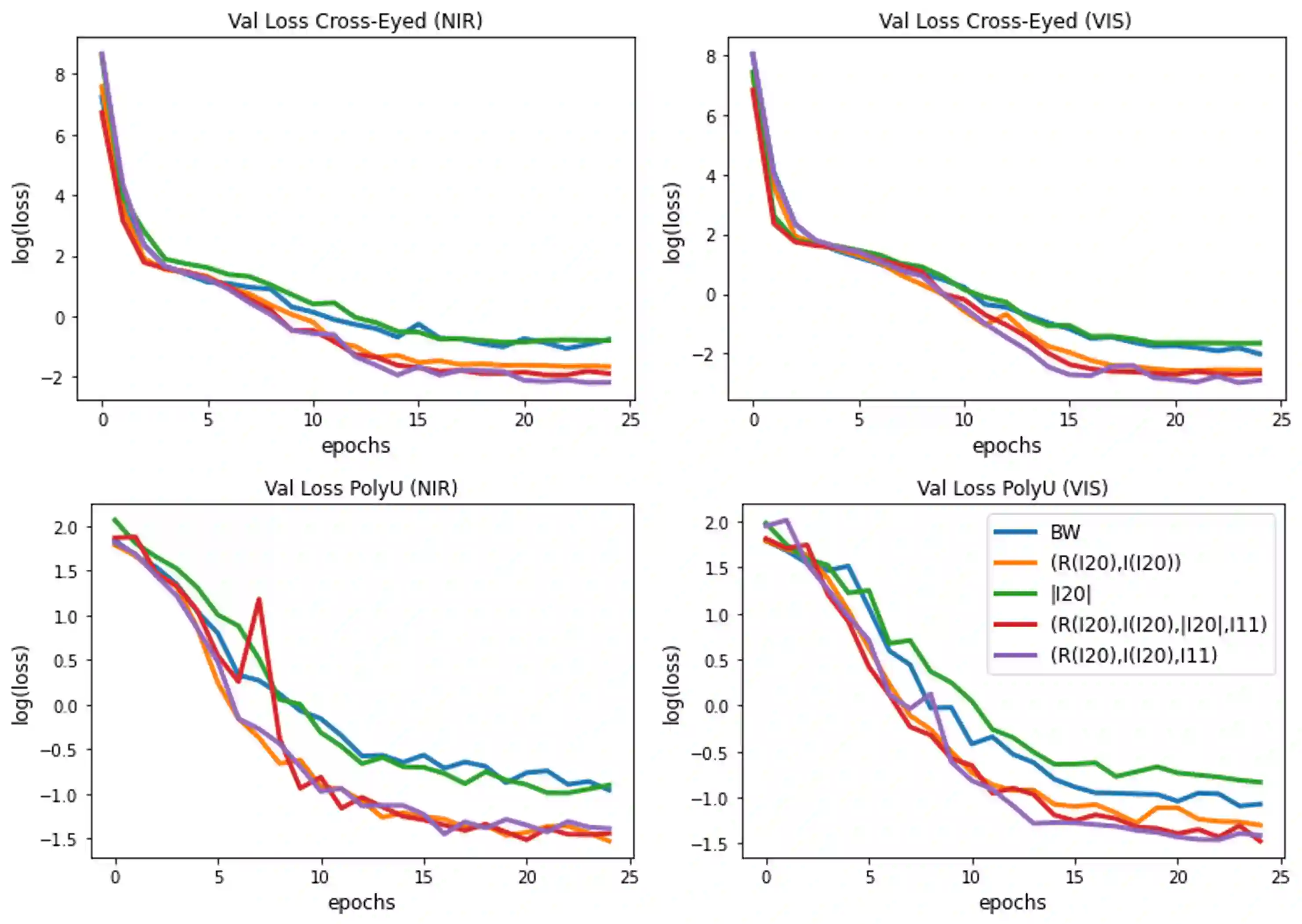
Our study provides evidence that CNNs struggle to effectively extract orientation features. We show that the use of Complex Structure Tensor, which contains compact orientation features with certainties, as input to CNNs consistently improves identification accuracy compared to using grayscale inputs alone. Experiments also demonstrated that our inputs, which were provided by mini complex conv-nets, combined with reduced CNN sizes, outperformed full-fledged, prevailing CNN architectures. This suggests that the upfront use of orientation features in CNNs, a strategy seen in mammalian vision, not only mitigates their limitations but also enhances their explainability and relevance to thin-clients. Experiments were done on publicly available data sets comprising periocular images for biometric identification and verification (Close and Open World) using 6 State of the Art CNN architectures. We reduced SOA Equal Error Rate (EER) on the PolyU dataset by 5-26% depending on data and scenario.
翻译:我们的研究提供了证据表明,卷积神经网络(CNN)难以有效提取方向特征。我们证明,与仅使用灰度输入相比,将包含具有确定性的紧凑方向特征的复数结构张量作为CNN输入,能持续提升识别准确率。实验还表明,由微型复数卷积网络提供的这种输入,结合精简后的CNN架构,其性能超越了成熟的通用CNN架构。这表明,在CNN中前置使用方向特征(一种在哺乳动物视觉中存在的策略),不仅缓解了CNN的局限性,还增强了其可解释性及对轻量级终端的适用性。实验采用6种最先进的CNN架构,基于公开数据集(包含用于生物特征识别与验证的眼周图像,涵盖开放世界与封闭世界场景)进行。在PolyU数据集上,我们根据数据与场景不同,将最先进等错误率(EER)降低了5%至26%。




相关内容


 微信扫码咨询专知VIP会员