

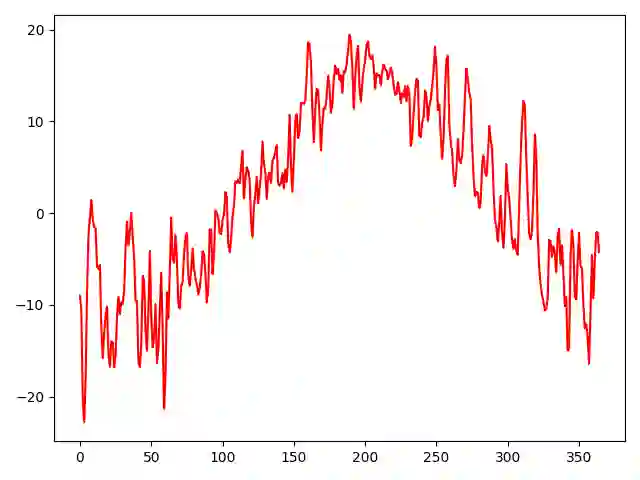
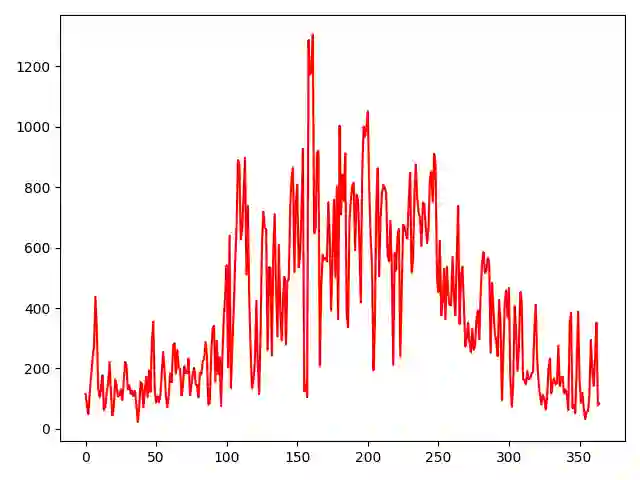
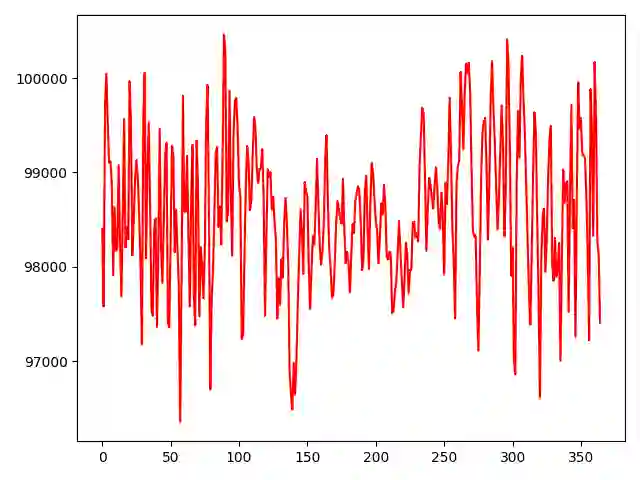
Understanding the future climate is crucial for informed policy decisions on climate change prevention and mitigation. Earth system models play an important role in predicting future climate, requiring accurate representation of complex sub-processes that span multiple time scales and spatial scales. One such process that links seasonal and interannual climate variability to cyclical biological events is tree phenology in deciduous broadleaf forests. Phenological dates, such as the start and end of the growing season, are critical for understanding the exchange of carbon and water between the biosphere and the atmosphere. Mechanistic prediction of these dates is challenging. Hybrid modelling, which integrates data-driven approaches into complex models, offers a solution. In this work, as a first step towards this goal, train a deep neural network to predict a phenological index from meteorological time series. We find that this approach outperforms traditional process-based models. This highlights the potential of data-driven methods to improve climate predictions. We also analyze which variables and aspects of the time series influence the predicted onset of the season, in order to gain a better understanding of the advantages and limitations of our model.
翻译:理解未来气候对于制定应对和减缓气候变化的有依据的政策至关重要。地球系统模型在预测未来气候中扮演重要角色,需精确表征跨越多个时间尺度和空间尺度的复杂子过程。其中一个连接季节及年际气候变率与周期性生物事件的过程,便是落叶阔叶林的树木物候学。诸如生长季开始与结束等物候日期,对理解生物圈与大气间碳和水交换至关重要。这些日期的机理预测具有挑战性。混合建模方法将数据驱动技术融入复杂模型,为此提供了解决方案。本研究作为迈向该目标的第一步,训练了一个深度神经网络,通过气象时间序列预测物候指数。我们发现该方法优于传统过程模型,凸显了数据驱动方法在改进气候预测方面的潜力。我们还分析了影响预测生长季起始的时间序列变量及特征,以更深入理解本模型的优势与局限性。





相关内容




 微信扫码咨询专知VIP会员