

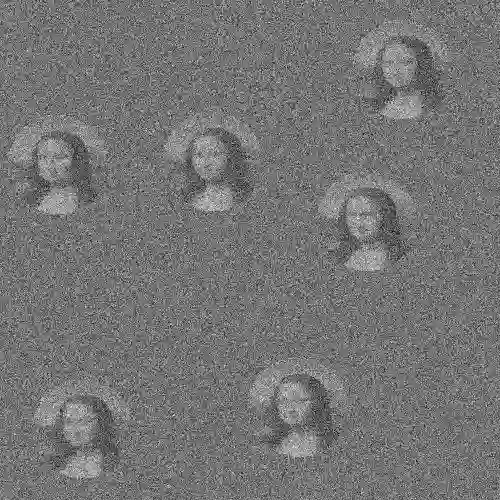
Motivated by single-particle cryo-electron microscopy, we study the sample complexity of the multi-target detection (MTD) problem, in which an unknown signal appears multiple times at unknown locations within a long, noisy observation. We propose a patching scheme that reduces MTD to a non-i.i.d. multi-reference alignment (MRA) model. In the one-dimensional setting, the latent group elements form a Markov chain, and we show that the convergence rate of any estimator matches that of the corresponding i.i.d. MRA model, up to a logarithmic factor in the number of patches. Moreover, for estimators based on empirical averaging, such as the method of moments, the convergence rates are identical in both settings. We further establish an analogous result in two dimensions, where the latent structure arises from an exponentially mixing random field generated by a hard-core placement model. As a consequence, if the signal in the corresponding i.i.d. MRA model is determined by moments up to order $n_{\min}$, then in the low-SNR regime the number of patches required to estimate the signal in the MTD model scales as $\sigma^{2n_{\min}}$, where $\sigma^2$ denotes the noise variance.
翻译:受单颗粒冷冻电子显微镜的启发,我们研究了多目标检测问题的样本复杂度,其中未知信号在长噪声观测中以未知位置多次出现。我们提出了一种分块方案,将多目标检测问题转化为非独立同分布的多参考对齐模型。在一维情形下,潜在群元素构成马尔可夫链,我们证明任何估计器的收敛速率均与对应的独立同分布多参考对齐模型相匹配,仅相差一个关于分块数量的对数因子。此外,对于基于经验平均的估计器(如矩量法),两种设定下的收敛速率完全相同。我们进一步在二维情形中建立了类似结论,其中潜在结构源于由硬核放置模型生成的指数混合随机场。因此,若对应独立同分布多参考对齐模型中的信号可由直至 $n_{\min}$ 阶矩确定,则在低信噪比条件下,多目标检测模型中估计信号所需的分块数量按 $\sigma^{2n_{\min}}$ 比例增长,其中 $\sigma^2$ 表示噪声方差。






相关内容




 微信扫码咨询专知VIP会员