

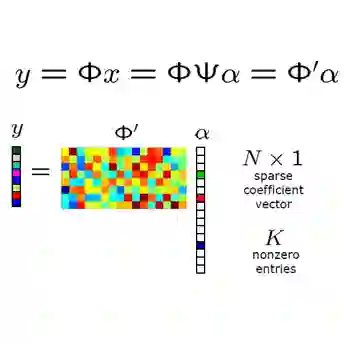
Popular social media platforms employ neural network based image moderation engines to classify images uploaded on them as having potentially objectionable content. Such moderation engines must answer a large number of queries with heavy computational cost, even though the actual number of images with objectionable content is usually a tiny fraction. Inspired by recent work on Neural Group Testing, we propose an approach which exploits this fact to reduce the overall computational cost of such engines using the technique of Compressed Sensing (CS). We present the quantitative matrix-pooled neural network (QMPNN), which takes as input $n$ images, and a $m \times n$ binary pooling matrix with $m < n$, whose rows indicate $m$ pools of images i.e. selections of $r$ images out of $n$. The QMPNN efficiently outputs the product of this matrix with the unknown sparse binary vector indicating whether each image is objectionable or not, i.e. it outputs the number of objectionable images in each pool. For suitable matrices, this is decoded using CS decoding algorithms to predict which images were objectionable. The computational cost of running the QMPNN and the CS algorithms is significantly lower than the cost of using a neural network with the same number of parameters separately on each image to classify the images, which we demonstrate via extensive experiments. Our technique is inherently resilient to moderate levels of errors in the prediction from the QMPNN. Furthermore, we present pooled deep outlier detection, which brings CS and group testing techniques to deep outlier detection, to provide for the case when the objectionable images do not belong to a set of pre-defined classes. This technique enables efficient automated moderation of off-topic images shared on topical forums dedicated to sharing images of a certain single class, many of which are currently human-moderated.
翻译:热门社交媒体平台采用基于神经网络的图像审核引擎,对用户上传的图片进行潜在不当内容分类。这类审核引擎需处理海量查询请求并承担高昂计算成本,尽管实际包含不当内容的图像仅占极小比例。受近期神经分组测试研究的启发,我们提出一种利用压缩感知技术降低此类引擎整体计算开销的方法。我们设计的量化矩阵池化神经网络以$n$张图像及一个$m \times n$的二元池化矩阵(其中$m < n$)为输入,该矩阵的每一行对应$m$个图像池——即从$n$张图像中选取$r$张的组合。QMPNN通过高效运算输出该矩阵与未知稀疏二元向量的乘积(该向量指示每张图像是否包含不当内容),即输出每个图像池中不当内容的计数。通过选择适当的矩阵,可结合压缩感知解码算法推断具体的不当图像。实验证明,采用相同参数量的QMPNN与CS算法相比,其计算成本显著低于对每张图像单独进行神经网络分类的方法。该技术对QMPNN预测中的中等程度误差具有天然鲁棒性。此外,我们提出池化深度异常检测方法,将压缩感知与分组测试技术引入深度异常检测领域,以应对不当图像不属于预定义类别的情况。该技术能高效实现对特定主题论坛(如专注于分享单类图像的专题论坛)中离题图像的自动化审核,而这些论坛目前多依赖人工审核。




相关内容




 微信扫码咨询专知VIP会员