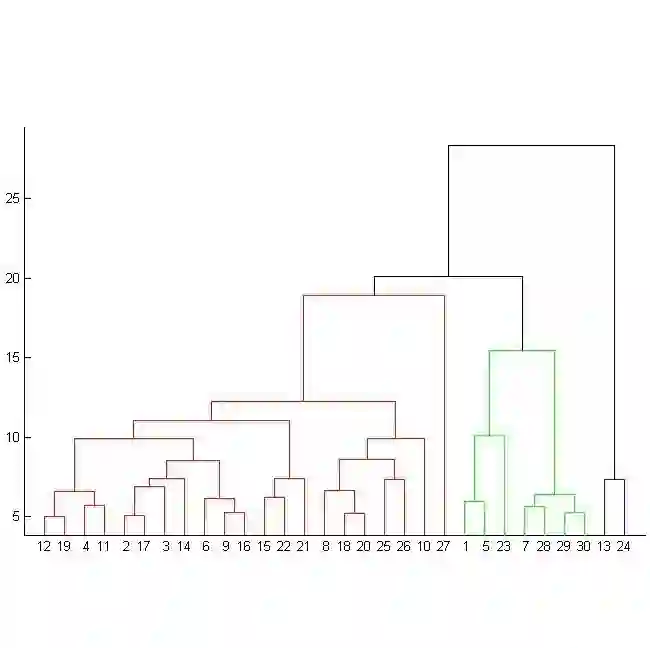
Hierarchical clustering of networks consists in finding a tree of communities, such that lower levels of the hierarchy reveal finer-grained community structures. There are two main classes of algorithms tackling this problem. Divisive ($\textit{top-down}$) algorithms recursively partition the nodes into two communities, until a stopping rule indicates that no further split is needed. In contrast, agglomerative ($\textit{bottom-up}$) algorithms first identify the smallest community structure and then repeatedly merge the communities using a $\textit{linkage}$ method. In this article, we establish theoretical guarantees for the recovery of the hierarchical tree and community structure of a Hierarchical Stochastic Block Model by a bottom-up algorithm. We also establish that this bottom-up algorithm attains the information-theoretic threshold for exact recovery at intermediate levels of the hierarchy. Notably, these recovery conditions are less restrictive compared to those existing for top-down algorithms. This shows that bottom-up algorithms extend the feasible region for achieving exact recovery at intermediate levels. Numerical experiments on both synthetic and real data sets confirm the superiority of bottom-up algorithms over top-down algorithms. We also observe that top-down algorithms can produce dendrograms with inversions. These findings contribute to a better understanding of hierarchical clustering techniques and their applications in network analysis.


翻译:网络层次聚类旨在寻找一棵社区树,使得层次结构中较低的层级揭示更细粒度的社区结构。解决此问题的算法主要有两类。分裂型(自顶向下)算法递归地将节点划分为两个社区,直到停止规则指示无需进一步划分为止。相反,凝聚型(自底向上)算法首先识别最小的社区结构,然后使用链接方法反复合并社区。在本文中,我们为自底向上算法在层次随机块模型中恢复层次树和社区结构建立了理论保证。我们还证明,该自底向上算法在层次结构的中间层级达到了精确恢复的信息论阈值。值得注意的是,这些恢复条件比现有自顶向下算法的条件更为宽松。这表明自底向上算法扩展了在中间层级实现精确恢复的可行区域。在合成和真实数据集上的数值实验证实了自底向上算法优于自顶向下算法。我们还观察到,自顶向下算法可能产生带有倒置的树状图。这些发现有助于更好地理解层次聚类技术及其在网络分析中的应用。


0
下载
关闭预览

相关内容

不可错过!《机器学习100讲》课程,UBC Mark Schmidt讲授
专知会员服务
76+阅读 · 2022年6月28日
神经常微分方程教程,50页ppt,A brief tutorial on Neural ODEs
专知会员服务
74+阅读 · 2020年8月2日
[综述]深度学习下的场景文本检测与识别
专知会员服务
78+阅读 · 2019年10月10日
机器学习入门的经验与建议
专知会员服务
94+阅读 · 2019年10月10日
Hierarchically Structured Meta-learning
CreateAMind
27+阅读 · 2019年5月22日
Transferring Knowledge across Learning Processes
CreateAMind
29+阅读 · 2019年5月18日
A Technical Overview of AI & ML in 2018 & Trends for 2019
待字闺中
18+阅读 · 2018年12月24日
ResNet, AlexNet, VGG, Inception:各种卷积网络架构的理解
全球人工智能
20+阅读 · 2017年12月17日
【推荐】ResNet, AlexNet, VGG, Inception:各种卷积网络架构的理解
机器学习研究会
20+阅读 · 2017年12月17日
【推荐】用Python/OpenCV实现增强现实
机器学习研究会
15+阅读 · 2017年11月16日
【论文】变分推断(Variational inference)的总结
机器学习研究会
39+阅读 · 2017年11月16日
【推荐】RNN/LSTM时序预测
机器学习研究会
25+阅读 · 2017年9月8日
【推荐】深度学习目标检测概览
机器学习研究会
10+阅读 · 2017年9月1日
国家自然科学基金
2+阅读 · 2017年12月31日
国家自然科学基金
0+阅读 · 2015年12月31日
国家自然科学基金
0+阅读 · 2014年12月31日
国家自然科学基金
1+阅读 · 2013年12月31日
国家自然科学基金
0+阅读 · 2013年12月31日
国家自然科学基金
0+阅读 · 2012年12月31日
国家自然科学基金
0+阅读 · 2012年12月31日
国家自然科学基金
0+阅读 · 2011年12月31日
Arxiv
13+阅读 · 2019年11月14日
Arxiv
11+阅读 · 2019年4月15日
VIP会员
最新内容
重新思考无人机时代的生存能力
专知会员服务
4+阅读 · 今天7:44
装甲突击旅:现代战争思考、战斗与组织
专知会员服务
4+阅读 · 今天7:28
在人工智能加速决策环境中拓展OODA循环
专知会员服务
4+阅读 · 今天7:18
军事欺骗:供作战战术指挥官使用的工具
专知会员服务
4+阅读 · 今天7:03
综述 | 世界动作模型:少做梦,多行动
专知会员服务
5+阅读 · 6月23日
美以伊冲突:无人机与人工智能的运用
专知会员服务
10+阅读 · 6月23日
《特种部队在透明战场中的生存力》最新报告
专知会员服务
5+阅读 · 6月23日
相关资讯
Hierarchically Structured Meta-learning
CreateAMind
27+阅读 · 2019年5月22日
Transferring Knowledge across Learning Processes
CreateAMind
29+阅读 · 2019年5月18日
A Technical Overview of AI & ML in 2018 & Trends for 2019
待字闺中
18+阅读 · 2018年12月24日
ResNet, AlexNet, VGG, Inception:各种卷积网络架构的理解
全球人工智能
20+阅读 · 2017年12月17日
【推荐】ResNet, AlexNet, VGG, Inception:各种卷积网络架构的理解
机器学习研究会
20+阅读 · 2017年12月17日
【推荐】用Python/OpenCV实现增强现实
机器学习研究会
15+阅读 · 2017年11月16日
【论文】变分推断(Variational inference)的总结
机器学习研究会
39+阅读 · 2017年11月16日
【推荐】RNN/LSTM时序预测
机器学习研究会
25+阅读 · 2017年9月8日
【推荐】深度学习目标检测概览
机器学习研究会
10+阅读 · 2017年9月1日
相关基金
国家自然科学基金
2+阅读 · 2017年12月31日
国家自然科学基金
0+阅读 · 2015年12月31日
国家自然科学基金
0+阅读 · 2014年12月31日
国家自然科学基金
1+阅读 · 2013年12月31日
国家自然科学基金
0+阅读 · 2013年12月31日
国家自然科学基金
0+阅读 · 2012年12月31日
国家自然科学基金
0+阅读 · 2012年12月31日
国家自然科学基金
0+阅读 · 2011年12月31日
Top
微信扫码咨询专知VIP会员