

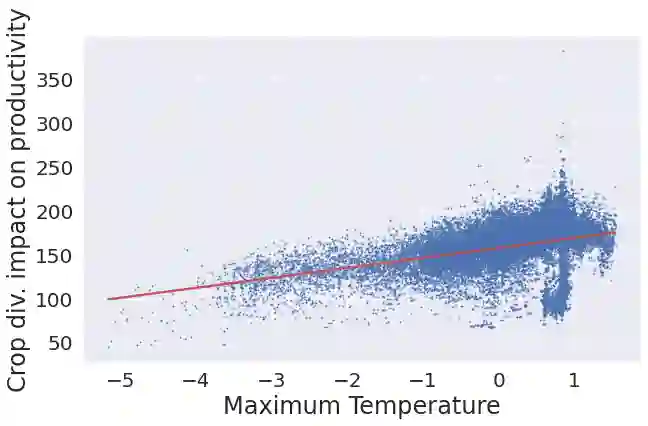
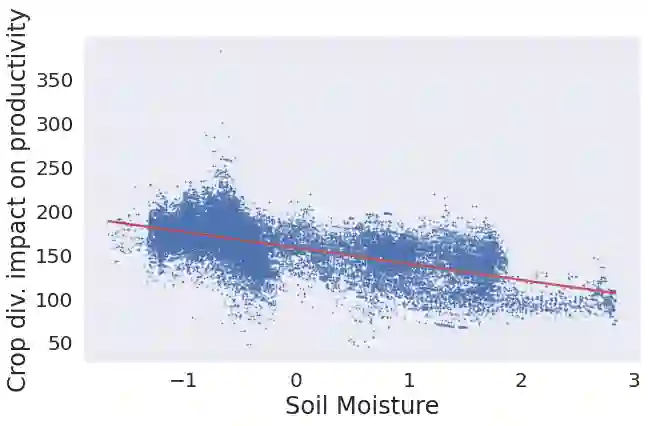
The concept of sustainable intensification in agriculture necessitates the implementation of management practices that prioritize sustainability without compromising productivity. However, the effects of such practices are known to depend on environmental conditions, and are therefore expected to change as a result of a changing climate. We study the impact of crop diversification on productivity in the context of climate change. We leverage heterogeneous Earth Observation data and contribute a data-driven approach based on causal machine learning for understanding how crop diversification impacts may change in the future. We apply this method to the country of Cyprus throughout a 4-year period. We find that, on average, crop diversification significantly benefited the net primary productivity of crops, increasing it by 2.8%. The effect generally synergized well with higher maximum temperatures and lower soil moistures. In a warmer and more drought-prone climate, we conclude that crop diversification exhibits promising adaptation potential and is thus a sensible policy choice with regards to agricultural productivity for present and future.
翻译:可持续集约化农业概念要求实施兼顾可持续性与生产力的管理实践。然而,这类实践的效果已知取决于环境条件,因此预计会因气候变化而改变。本研究在气候变化背景下探讨了作物多样化对生产力的影响。我们利用异构对地观测数据,提出了一种基于因果机器学习的数据驱动方法,以理解作物多样化影响在未来可能发生的变化。该方法在塞浦路斯全国范围内经过四年周期的实证应用。研究发现,作物多样化平均可使作物净初级生产力显著提升2.8%。该效应通常与更高最高气温和更低土壤湿度呈现协同增强趋势。在更温暖、更易干旱的气候条件下,我们得出结论:作物多样化展现出良好的适应潜力,因此是当前及未来农业生产力方面明智的政策选择。




相关内容




 微信扫码咨询专知VIP会员