

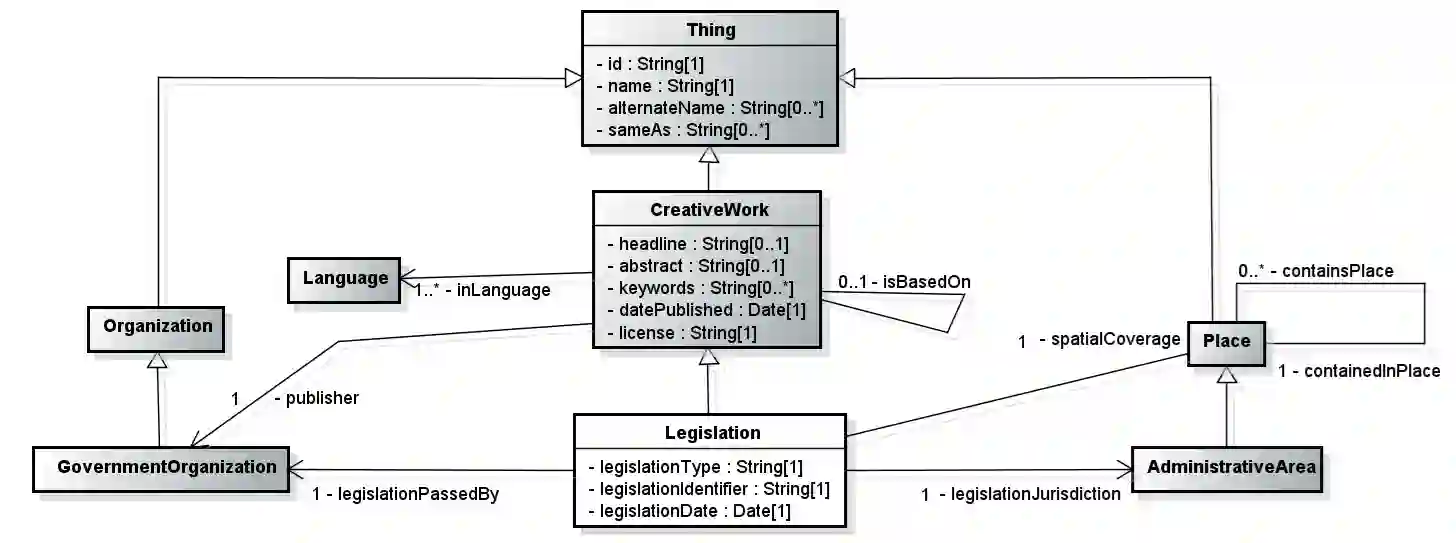
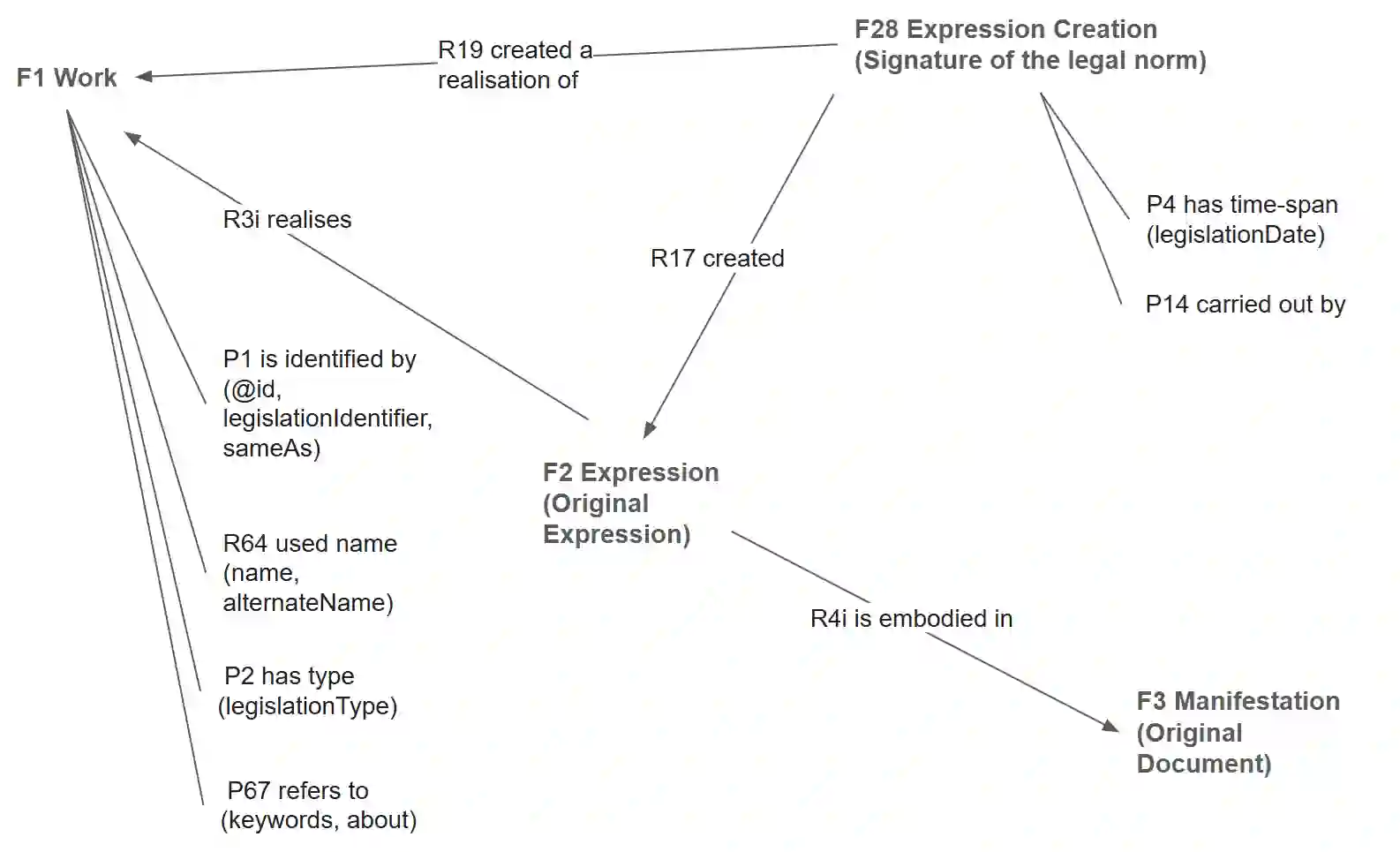
Building upon a formal, event-centric model for the diachronic evolution of legal norms grounded in the IFLA Library Reference Model (LRMoo), this paper addresses the essential first step of publishing this model's foundational entity-the abstract legal Work (F1)-on the Semantic Web. We propose a detailed, property-by-property mapping of the LRMoo F1 Work to the widely adopted schema.org/Legislation vocabulary. Using Brazilian federal legislation from the Normas.leg.br portal as a practical case study, we demonstrate how to create interoperable, machine-readable descriptions via JSON-LD, focusing on stable URN identifiers, core metadata, and norm relationships. This structured mapping establishes a stable, URI-addressable anchor for each legal norm, creating a verifiable "ground truth". It provides the essential, interoperable foundation upon which subsequent layers of the model, such as temporal versions (Expressions) and internal components, can be built. By bridging formal ontology with web-native standards, this work paves the way for building deterministic and reliable Legal Knowledge Graphs (LKGs), overcoming the limitations of purely probabilistic models.
翻译:本文基于一个以事件为中心、根植于IFLA图书馆参考模型(LRMoo)的法律规范历时演化的形式化模型,探讨了在语义网上发布该模型基础实体——抽象法律作品(F1)——这一关键的第一步。我们提出了将LRMoo F1作品逐属性映射到广泛采用的schema.org/Legislation词汇表的详细方案。以Normas.leg.br门户中的巴西联邦立法为实际案例,我们展示了如何通过JSON-LD创建可互操作的、机器可读的描述,重点关注稳定的URN标识符、核心元数据以及规范关系。这种结构化映射为每个法律规范建立了一个稳定的、URI可寻址的锚点,从而创建了可验证的“基础事实”。它提供了一个关键的、可互操作的基础,模型的后续层次(如时间版本(表达式)和内部组件)可以在此基础上构建。通过将形式化本体与网络原生标准相连接,这项工作为构建确定性和可靠的法律知识图谱(LKG)铺平了道路,克服了纯概率模型的局限性。




相关内容




 微信扫码咨询专知VIP会员