

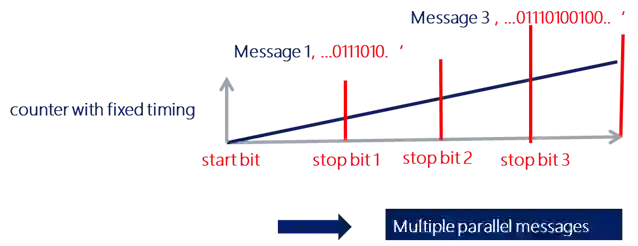
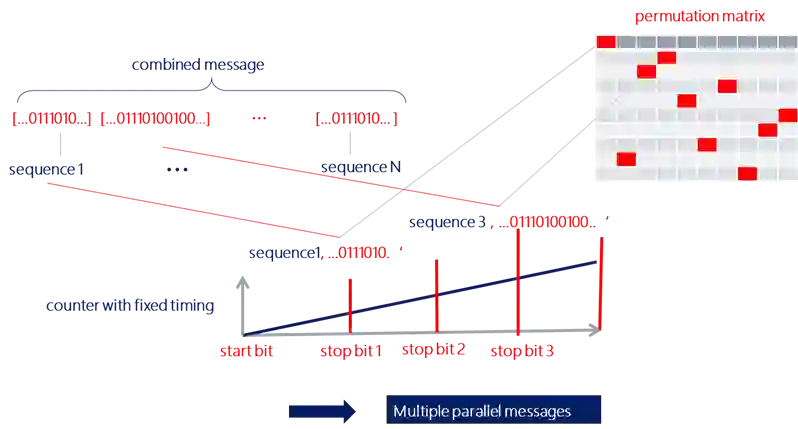
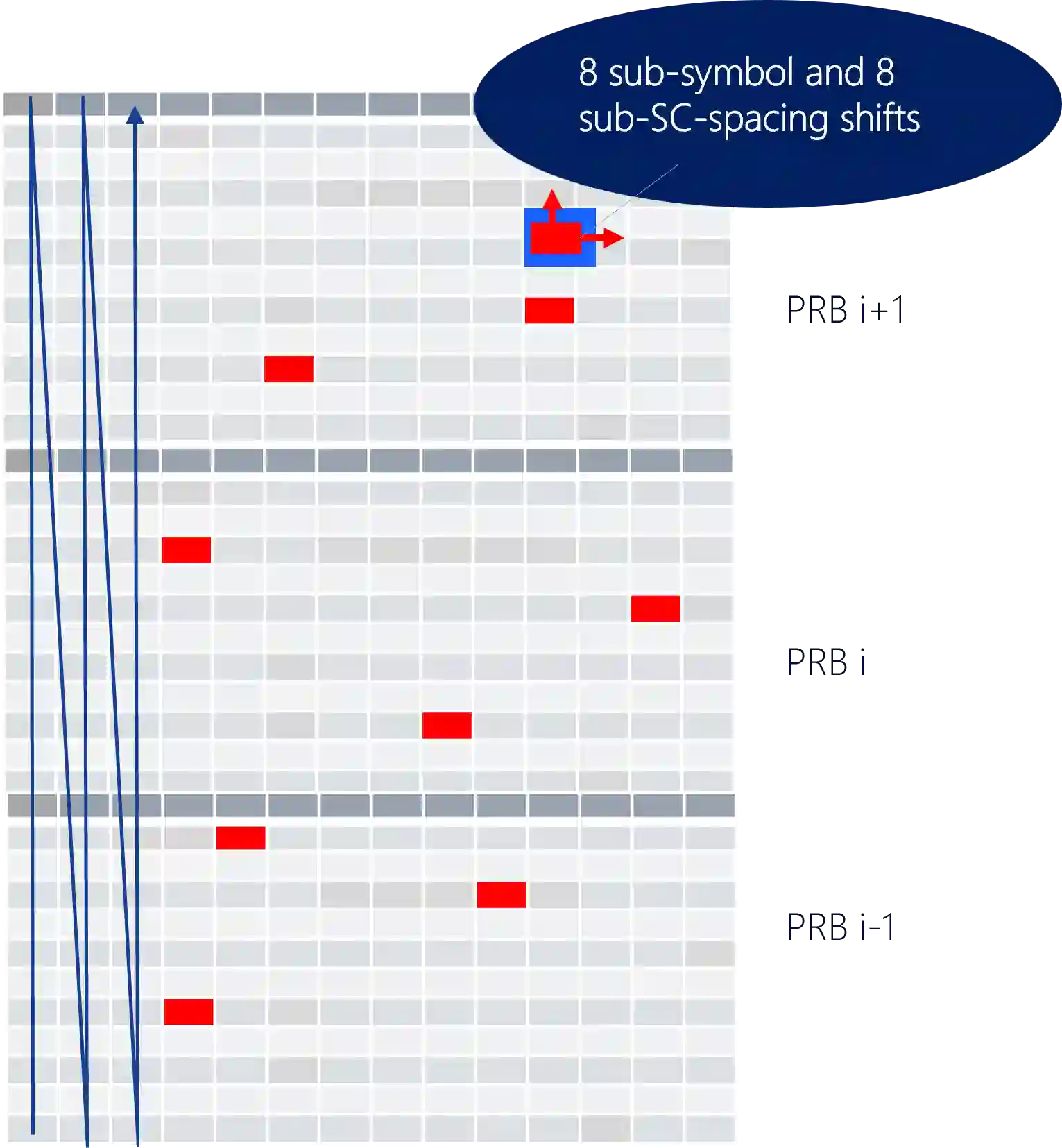
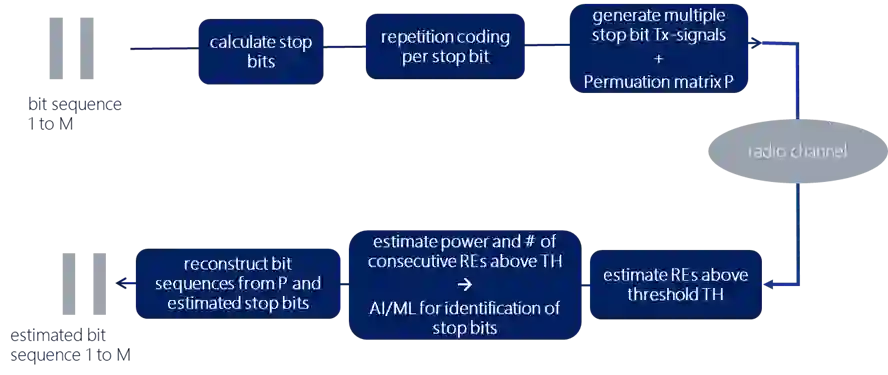
In this article, a novel approach for mobile radio communications is proposed and analysed, which is promising for future 6G cooperative distributed MIMO systems. The fundamental idea is a new mechanism namely start stop bit method, which transmits bit sequences as the start/stop bits of a synchronized counter instead of transmitting the full encoded bit sequence itself. In that way, theoretically, we can transmit infinitely long data messages with only one bit for starting and one bit for stopping the counter. The value of the counter, as identified by the stop bit, is then used to reconstruct and remap the one and unique transmitted bit sequence. The start stop bit method is characterized by a high signal sparsity as only two bits are transmitted, independently of the bit sequence length for the message. Among the benefits of the start stop bit method are energy efficient data transmission, and effective distributed MIMO systems, which exploit the sparse inter cooperation area interference as well as the low processing complexity for the sparse precoder calculation. Moreover, for the next mobile wireless generation, we propose an advanced scheme of the start stop bit method which enhances its resource usage. We call the resulting method a sparse dMIMO system.
翻译:本文提出并分析了一种适用于未来6G协作分布式MIMO系统的新型移动无线电通信方法。其核心思想是引入一种名为"起始停止比特方法"的新机制,该方法通过传输同步计数器的起始/停止比特序列,而非传输完整的编码比特序列本身。理论上,该方法仅需一个起始比特和一个停止比特即可实现无限长度数据消息的传输。通过停止比特确定的计数器数值可用于重构和映射出唯一传输的比特序列。起始停止比特方法具有高信号稀疏性特征——无论消息比特序列长度如何,仅需传输两个比特。该方法的优势包括:实现节能数据传输,构建高效的分布式MIMO系统,利用稀疏区间协作干扰特性,以及降低稀疏预编码器计算的处理复杂度。此外,针对下一代移动无线通信,我们提出了一种增强资源利用率的起始停止比特方法改进方案,并将其命名为稀疏分布式MIMO系统。





相关内容



 微信扫码咨询专知VIP会员