

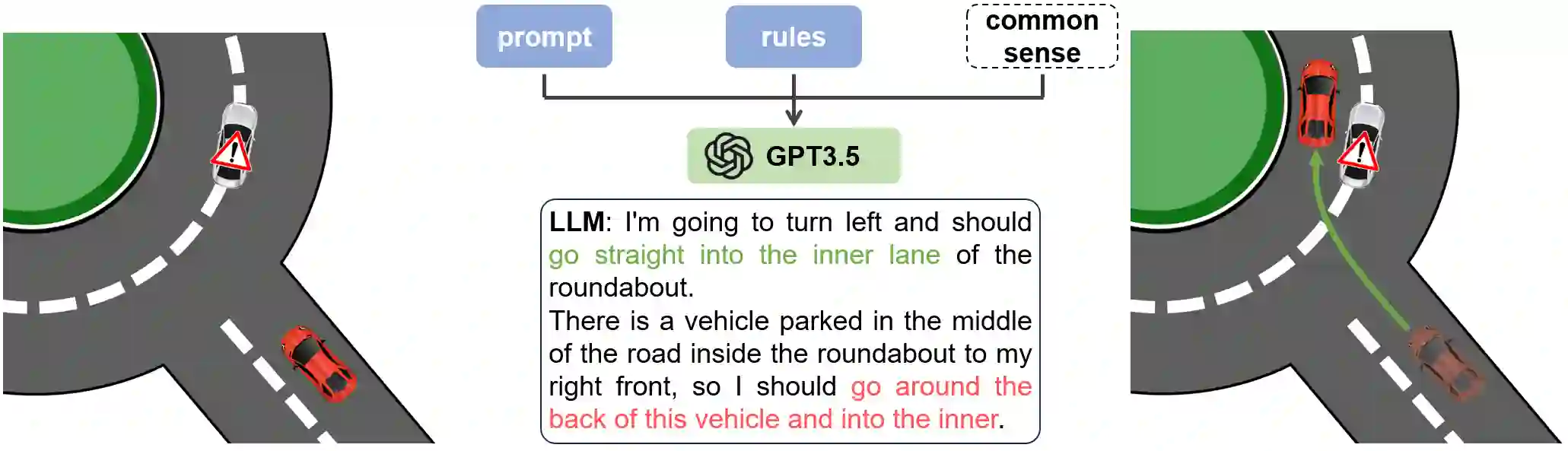
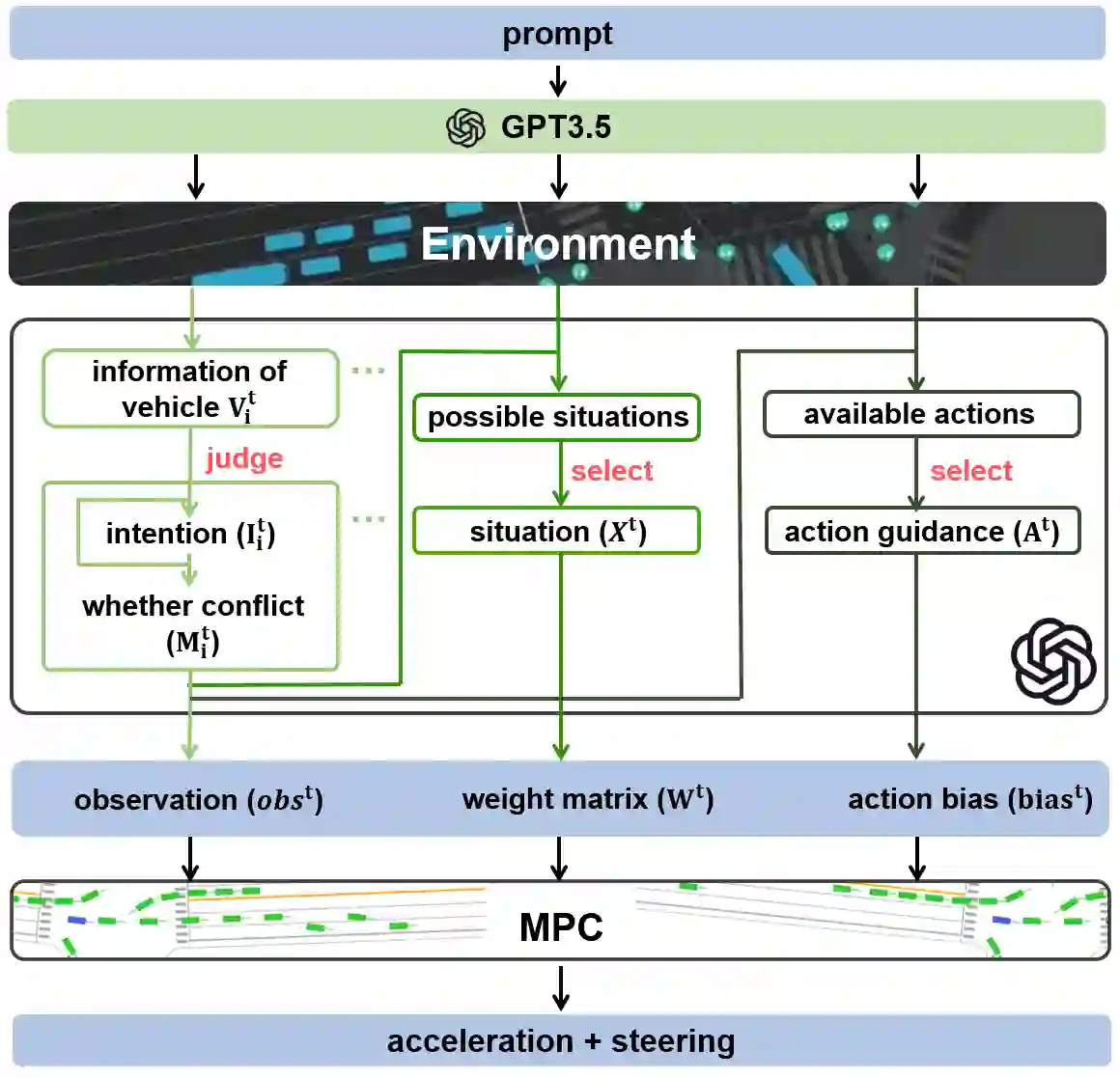
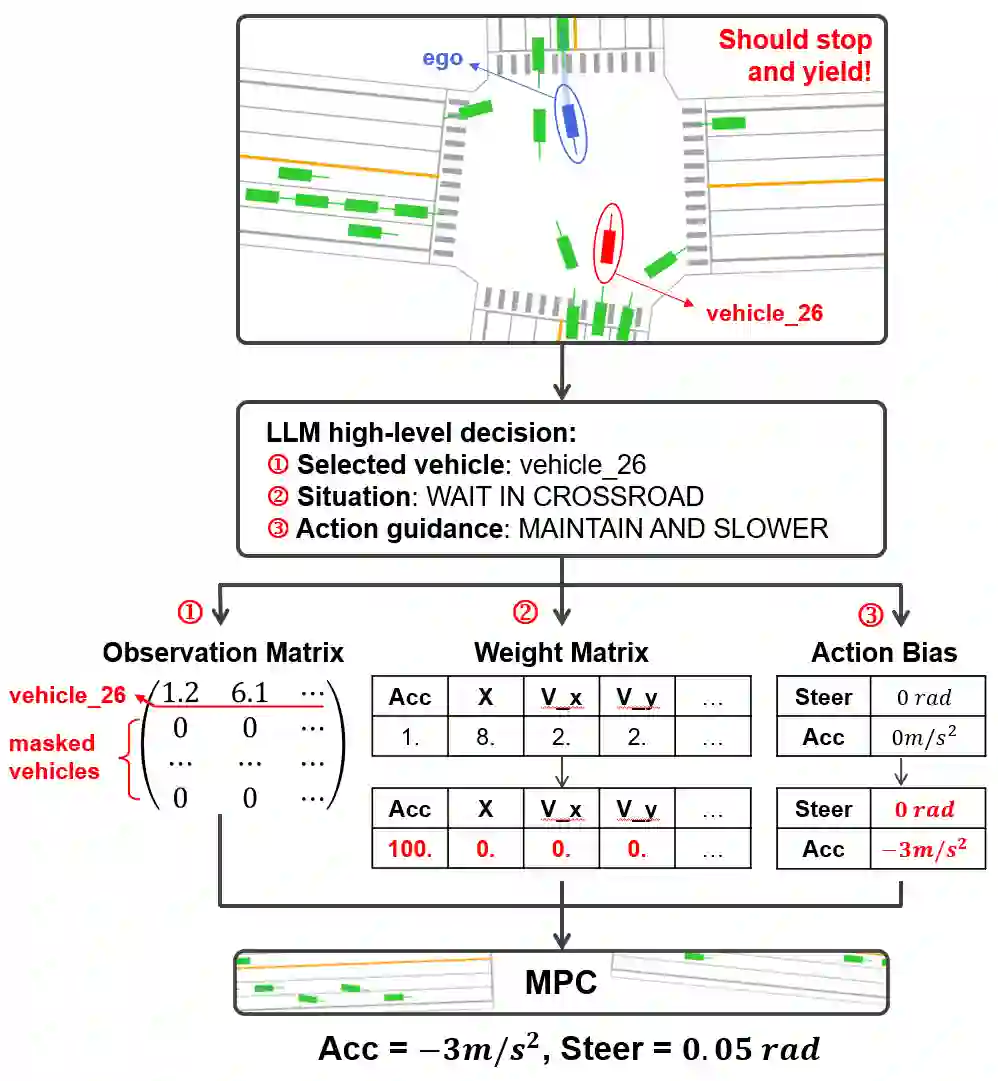
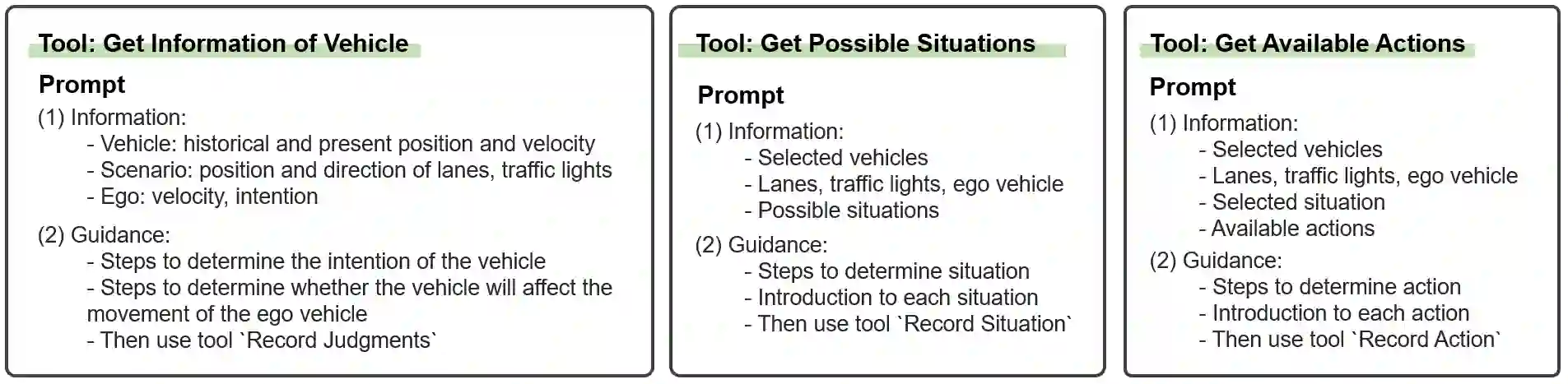
Existing learning-based autonomous driving (AD) systems face challenges in comprehending high-level information, generalizing to rare events, and providing interpretability. To address these problems, this work employs Large Language Models (LLMs) as a decision-making component for complex AD scenarios that require human commonsense understanding. We devise cognitive pathways to enable comprehensive reasoning with LLMs, and develop algorithms for translating LLM decisions into actionable driving commands. Through this approach, LLM decisions are seamlessly integrated with low-level controllers by guided parameter matrix adaptation. Extensive experiments demonstrate that our proposed method not only consistently surpasses baseline approaches in single-vehicle tasks, but also helps handle complex driving behaviors even multi-vehicle coordination, thanks to the commonsense reasoning capabilities of LLMs. This paper presents an initial step toward leveraging LLMs as effective decision-makers for intricate AD scenarios in terms of safety, efficiency, generalizability, and interoperability. We aspire for it to serve as inspiration for future research in this field. Project page: https://sites.google.com/view/llm-mpc
翻译:现有的基于学习的自动驾驶系统在理解高层信息、泛化到罕见事件以及提供可解释性方面面临挑战。为解决这些问题,本研究将大型语言模型(LLMs)作为复杂自动驾驶场景中的决策组件,这些场景需要人类常识理解。我们设计了认知路径以实现LLMs的全面推理,并开发了将LLM决策转化为可执行驾驶指令的算法。通过这一方法,借助引导参数矩阵自适应,LLM决策得以与低层控制器无缝集成。大量实验表明,我们所提出的方法不仅在单车任务中持续超越基线方法,而且得益于LLMs的常识推理能力,还能帮助处理复杂的驾驶行为(甚至多车协调)。本文向利用LLMs作为复杂自动驾驶场景中有效决策者的方向迈出了初步一步,涉及安全性、效率、泛化性和互操作性。我们期望这项工作能够为该领域的未来研究提供启发。项目页面:https://sites.google.com/view/llm-mpc




相关内容





 微信扫码咨询专知VIP会员