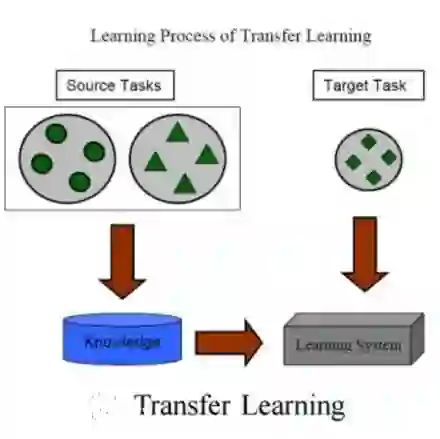
People can innately recognize human facial expressions in unnatural forms, such as when depicted on the unusual faces drawn in cartoons or when applied to an animal's features. However, current machine learning algorithms struggle with out-of-domain transfer in facial expression recognition (FER). We propose a biologically-inspired mechanism for such transfer learning, which is based on norm-referenced encoding, where patterns are encoded in terms of difference vectors relative to a domain-specific reference vector. By incorporating domain-specific reference frames, we demonstrate high data efficiency in transfer learning across multiple domains. Our proposed architecture provides an explanation for how the human brain might innately recognize facial expressions on varying head shapes (humans, monkeys, and cartoon avatars) without extensive training. Norm-referenced encoding also allows the intensity of the expression to be read out directly from neural unit activity, similar to face-selective neurons in the brain. Our model achieves a classification accuracy of 92.15\% on the FERG dataset with extreme data efficiency. We train our proposed mechanism with only 12 images, including a single image of each class (facial expression) and one image per domain (avatar). In comparison, the authors of the FERG dataset achieved a classification accuracy of 89.02\% with their FaceExpr model, which was trained on 43,000 images.


翻译:人类能够本能地识别非自然形式的人脸表情,例如卡通画中描绘的异形面孔或应用于动物特征的表情。然而,当前机器学习算法在人脸表情识别(FER)中的跨域迁移仍面临挑战。我们提出了一种受生物学启发的迁移学习机制,该机制基于规范参考编码——将模式编码为相对于特定域参考向量的差异向量。通过整合域特定的参考框架,我们展示了在多域迁移学习中极高的数据效率。所提出的架构解释了人类大脑如何无需大量训练即可本能识别不同头部形状(人类、猴子、卡通头像)上的面部表情。规范参考编码还允许从神经单元活动中直接读取表情强度,类似于大脑中具有面部选择性的神经元。我们的模型在FERG数据集上以极端的数据效率实现了92.15%的分类准确率。我们仅用12张图像训练所提机制,包括每类(面部表情)单张图像和每域(头像)单张图像。相比之下,FERG数据集的作者使用其FaceExpr模型在43000张图像上训练后达到了89.02%的分类准确率。


0
下载
关闭预览

相关内容

100+篇《自监督学习(Self-Supervised Learning)》论文最新合集
专知会员服务
167+阅读 · 2020年3月18日
[综述]深度学习下的场景文本检测与识别
专知会员服务
78+阅读 · 2019年10月10日
Multi-Task Learning的几篇综述文章
深度学习自然语言处理
15+阅读 · 2020年6月15日
Hierarchically Structured Meta-learning
CreateAMind
27+阅读 · 2019年5月22日
Transferring Knowledge across Learning Processes
CreateAMind
29+阅读 · 2019年5月18日
领域自适应学习论文大列表
专知
71+阅读 · 2019年3月2日
Unsupervised Learning via Meta-Learning
CreateAMind
44+阅读 · 2019年1月3日
MoCoGAN 分解运动和内容的视频生成
CreateAMind
18+阅读 · 2017年10月21日
Generative Adversarial Text to Image Synthesis论文解读
统计学习与视觉计算组
13+阅读 · 2017年6月9日
国家自然科学基金
4+阅读 · 2015年12月31日
国家自然科学基金
0+阅读 · 2014年12月31日
国家自然科学基金
0+阅读 · 2013年12月31日
国家自然科学基金
0+阅读 · 2013年12月31日
国家自然科学基金
0+阅读 · 2012年12月31日
国家自然科学基金
0+阅读 · 2011年12月31日
国家自然科学基金
0+阅读 · 2009年12月31日
国家自然科学基金
0+阅读 · 2009年12月31日
国家自然科学基金
0+阅读 · 2008年12月31日
Arxiv
17+阅读 · 2021年2月15日
VIP会员
最新内容
ICML 2026 | CFPO:用反事实策略优化提升多模态推理
专知会员服务
1+阅读 · 今天14:45
综述 | 世界动作模型:少做梦,多行动
专知会员服务
1+阅读 · 今天14:43
美以伊冲突:无人机与人工智能的运用
专知会员服务
3+阅读 · 今天14:31
《特种部队在透明战场中的生存力》最新报告
专知会员服务
2+阅读 · 今天14:11
《人工智能生成的零日漏洞:对未来作战的影响》
综述 | 3D场景图:开放挑战与未来方向
专知会员服务
8+阅读 · 6月22日
21世纪的无人机战争
专知会员服务
4+阅读 · 6月22日
《量子技术的军事任务技术适配与利用》
专知会员服务
5+阅读 · 6月22日
相关VIP内容
100+篇《自监督学习(Self-Supervised Learning)》论文最新合集
专知会员服务
167+阅读 · 2020年3月18日
[综述]深度学习下的场景文本检测与识别
专知会员服务
78+阅读 · 2019年10月10日
相关资讯
Multi-Task Learning的几篇综述文章
深度学习自然语言处理
15+阅读 · 2020年6月15日
Hierarchically Structured Meta-learning
CreateAMind
27+阅读 · 2019年5月22日
Transferring Knowledge across Learning Processes
CreateAMind
29+阅读 · 2019年5月18日
领域自适应学习论文大列表
专知
71+阅读 · 2019年3月2日
Unsupervised Learning via Meta-Learning
CreateAMind
44+阅读 · 2019年1月3日
MoCoGAN 分解运动和内容的视频生成
CreateAMind
18+阅读 · 2017年10月21日
Generative Adversarial Text to Image Synthesis论文解读
统计学习与视觉计算组
13+阅读 · 2017年6月9日
相关基金
国家自然科学基金
4+阅读 · 2015年12月31日
国家自然科学基金
0+阅读 · 2014年12月31日
国家自然科学基金
0+阅读 · 2013年12月31日
国家自然科学基金
0+阅读 · 2013年12月31日
国家自然科学基金
0+阅读 · 2012年12月31日
国家自然科学基金
0+阅读 · 2011年12月31日
国家自然科学基金
0+阅读 · 2009年12月31日
国家自然科学基金
0+阅读 · 2009年12月31日
国家自然科学基金
0+阅读 · 2008年12月31日
Top
微信扫码咨询专知VIP会员