

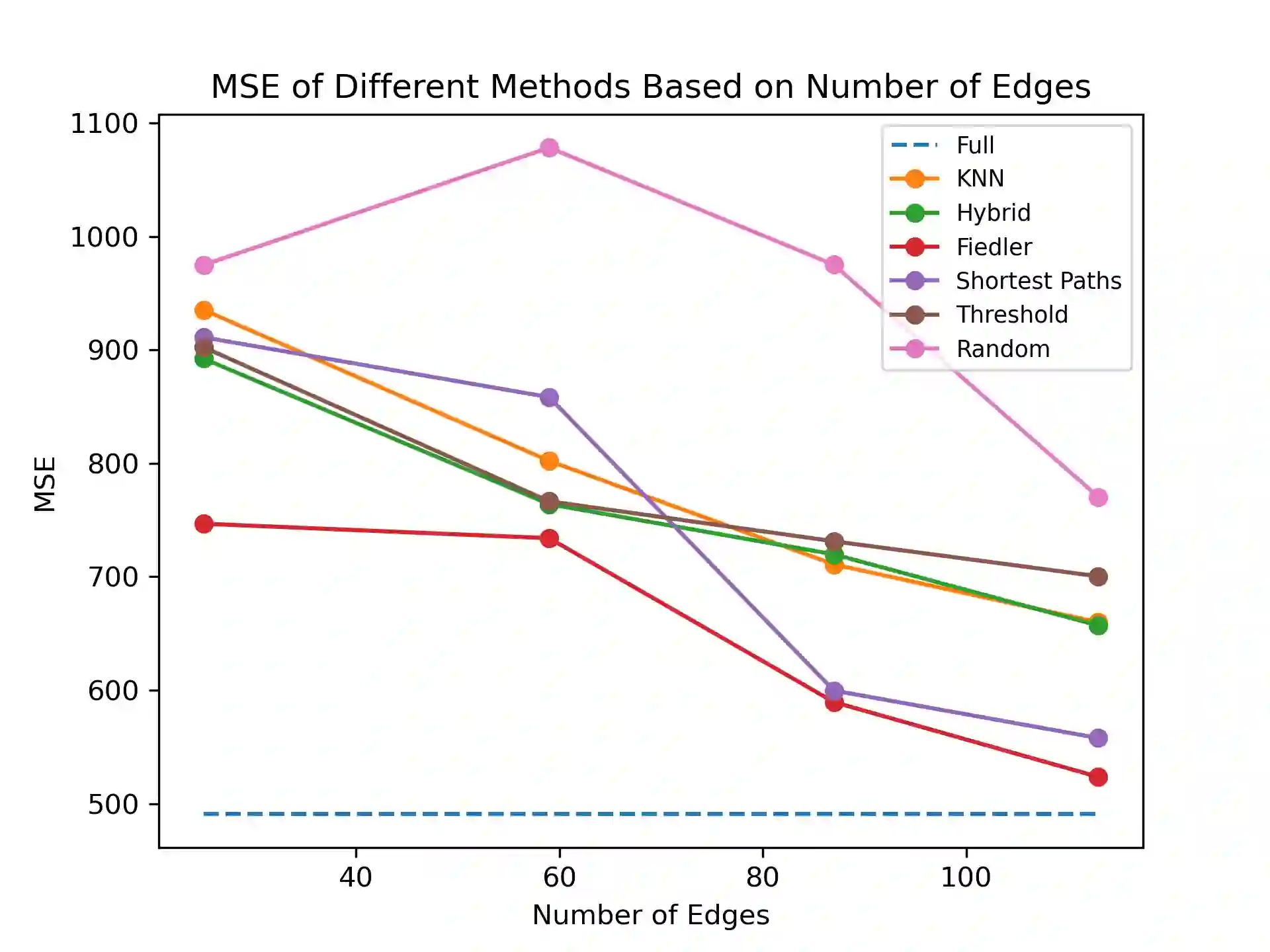
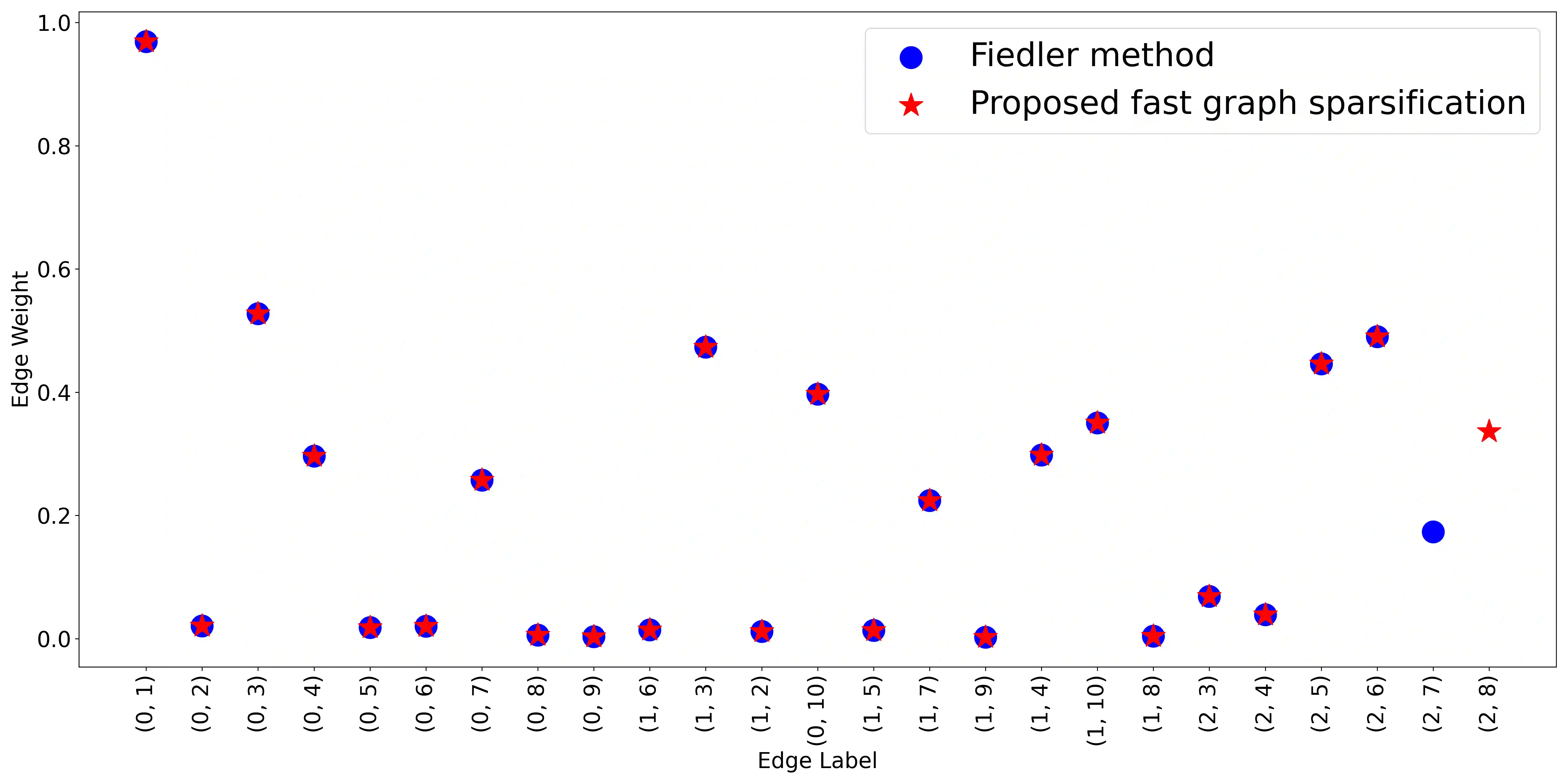
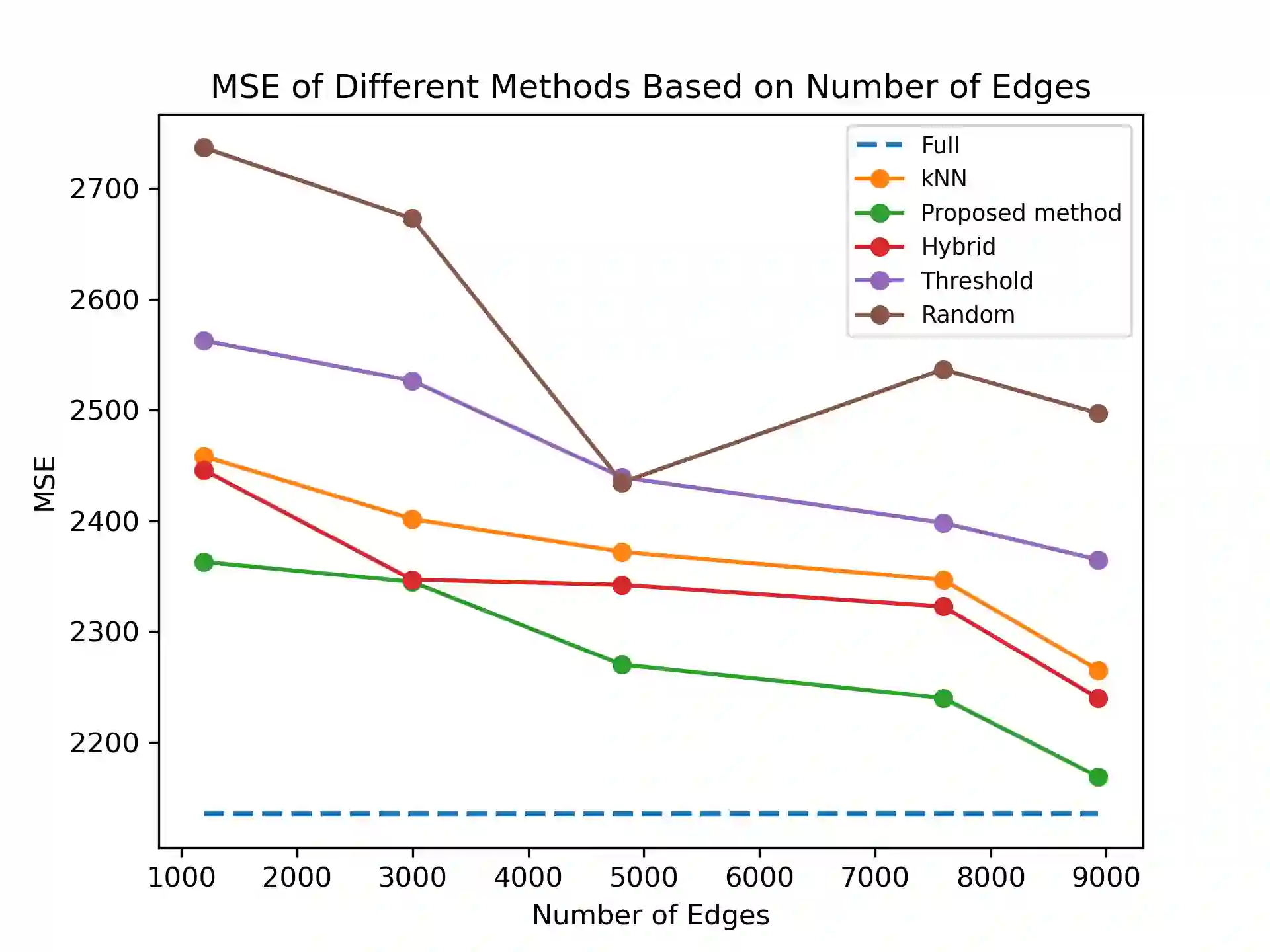
In agronomics, predicting crop yield at a per field/county granularity is important for farmers to minimize uncertainty and plan seeding for the next crop cycle. While state-of-the-art prediction techniques employ graph convolutional nets (GCN) to predict future crop yields given relevant features and crop yields of previous years, a dense underlying graph kernel requires long training and execution time. In this paper, we propose a graph sparsification method based on the Fiedler number to remove edges from a complete graph kernel, in order to lower the complexity of GCN training/execution. Specifically, we first show that greedily removing an edge at a time that induces the minimal change in the second eigenvalue leads to a sparse graph with good GCN performance. We then propose a fast method to choose an edge for removal per iteration based on an eigenvalue perturbation theorem. Experiments show that our Fiedler-based method produces a sparse graph with good GCN performance compared to other graph sparsification schemes in crop yield prediction.
翻译:在农学领域,以田块/县域为粒度的作物产量预测对于帮助农民降低不确定性、规划下一轮播种至关重要。尽管现有最优预测技术采用图卷积网络(GCN),根据相关特征及历史年份作物产量预测未来产量,但稠密的底层图核需要较长的训练与执行时间。本文提出一种基于Fiedler数的图稀疏化方法,通过从完整图核中移除边来降低GCN训练/执行的复杂度。具体而言,我们首先证明:每次贪心地移除一条导致第二特征值变化最小的边,可生成稀疏图且保持良好GCN性能。继而基于特征值摄动定理,提出一种快速方法用于每轮迭代中选取待移除的边。实验表明,与其它作物产量预测中的图稀疏化方案相比,基于Fiedler数的方法所生成的稀疏图可保持良好GCN性能。




相关内容



 微信扫码咨询专知VIP会员