

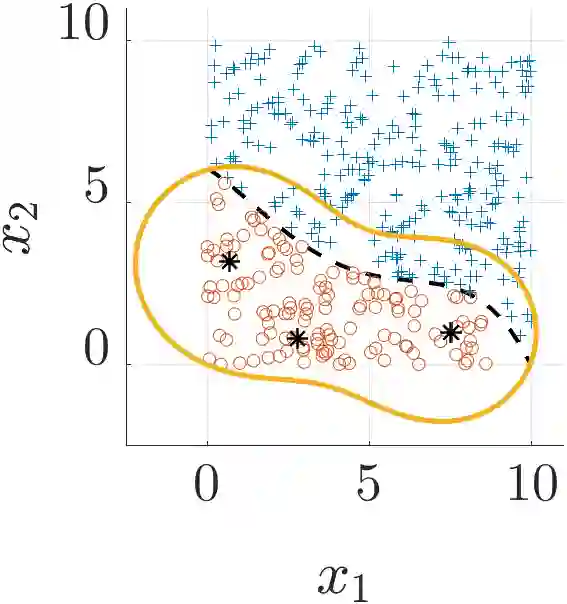
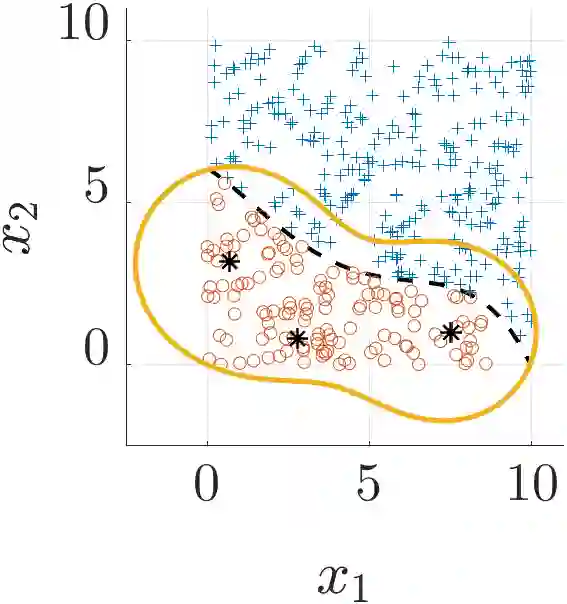
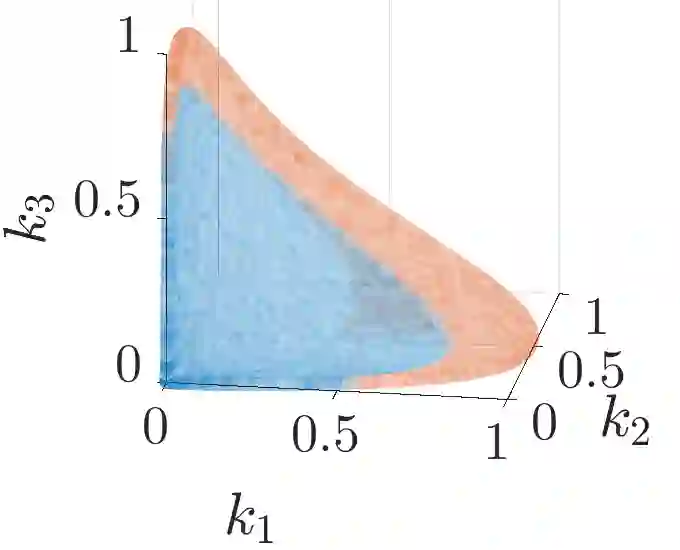
Barrier function-based inequality constraints are a means to enforce safety specifications for control systems. When used in conjunction with a convex optimization program, they provide a computationally efficient method to enforce safety for the general class of control-affine systems. One of the main assumptions when taking this approach is the a priori knowledge of the barrier function itself, i.e., knowledge of the safe set. In the context of navigation through unknown environments where the locally safe set evolves with time, such knowledge does not exist. This manuscript focuses on the synthesis of a zeroing barrier function characterizing the safe set based on safe and unsafe sample measurements, e.g., from perception data in navigation applications. Prior work formulated a supervised machine learning algorithm whose solution guaranteed the construction of a zeroing barrier function with specific level-set properties. However, it did not explore the geometry of the neural network design used for the synthesis process. This manuscript describes the specific geometry of the neural network used for zeroing barrier function synthesis, and shows how the network provides the necessary representation for splitting the state space into safe and unsafe regions.
翻译:基于障碍函数的约束不等式是确保控制系统安全规范的一种手段。当与凸优化程序结合使用时,这种方法为一般控制仿射系统提供了一种计算高效的安全保障方法。采用此方法的一个主要假设是障碍函数本身的先验知识,即安全集合的先验知识。在未知环境导航中(局部安全集合随时间演化),此类知识并不存在。本文聚焦于基于安全与不安全样本测量(例如导航应用中的感知数据)来合成刻画安全集合的零化障碍函数。已有研究提出了一种监督机器学习算法,其解能保证构建具有特定水平集性质的零化障碍函数,但未探讨合成过程中所用神经网络设计的几何结构。本文描述了用于零化障碍函数合成的神经网络的具体几何结构,并展示了该网络如何为状态空间划分为安全区域与不安全区域提供必要的表征。




相关内容



 微信扫码咨询专知VIP会员