

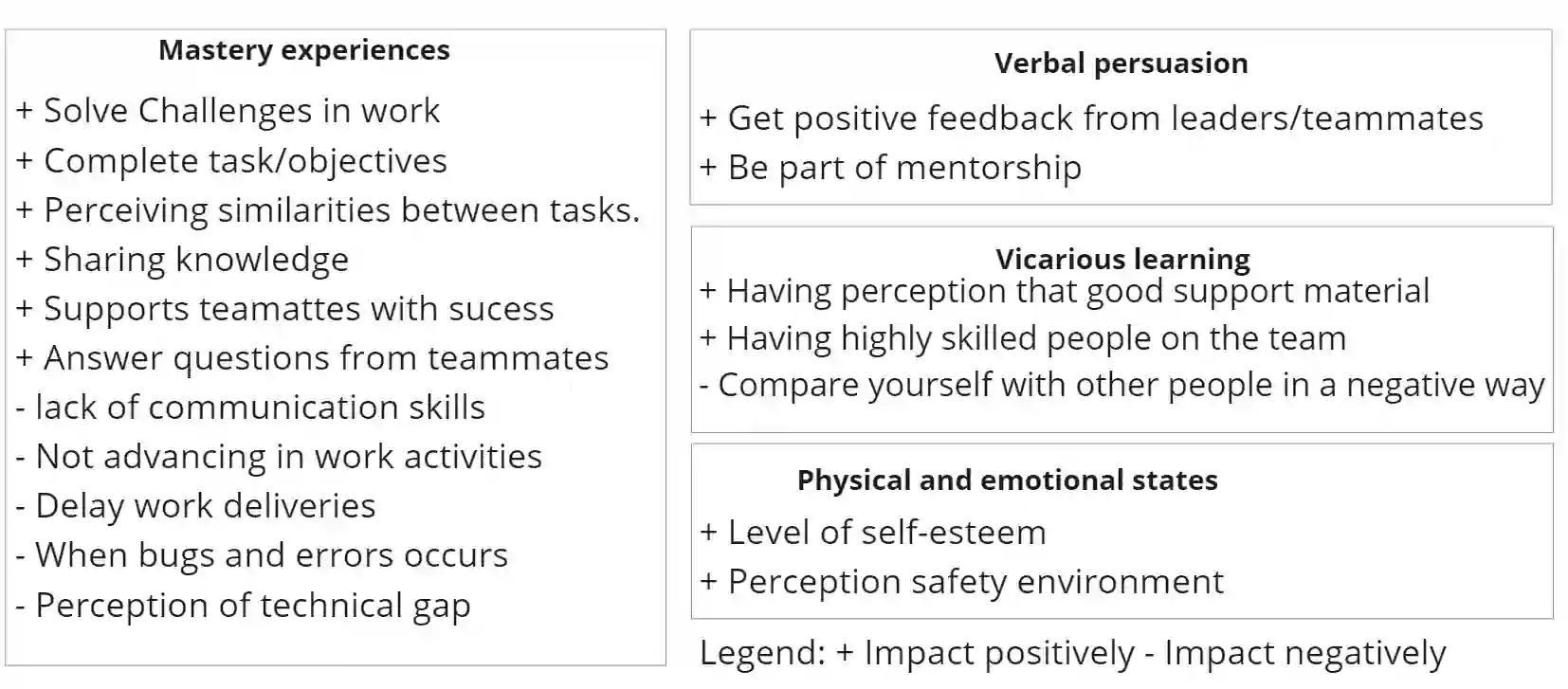
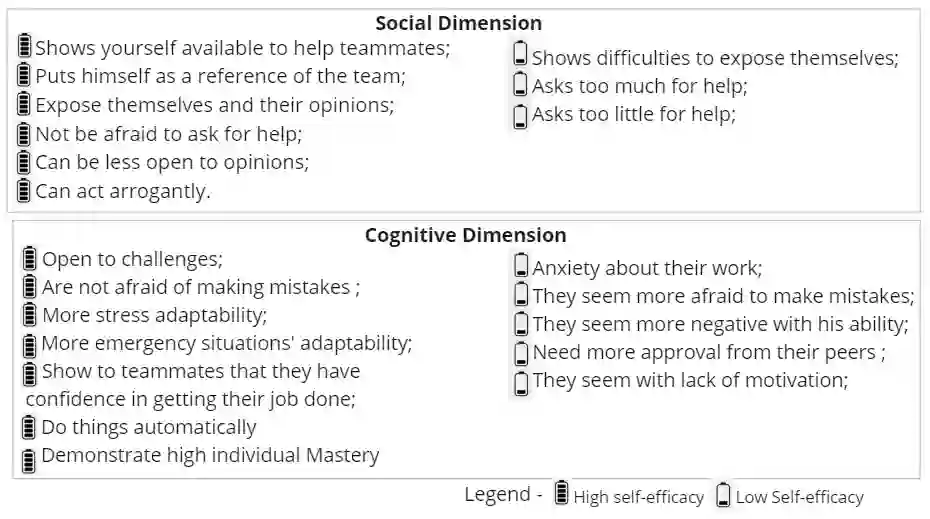
CONTEXT: Self-efficacy is a concept researched in various areas of knowledge that impacts various factors such as performance, satisfaction, and motivation. In Software Engineering, it has mainly been studied in the academic context, presenting results similar to other areas of knowledge. However, it is also important to understand its impact in the industrial context. OBJECTIVE: Therefore, this study aims to understand the impact on the software development context with a focus on understanding the behavioral signs of self-efficacy in software engineers and how self-efficacy can impact the work-day of software engineers. METHOD: A qualitative research was conducted using semi-structured questionnaires with 31 interviewees from a software development company located in Brazil. The interviewees participated in a Bootcamp and were later assigned to software development teams. Thematic analysis was used to analyze the data. RESULTS: In the perception of the interviewees, 21 signs were found that are related to people with high and low self-efficacy. These signs were divided into two dimensions: social and cognitive. Also, 18 situations were found that can lead to an increase or decrease of self-efficacy of software engineers. Finally, 12 factors were mentioned that can impact software development teams. CONCLUSION: This work evidences a set of behavioral signs that can help team leaders to better perceive the self-efficacy of their members. It also presents a set of situations that both leaders and individuals can use to improve their self-efficacy in the development context, and finally, factors that can be impacted by self-efficacy in the software development context are also presented. Finally, this work emphasizes the importance of understanding self-efficacy in the industrial context.
翻译:**背景**:自我效能感是一个在多个知识领域中被研究的概念,影响着绩效、满意度和动机等多种因素。在软件工程领域,它主要在学术背景下被研究,其结果与其他知识领域相似。然而,理解其在工业背景下的影响同样重要。**目标**:因此,本研究旨在理解自我效能感在软件开发背景下的影响,重点关注软件工程师自我效能感的行为迹象以及自我效能感如何影响软件工程师的日常工作。**方法**:采用定性研究方法,使用半结构化问卷对一家位于巴西的软件开发公司的31名受访者进行了访谈。受访者参加了一个训练营,之后被分配到软件开发团队。采用主题分析法对数据进行分析。**结果**:在受访者的感知中,发现了21种与高自我效能感和低自我效能感人群相关的迹象。这些迹象被分为两个维度:社会维度和认知维度。此外,还发现了18种可能导致软件工程师自我效能感增强或减弱的情境。最后,提到了12种可能影响软件开发团队的因素。**结论**:本研究揭示了一系列行为迹象,可帮助团队领导者更好地感知成员的自我效能感。同时,提供了领导者和个人均可用于在开发环境中提升自我效能感的一系列情境,并展示了自我效能感在软件开发环境中可能影响的若干因素。最后,本研究强调了在工业背景下理解自我效能感的重要性。





相关内容




 微信扫码咨询专知VIP会员