

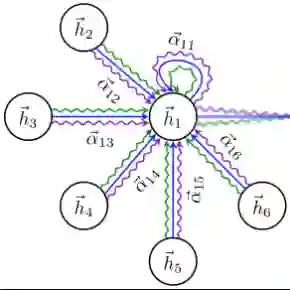
Accurate prediction of future blood glucose (BG) levels can effectively improve BG management for people living with diabetes, thereby reducing complications and improving quality of life. The state of the art of BG prediction has been achieved by leveraging advanced deep learning methods to model multi-modal data, i.e., sensor data and self-reported event data, organised as multi-variate time series (MTS). However, these methods are mostly regarded as ``black boxes'' and not entirely trusted by clinicians and patients. In this paper, we propose interpretable graph attentive recurrent neural networks (GARNNs) to model MTS, explaining variable contributions via summarizing variable importance and generating feature maps by graph attention mechanisms instead of post-hoc analysis. We evaluate GARNNs on four datasets, representing diverse clinical scenarios. Upon comparison with twelve well-established baseline methods, GARNNs not only achieve the best prediction accuracy but also provide high-quality temporal interpretability, in particular for postprandial glucose levels as a result of corresponding meal intake and insulin injection. These findings underline the potential of GARNN as a robust tool for improving diabetes care, bridging the gap between deep learning technology and real-world healthcare solutions.
翻译:准确预测未来血糖水平可有效改善糖尿病患者的血糖管理,从而减少并发症并提高生活质量。目前最先进的血糖预测方法通过利用先进的深度学习方法对多模态数据(即传感器数据和自我报告事件数据)进行建模,这些数据以多元时间序列的形式组织。然而,这些方法大多被视为“黑箱”,并未得到临床医生和患者的完全信任。本文提出可解释的图注意力循环神经网络对多元时间序列进行建模,通过图注意力机制总结变量重要性并生成特征图,而非依赖事后分析来解释变量贡献。我们在四个代表不同临床场景的数据集上评估了GARNN。与十二种成熟基线方法相比,GARNN不仅取得了最佳预测精度,还提供了高质量的时域可解释性,尤其是针对相应餐食摄入和胰岛素注射导致的餐后血糖水平。这些发现凸显了GARNN作为改善糖尿病护理的稳健工具的潜力,弥合了深度学习技术与现实医疗解决方案之间的差距。




相关内容



 微信扫码咨询专知VIP会员