

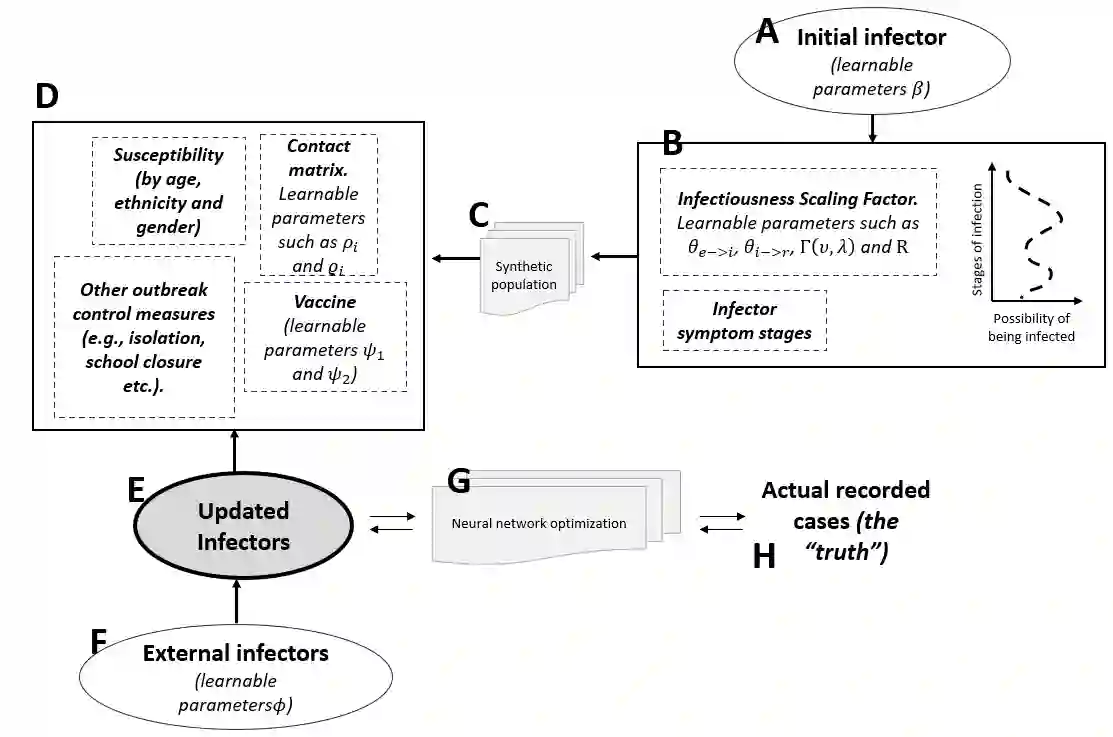
Agent Based Models (ABMs) have emerged as a powerful tool for investigating complex social interactions, particularly in the context of public health and infectious disease investigation. In an effort to enhance the conventional ABM, enabling automated model calibration and reducing the computational resources needed for scaling up the model, we have developed a tensorized and differentiable agent-based model by coupling Graph Neural Network (GNN) and Long Short-Term Memory (LSTM) network. The model was employed to investigate the 2019 measles outbreak occurred in New Zealand, demonstrating a promising ability to accurately simulate the outbreak dynamics, particularly during the peak period of repeated cases. This paper shows that by leveraging the latest Artificial Intelligence (AI) technology and the capabilities of traditional ABMs, we gain deeper insights into the dynamics of infectious disease outbreaks. This, in turn, helps us make more informed decision when developing effective strategies that strike a balance between managing outbreaks and minimizing disruptions to everyday life.
翻译:基于智能体的模型(Agent Based Models, ABMs)已成为研究复杂社会交互的强大工具,特别是在公共卫生和传染病调查领域。为增强传统ABM,实现模型自动校准并减少扩大模型规模所需的计算资源,我们通过结合图神经网络(Graph Neural Network, GNN)和长短期记忆网络(Long Short-Term Memory, LSTM)开发了一种张量化和可微分的基于智能体的模型。该模型被用于研究2019年发生在新西兰的麻疹暴发,展示了准确模拟暴发动态的显著能力,尤其是在重复病例的高峰期。本文表明,通过利用最新人工智能(AI)技术和传统ABM的能力,我们能更深入地理解传染病暴发动态,进而有助于在制定有效策略时做出更明智的决策,平衡疫情管理与对日常生活的最小化干扰。




相关内容





 微信扫码咨询专知VIP会员