

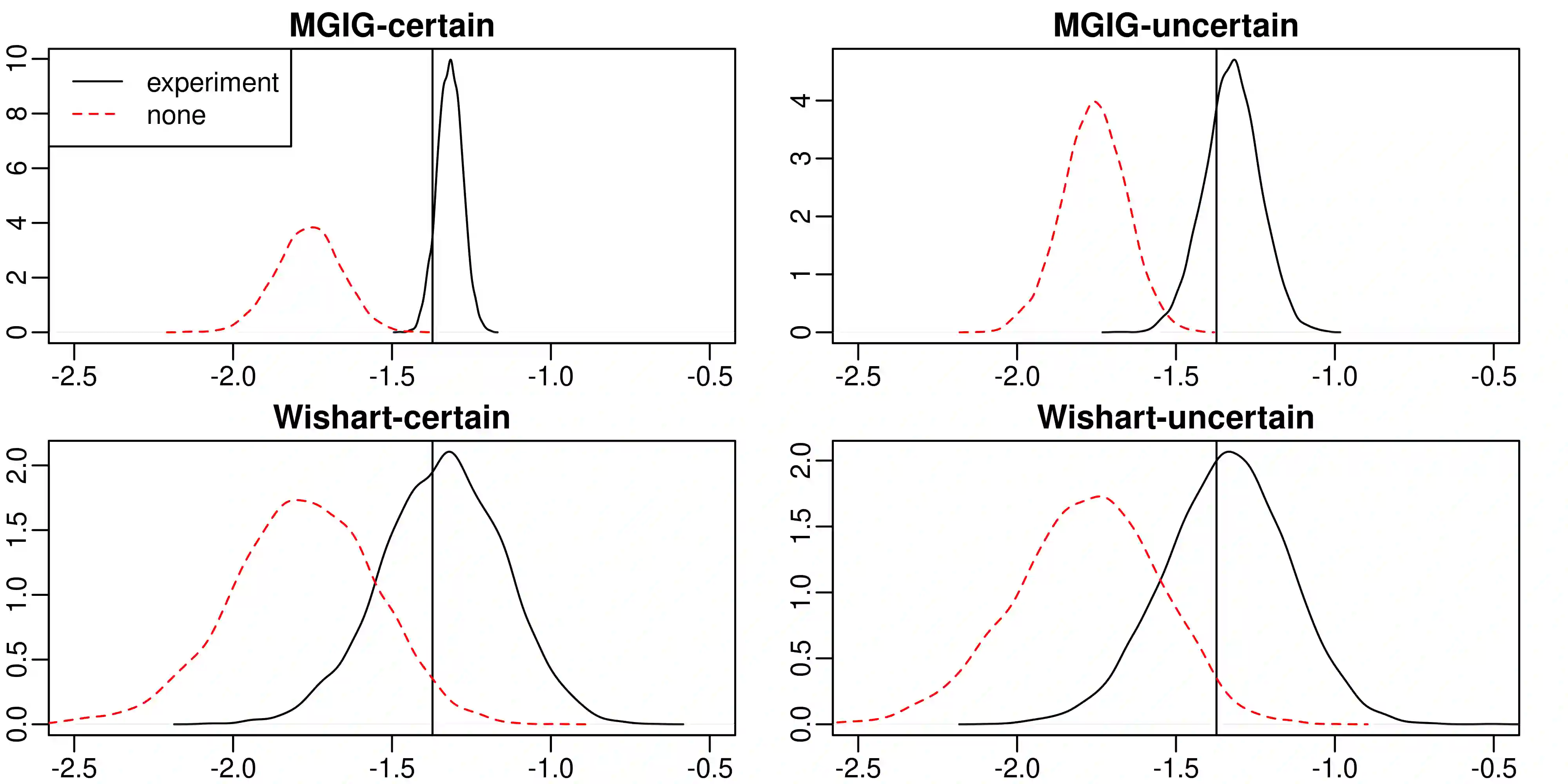
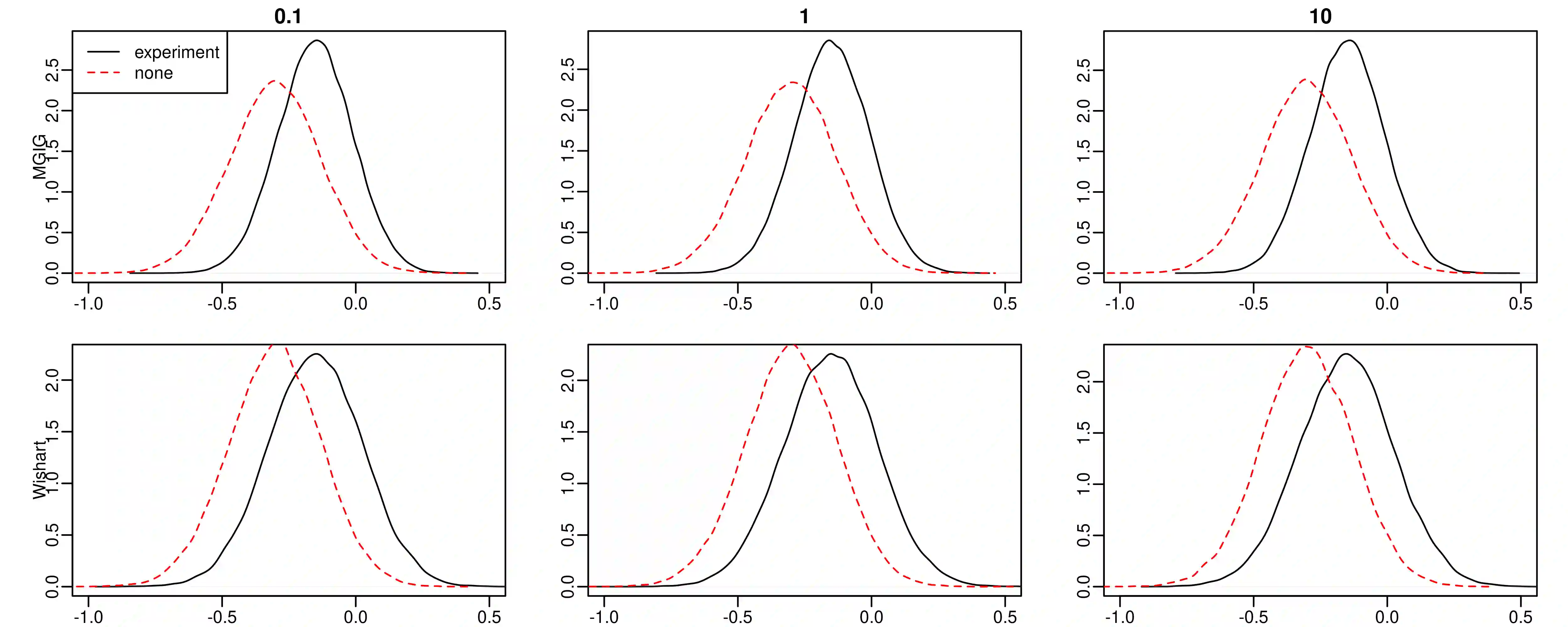
Here, we investigate whether (and how) experimental design could aid in the estimation of the precision matrix in a Gaussian chain graph model, especially the interplay between the design, the effect of the experiment and prior knowledge about the effect. Estimation of the precision matrix is a fundamental task to infer biological graphical structures like microbial networks. We compare the marginal posterior precision of the precision matrix under four priors: flat, conjugate Normal-Wishart, Normal-MGIG and a general independent. Under the flat and conjugate priors, the Laplace-approximated posterior precision is not a function of the design matrix rendering useless any efforts to find an optimal experimental design to infer the precision matrix. In contrast, the Normal-MGIG and general independent priors do allow for the search of optimal experimental designs, yet there is a sharp upper bound on the information that can be extracted from a given experiment. We confirm our theoretical findings via a simulation study comparing i) the KL divergence between prior and posterior and ii) the Stein's loss difference of MAPs between random and no experiment. Our findings provide practical advice for domain scientists conducting experiments to better infer the precision matrix as a representation of a biological network.
翻译:本文旨在探究实验设计是否(以及如何)辅助高斯链图模型中精度矩阵的估计,尤其关注实验设计、实验效应及关于效应的先验知识三者间的相互作用。精度矩阵估计是推断微生物网络等生物图结构的基础任务。我们比较了四种先验下精度矩阵的边缘后验精度:平坦先验、共轭正态-威沙特先验、正态-MGIG先验及一般独立先验。在平坦先验与共轭先验下,拉普拉斯近似的后验精度与设计矩阵无关,使得寻找最优实验设计以推断精度矩阵的努力徒劳无功。相比之下,正态-MGIG先验与一般独立先验允许搜索最优实验设计,但给定实验所能提取的信息存在严格上界。我们通过模拟研究验证了理论发现:比较i)先验与后验之间的KL散度,以及ii)随机实验与无实验情境下MAP估计的斯坦因损失差异。本研究为领域科学家开展实验以更好推断作为生物网络表征的精度矩阵提供了实用建议。




相关内容



 微信扫码咨询专知VIP会员