

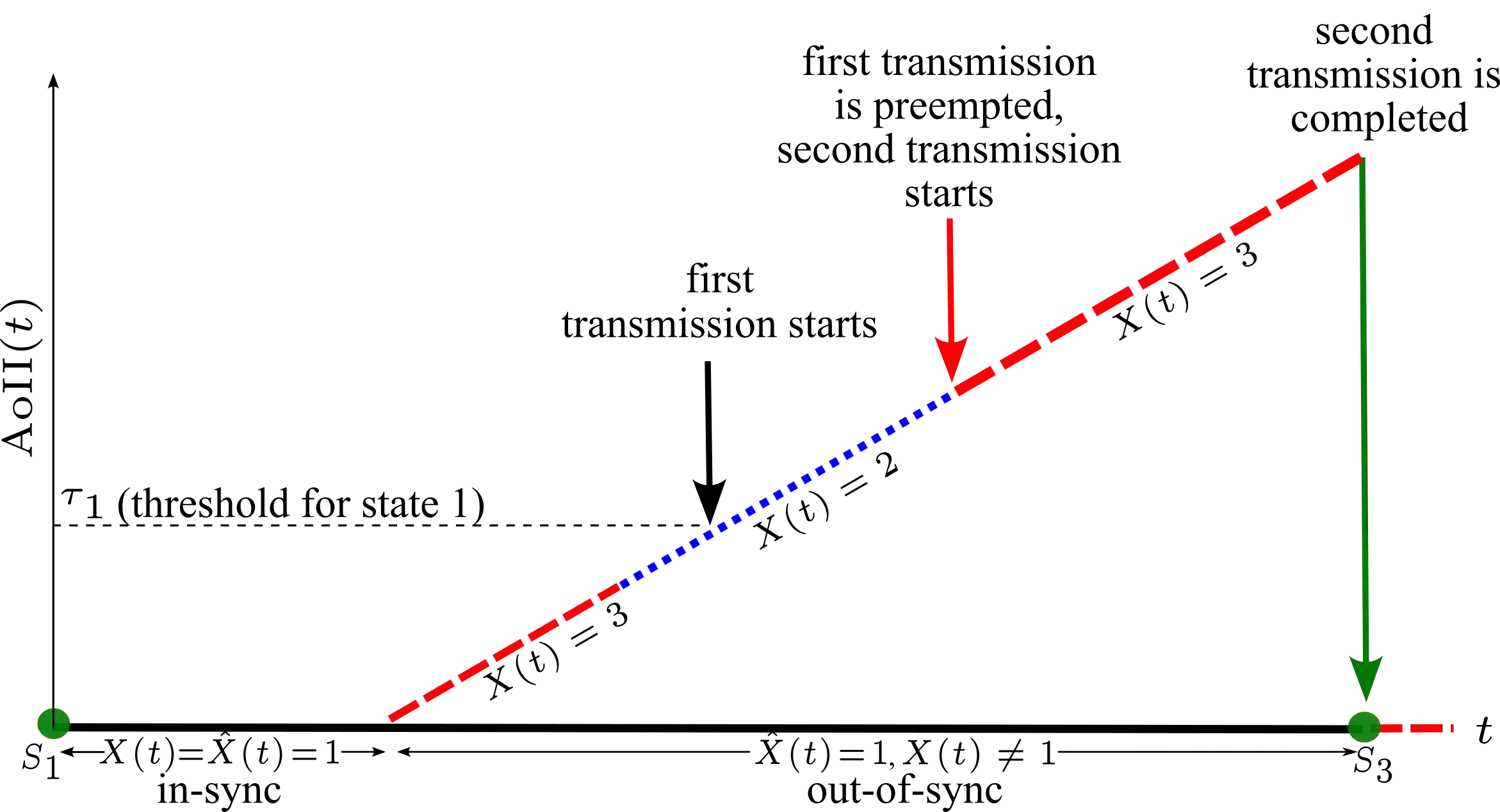
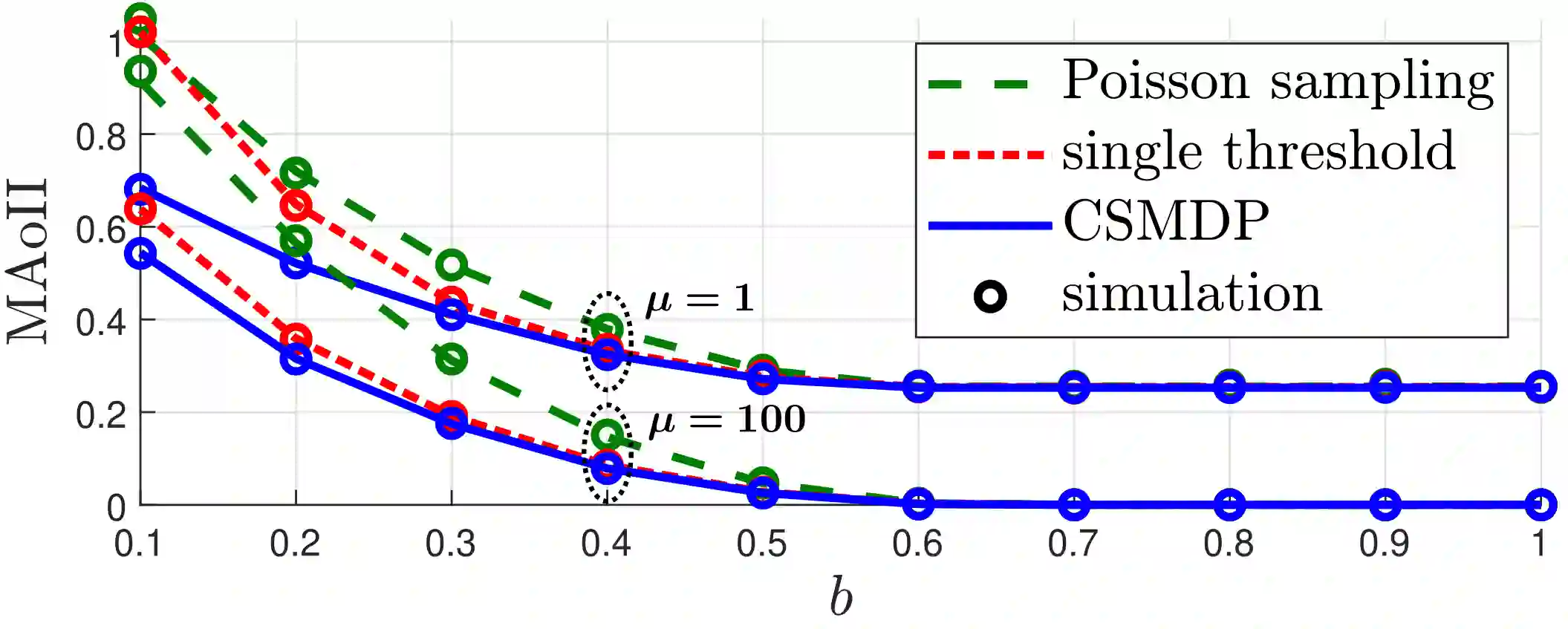
We consider a sensor that samples an $N$-state continuous-time Markov chain (CTMC)-based information source process, and transmits the observed state of the source, to a remote monitor tasked with timely tracking of the source process. The mismatch between the source and monitor processes is quantified by age of incorrect information (AoII), which penalizes the mismatch as it stays longer, and our objective is to minimize the average AoII under an average sampling rate constraint. We assume a perfect reverse channel and hence the sensor has information of the estimate while initiating a transmission or preempting an ongoing transmission. First, by modeling the problem as an average cost constrained semi-Markov decision process (CSMDP), we show that the structure of the problem gives rise to an optimum threshold policy for which the sensor initiates a transmission once the AoII exceeds a threshold depending on the instantaneous values of both the source and monitor processes. However, due to the high complexity of obtaining the optimum policy in this general setting, we consider a relaxed problem where the thresholds are allowed to be dependent only on the estimate. We show that this relaxed problem can be solved with a novel CSMDP formulation based on the theory of absorbing MCs, with a computational complexity of $\mathcal{O}(N^4)$, allowing one to obtain optimum policies for general CTMCs with over a hundred states.
翻译:我们考虑一个传感器对基于N态连续时间马尔可夫链(CTMC)的信息源过程进行采样,并将观测到的源状态传输给负责及时跟踪源进程的远程监控器。源进程与监控器进程之间的失配由错误信息年龄(AoII)量化,该指标随失配持续时间的增加而施以惩罚,我们的目标是在平均采样率约束下最小化平均AoII。假设存在完美的反向信道,因此传感器在发起传输或抢占正在进行的传输时可获知估计值。首先,通过将问题建模为平均成本约束半马尔可夫决策过程(CSMDP),我们证明问题结构催生了一种最优阈值策略:当AoII超过一个取决于源进程与监控器进程瞬时值的阈值时,传感器发起传输。然而,由于在此通用设置下获取最优策略的高复杂性,我们考虑一个松弛问题,其中阈值仅允许依赖于估计值。我们证明该松弛问题可通过基于吸收马尔可夫链理论的新型CSMDP公式求解,其计算复杂度为$\mathcal{O}(N^4)$,从而可为具有超过一百个状态的通用CTMC获得最优策略。





相关内容



 微信扫码咨询专知VIP会员