

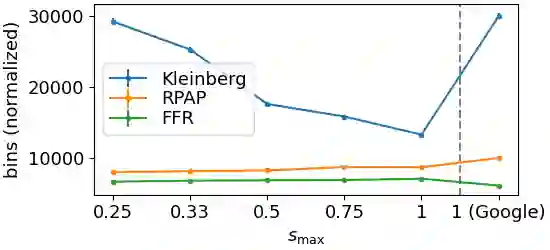
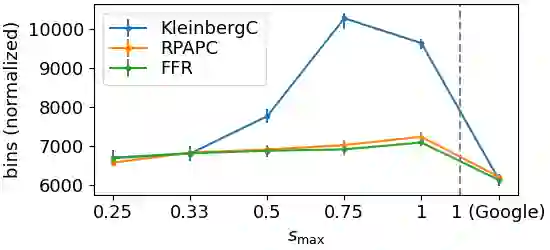
A cloud scheduler packs tasks onto machines with contradictory goals of (1) using the machines as efficiently as possible while (2) avoiding overloading that might result in CPU throttling or out-of-memory errors. We take a stochastic approach that models the uncertainty of tasks' resource requirements by random variables. We focus on a little-explored case of items, each having a Bernoulli distribution that corresponds to tasks that are either idle or need a certain CPU share. RPAP, our online approximation algorithm, upper-bounds a subset of items by Poisson distributions. Unlike existing algorithms for Bernoulli items that prove the approximation ratio only up to a multiplicative constant, we provide a closed-form expression. We derive RPAPC, a combined approach having the same theoretical guarantees as RPAP. In simulations, RPAPC's results are close to FFR, a greedy heuristic with no worst-case guarantees; RPAPC slightly outperforms FFR on datasets with small items.
翻译:云调度器将任务打包到机器上,面临两个相互矛盾的目标:(1)尽可能高效地利用机器,同时(2)避免可能导致CPU限速或内存不足错误的过载。我们采用随机方法,用随机变量对任务资源需求的不确定性进行建模。我们关注一个鲜少探索的物品案例,每个物品具有伯努利分布,对应于要么空闲、要么需要特定CPU份额的任务。我们的在线近似算法RPAP,通过泊松分布对物品子集进行上界约束。与现有仅证明伯努利物品近似比达到乘法常数的算法不同,我们给出了一个闭式表达式。我们推导出RPAPC,这是一种结合方法,具有与RPAP相同的理论保证。在仿真中,RPAPC的结果接近FFR(一种无最坏情况保证的贪婪启发式算法);在包含小物品的数据集上,RPAPC略优于FFR。




相关内容



 微信扫码咨询专知VIP会员