

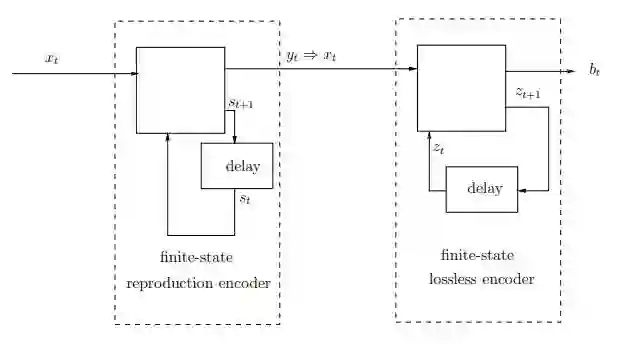
We extend Ziv and Lempel's model of finite-state encoders to the realm of lossy compression of individual sequences. In particular, the model of the encoder includes a finite-state reconstruction codebook followed by an information lossless finite-state encoder that compresses the reconstruction codeword with no additional distortion. We first derive two different lower bounds to the compression ratio that depend on the number of states of the lossless encoder. Both bounds are asymptotically achievable by conceptually simple coding schemes. We then show that when the number of states of the lossless encoder is large enough in terms of the reconstruction block-length, the performance can be improved, sometimes significantly so. In particular, the improved performance is achievable using a random-coding ensemble that is universal, not only in terms of the source sequence, but also in terms of the distortion measure.
翻译:我们将Ziv和Lempel的有限状态编码器模型扩展至个体序列的有损压缩领域。具体而言,编码器模型包含一个有限状态重构码本,后接一个信息无损的有限状态编码器,该编码器压缩重构码字且不引入额外失真。我们首先推导了两个依赖于无损编码器状态数的压缩率下界,这两个下界均可通过概念简单的编码方案渐进实现。进一步研究表明,当无损编码器的状态数相对于重构块长足够大时,其性能可获改善,有时甚至显著提升。特别值得注意的是,这种改进性能可通过随机编码集成实现,该集成不仅对信源序列具有普适性,而且对失真测度同样具有普适性。




相关内容




 微信扫码咨询专知VIP会员