

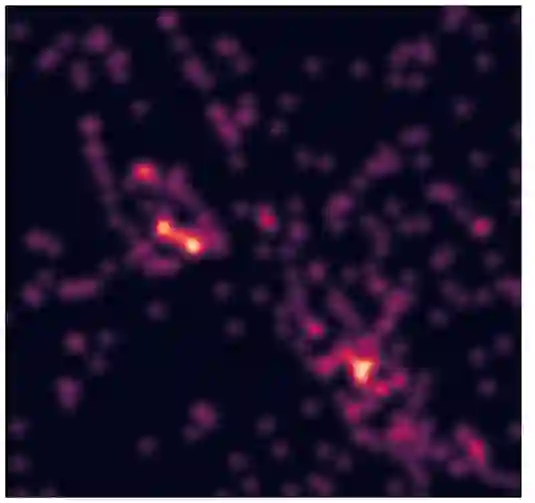
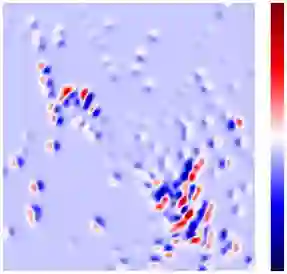
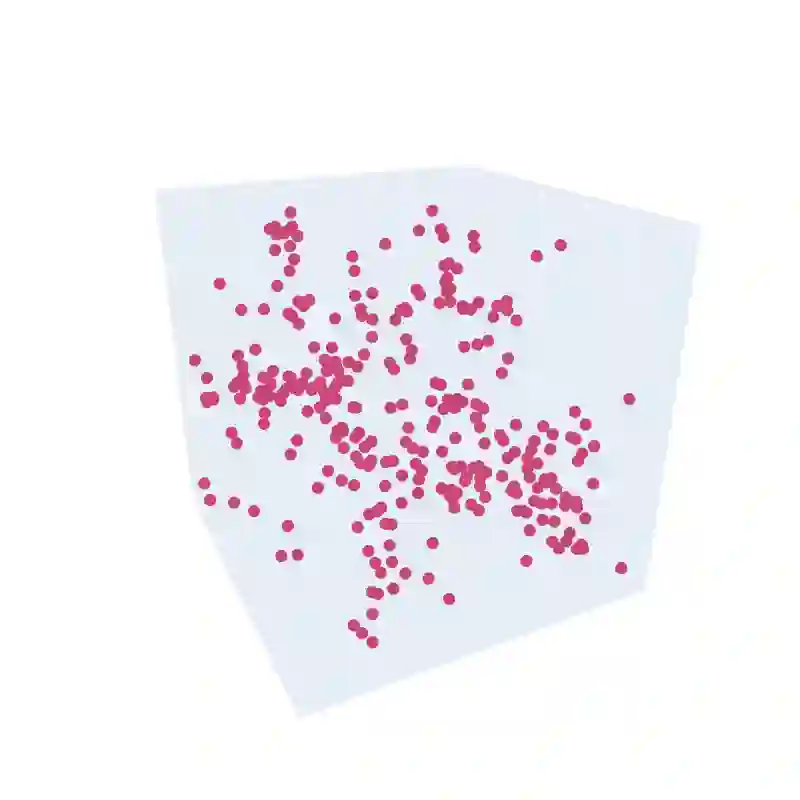
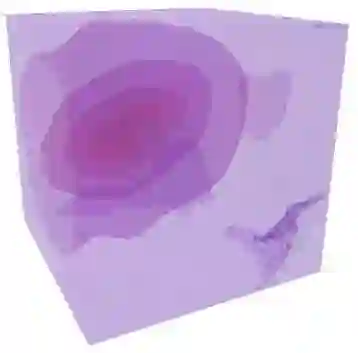
Refractive Index Tomography is an inverse problem in which we seek to reconstruct a scene's 3D refractive field from 2D projected image measurements. The refractive field is not visible itself, but instead affects how the path of a light ray is continuously curved as it travels through space. Refractive fields appear across a wide variety of scientific applications, from translucent cell samples in microscopy to fields of dark matter bending light from faraway galaxies. This problem poses a unique challenge because the refractive field directly affects the path that light takes, making its recovery a non-linear problem. In addition, in contrast with traditional tomography, we seek to recover the refractive field using a projected image from only a single viewpoint by leveraging knowledge of light sources scattered throughout the medium. In this work, we introduce a method that uses a coordinate-based neural network to model the underlying continuous refractive field in a scene. We then use explicit modeling of rays' 3D spatial curvature to optimize the parameters of this network, reconstructing refractive fields with an analysis-by-synthesis approach. The efficacy of our approach is demonstrated by recovering refractive fields in simulation, and analyzing how recovery is affected by the light source distribution. We then test our method on a simulated dark matter mapping problem, where we recover the refractive field underlying a realistic simulated dark matter distribution.
翻译:折射率层析成像是一类逆问题,旨在从二维投影图像测量值重建场景的三维折射场。折射场本身不可见,但会影响光线在空间中传播时的连续弯曲路径。折射场广泛存在于各类科学应用中,从显微镜下的半透明细胞样本到使遥远星系光线发生弯曲的暗物质场。该问题的独特挑战在于折射场直接影响光线传播路径,使其恢复过程成为非线性问题。此外,与传统层析成像不同,我们需利用分布在介质中的光源信息,仅通过单一视角的投影图像恢复折射场。本文提出一种方法,采用基于坐标的神经网络对场景中潜在的连续折射场进行建模,并通过显式建模射线三维空间曲率来优化网络参数,采用分析-合成策略重建折射场。通过仿真实验恢复折射场并分析光源分布对恢复效果的影响,验证了方法的有效性。最后,我们将该方法应用于模拟暗物质映射问题,成功恢复了符合真实物理分布的折射场。




相关内容

Source: Apple - iOS 8




 微信扫码咨询专知VIP会员