

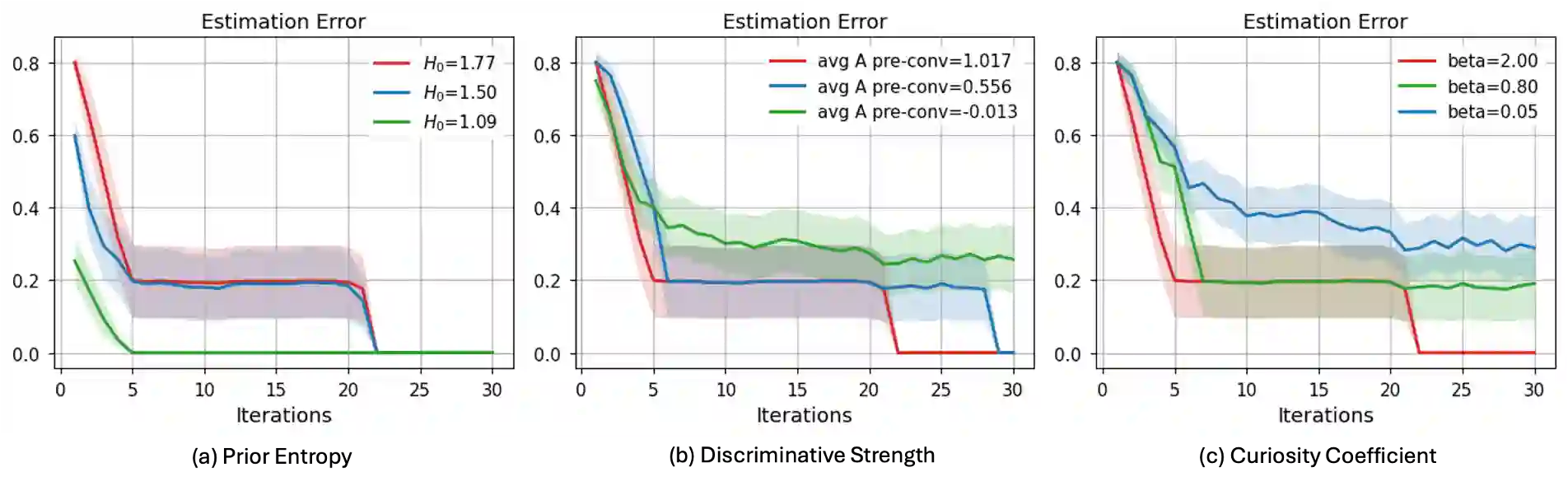
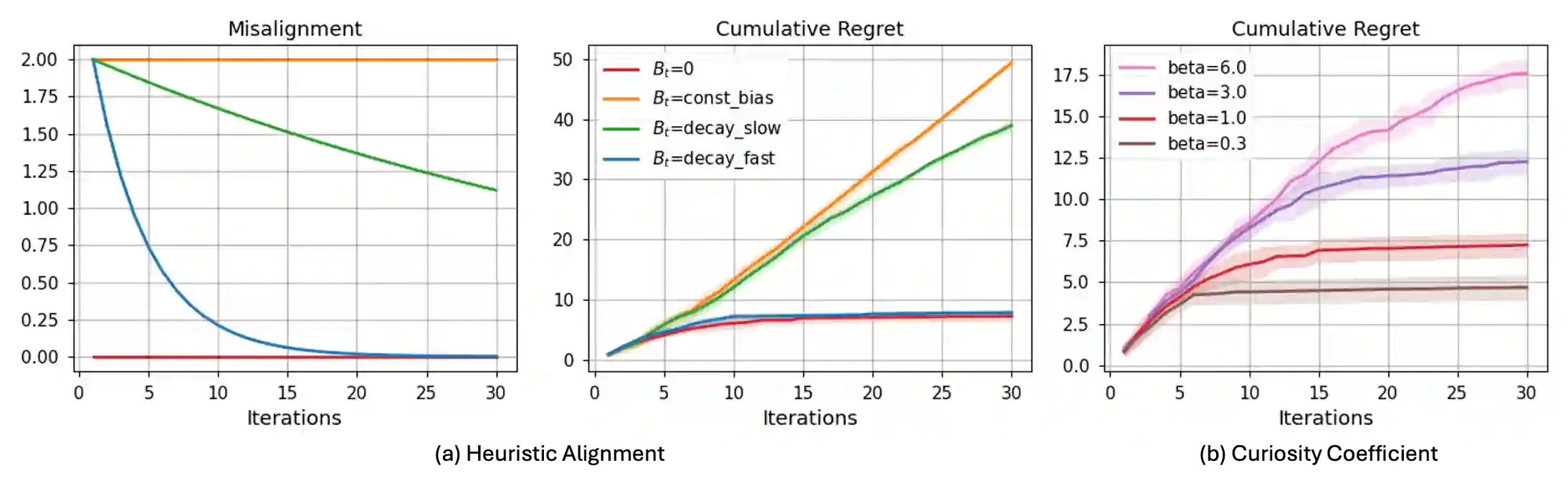
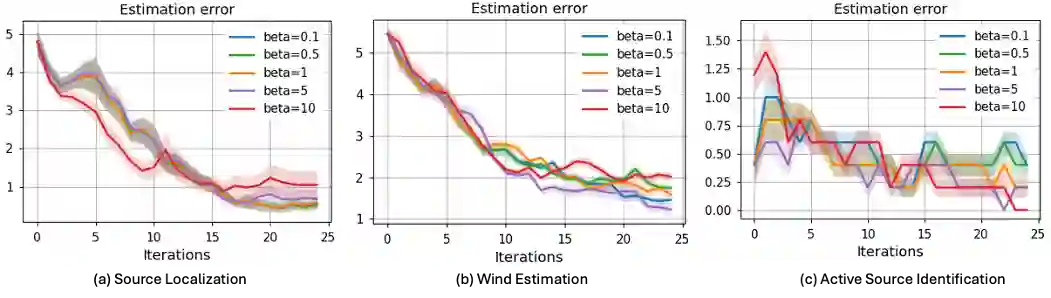
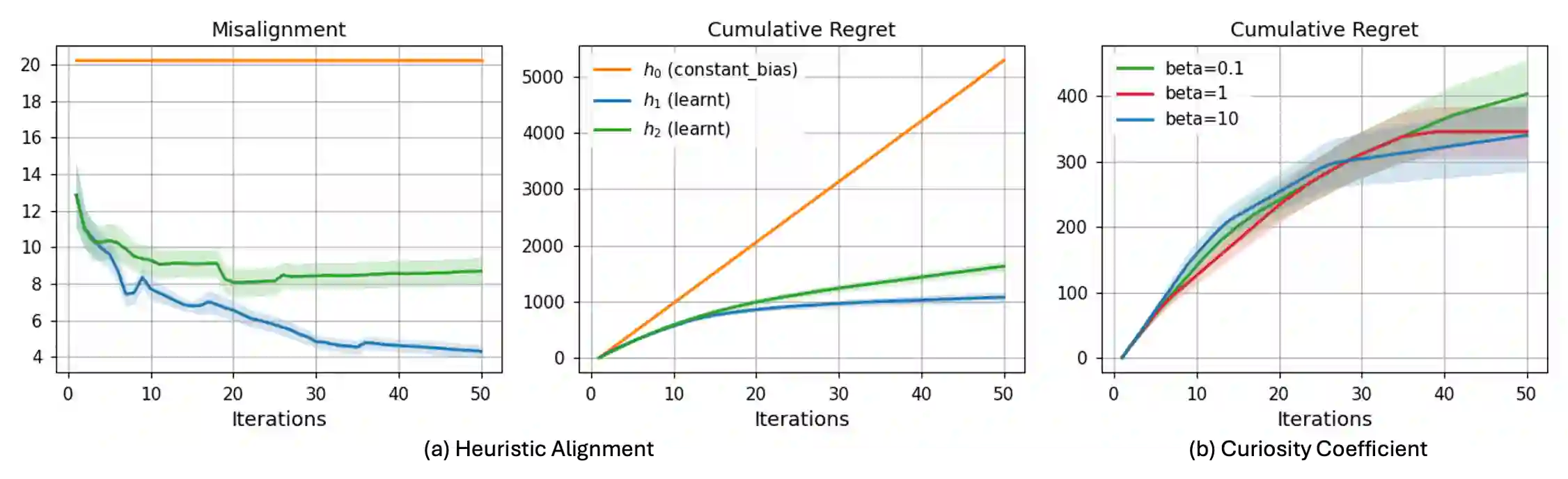
Active inference (AIF) unifies exploration and exploitation by minimizing the Expected Free Energy (EFE), balancing epistemic value (information gain) and pragmatic value (task performance) through a curiosity coefficient. Yet it has been unclear when this balance yields both coherent learning and efficient decision-making: insufficient curiosity can drive myopic exploitation and prevent uncertainty resolution, while excessive curiosity can induce unnecessary exploration and regret. We establish the first theoretical guarantee for EFE-minimizing agents, showing that a single requirement--sufficient curiosity--simultaneously ensures self-consistent learning (Bayesian posterior consistency) and no-regret optimization (bounded cumulative regret). Our analysis characterizes how this mechanism depends on initial uncertainty, identifiability, and objective alignment, thereby connecting AIF to classical Bayesian experimental design and Bayesian optimization within one theoretical framework. We further translate these theories into practical design guidelines for tuning the epistemic-pragmatic trade-off in hybrid learning-optimization problems, validated through real-world experiments.
翻译:主动推理(AIF)通过最小化期望自由能(EFE)统一了探索与利用,并通过一个好奇心系数平衡认知价值(信息增益)与实用价值(任务性能)。然而,这种平衡何时能同时实现连贯的学习与高效的决策尚不明确:好奇心不足可能导致短视的利用并阻碍不确定性消解,而过度的好奇心则可能引发不必要的探索并产生遗憾。我们为最小化EFE的智能体建立了首个理论保证,证明单一条件——足够的好奇心——可同时确保自洽学习(贝叶斯后验一致性)与无遗憾优化(有界累积遗憾)。我们的分析刻画了这一机制如何依赖于初始不确定性、可辨识性以及目标对齐,从而在一个理论框架内将AIF与经典贝叶斯实验设计及贝叶斯优化联系起来。我们进一步将这些理论转化为实际设计准则,用于在混合学习-优化问题中调整认知-实用权衡,并通过真实世界实验进行了验证。




相关内容


 微信扫码咨询专知VIP会员